AI Is Getting Good at Math. Here’s Why.
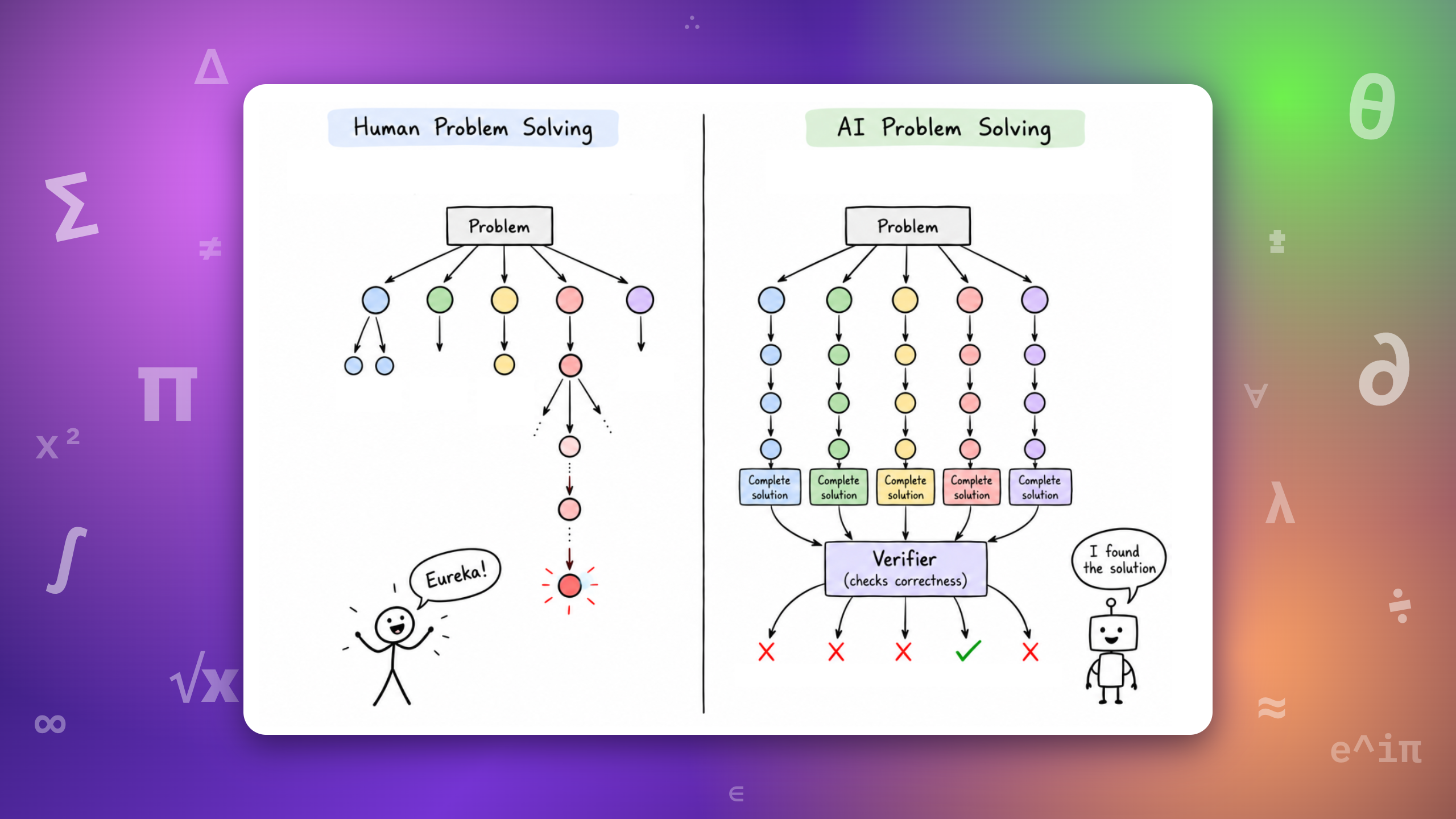
Between May and September, OpenAI ran a string of results against long-standing open problems using internal models. In May a model found a counterexample to Erdős's unit distance conjecture, open since 1946, where the expectation had been a proof. A month later the company published a proof of the Cycle Double Cover problem, then solutions to ten more open problems by July, and a proof of Navier-Stokes in September. Anthropic, in parallel, published a formalization of Fermat's Last Theorem and advanced bounds on the Riemann hypothesis. The framing question in the Latent Space piece is predictive rather than celebratory: what makes a problem tractable for a language model, and can that be known in advance.
The proposed mental model is that solving a problem means finding a short sequence of insights with substantial work between them: insight, effort, insight, effort, solution. WT Gowers, commenting on the unit-distance result, describes difficulty as the shortest sequence of hints that would let experts reconstruct the proof, and offers a formula of 2^k + t, where k is the number of hints and t is the work needed to develop them. The exponent matters: complexity grows exponentially in the number of conceptual jumps, while most of the calendar time sits in t. For the unit-distance problem the hint sequence was three steps: look for a counterexample; generalize the best known construction; try number fields of increasing degree using prime ideals of bounded norm. The order is load-bearing. Starting at the third hint, a solver would not even know the task is a disproof. The formula is post hoc, so age, number of prior attempts and prize value serve as everyday proxies for difficulty.
The interesting contrast is in search strategy. Human mathematicians work roughly breadth first: generate candidate directions, explore them shallowly, abandon most, and commit to a few. That is forced by cost, since developing an idea can take months, so a researcher needs early encouragement before committing. Models run depth first. A single prompt yields a solution, right or wrong, and extended chain-of-thought proceeds greedily down one path; running ten parallel agents yields ten attempts driven toward conclusions. Alone, that produces confident false proofs. Add an automated verifier that can prune finished trajectories, and spending large compute on unlikely ideas becomes rational, because you learn in minutes whether an approach works. The limitation is that a checker judges only completed arguments; it cannot say whether a half-developed idea is heading anywhere.
That asymmetry changes the quality bar for a hint. A human pays months to test one, so the idea must look promising first. A model pays minutes, so ordinary, implausible or barely formed hints are worth following. Failed attempts then become the raw material for the next round. The harness described has three parts: a drafter that writes prompts from model priors plus accumulated negative hints, a solver that produces candidates possibly through parallel subagents, and a verifier. In the Cycle Double Cover prompt, one line instructs the model to assume a complete affirmative proof exists, so that the problem's open status does not cause it to stop; another lists substitutes that do not count, such as special graph classes, reductions to other unproved conjectures or computational checks at fixed graph sizes; a third directs adversarial agents to check for failure modes including repeated-edge closed trails posing as cycles and circular use of an equivalent statement.
The human side is illustrated by Jacob Tsimerman, recently hired by OpenAI, who had worked toward the unit-distance counterexample, knew the number theory and had considered increasing degrees, and stopped. His own description: a scary dynamic, hard to think through the analytic regimes and retain guiding intuition, consuming much time and frequently not working out. Psychology offers a name for this. Metcalfe and Wiebe asked solvers every fifteen seconds how close they felt to a solution; on ordinary problems the reported sense climbed, on insight problems it stayed flat until the answer arrived. Insight problems have no gradient. Arul Shankar's comment on model behavior fits: ideas were tried quickly, but at the crucial step the model honed in methodically. Tsimerman suggests the edge may be that systems can play longer and in more treacherous waters without getting overwhelmed, while cautioning this is not yet robustly true.
Gowers's formula omits the cost of exploring the tree of possible hints. Let b be the number of plausible next hints at each step; k hints imply b^k paths. Human taste keeps b small and discards most branches by default. A model must pursue nearly every plausible branch, but fast. That yields a testable prediction: models should do well where b^k times compute cost is small. Cybersecurity fell early because the branching factor at intermediate steps is around one or two, even though the work demands skill and the shape of solutions is known in advance. A counterexample search is powerful precisely because it collapses the solution space and b. The Navier-Stokes proof, by this reading, completes work by Córdoba and Martínez-Zoroa: 166 pages with many corrections, few conceptual jumps, and reportedly 10,000 agents consuming 300B tokens over 88 hours. Anthropic's results show the same skeleton of hundreds of failed ideas, multiple agents under one orchestrator, and scripts and checkers, carried by a small number of leaps.
Three capabilities are credited with the shift this year. Models chain primitives well, because recent training objectives reward producing artifacts at step one that remain usable at step n of a long task, lowering t. Self-verification lets a model catch wrong steps within a trajectory before a human or external checker sees them; OpenAI is said to have trained specifically on math verification with real-world examples at scale. Orchestration lets a model direct subagents and use harness features such as memory for steering and eliminating wrong paths, which is how negative hints accumulate.
A divergence follows. Human failures carry information because someone was convinced enough to spend months on them, and a dead end can leave useful tools; model failures are cheap and often naive, and the reasoning behind them is rarely visible. Gowers expects any remaining human edge on problems where the search tree is deep and heavily branched, so that search is infeasible without rigorous pruning. Terence Tao's view frames proofs as proxies for the deeper purpose of developing shared understanding: a result is a community event that spreads new ideas and moves collective intuition, and announcing only the final solution mistakes the destination for the journey.
Why it matters: teams building agent systems should read this as a design pattern rather than a math story, since drafter, solver and verifier loops with negative hints are already general-purpose. The practical constraints are inference cost at parallelism and verifier coverage, and the open research question is intermediate pruning, where no gradient exists. Product teams in domains with narrow solution spaces can expect fast progress; domains needing many chained insights remain hard for humans and models alike, which is an inference from the branching-factor argument rather than a demonstrated result.
Based on reporting from the original publisher. Visit the source for full context and later updates.
Publisher excerpt
AI models are solving more mathematical problems. A pattern is emerging in their successes that could help us predict which problems they’ll solve next.