Generate presentations with Amazon Bedrock AgentCore
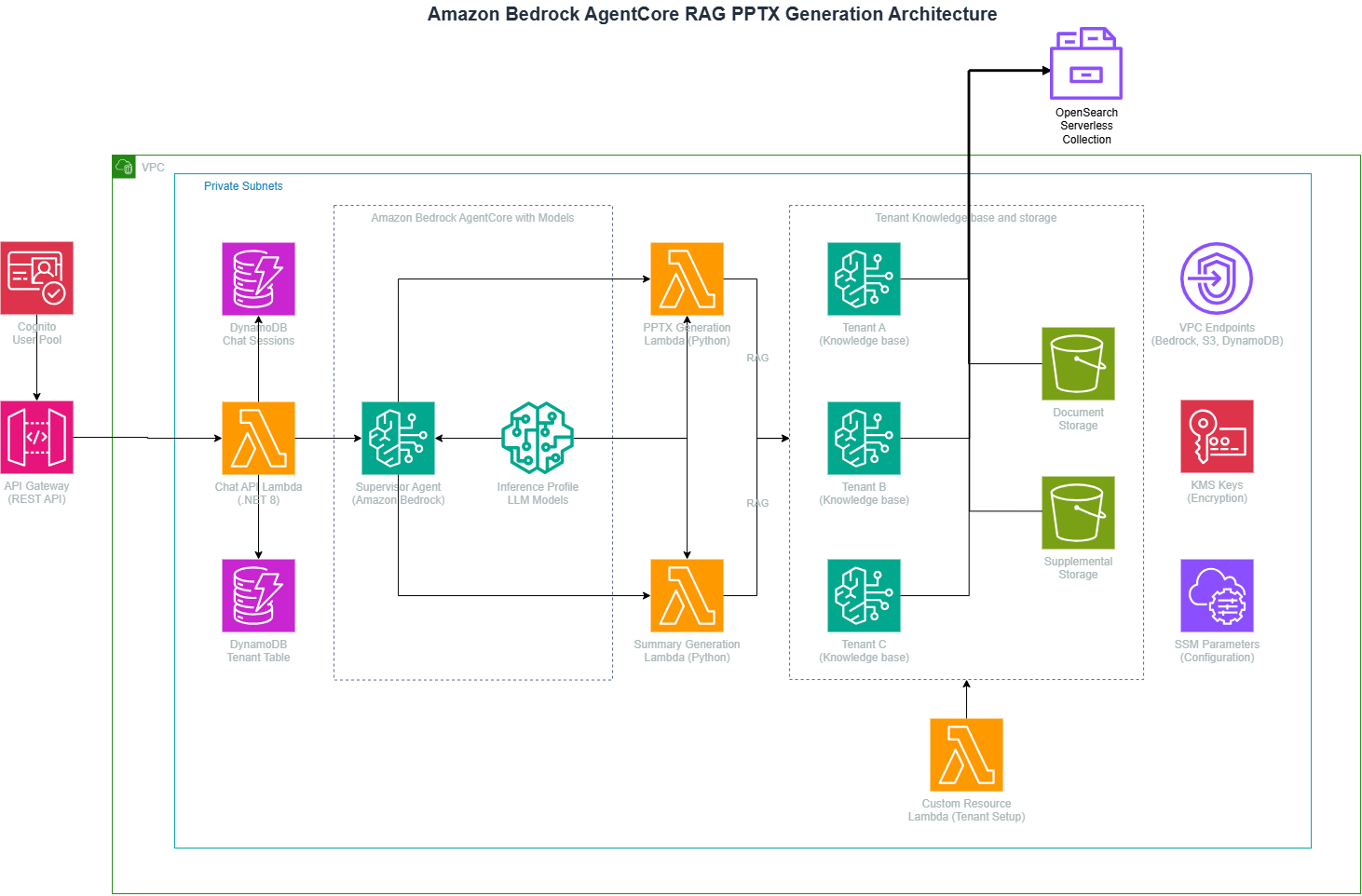
AWS published a walkthrough and companion sample repository for building an AI agent that generates client-ready PowerPoint presentations from enterprise documents, running on Amazon Bedrock AgentCore. The post describes a scenario in which a financial services team manually assembles decks from quarterly reports, compliance documents and market analyses. In internal testing the system generated a presentation end to end in 70 to 90 seconds, and it uses Retrieval Augmented Generation to ground generated slides in source material rather than model training data.
The pattern is a single supervisor agent deployed on AgentCore runtime, with Strands Agents, an open-source SDK, implementing the orchestration logic. AgentCore runtime hosts agent code in an isolated container with session management, identity and observability, and supports any framework or model. The supervisor exposes two tools. generate_pptx calls a PPTX Generator Lambda that retrieves content from a knowledge base, builds a slide outline, creates images and assembles the file. generate_summary queries the knowledge base through RAG. The agent decides whether a request needs document creation, summarization or both, and new capabilities can be added by defining additional tools without changing existing ones.
The model lineup is Anthropic Claude Sonnet 4.6 on Amazon Bedrock for agent reasoning and content, Amazon Titan Text Embeddings v2 for vector search, and Stability AI Stable Image Inpaint on Bedrock for slide imagery. Document parsing in the knowledge base is configured for Anthropic Claude Haiku 4.5. The sample recommends inference profiles rather than direct model IDs so requests draw on multi-Region capacity, which the post says increases throughput and helps hold performance under load.
The RAG pipeline ingests documents from Amazon S3, chunks and parses them including tables, charts and images, converts each chunk into vectors with Titan Text Embeddings v2, and stores those vectors in Amazon OpenSearch Serverless. At query time the request is embedded and a similarity search retrieves relevant chunks to supply as context to the language model. The post says this grounding is designed to reduce hallucinated content. One operational caveat is stated plainly: the OpenSearch Serverless collection data plane must stay publicly accessible, because Bedrock Knowledge Bases reaches it from AWS-managed infrastructure rather than through customer VPC endpoints. IAM data access policies protect the collection, and the OpenSearch Serverless dashboard is restricted to VPC-only access.
Content safety runs through Amazon Bedrock Guardrails, provisioned with AWS CDK and applied at model invocation rather than configured per deployment. Guardrails filter user input to help prevent injection and inappropriate content, monitor model output against content policies, and detect and anonymize or block personally identifiable information.
Data flow starts at Amazon API Gateway and a .NET 8 minimal-API chat service on AWS Lambda, with conversation state in Amazon DynamoDB. The service invokes the supervisor agent on AgentCore runtime. Summarization goes to a Summary Generator Lambda using the retrieve_and_generate API; document generation goes to the containerized Python PPTX Generator Lambda. Finished files land in Amazon S3 and are returned as presigned URLs. Because generation takes 70 to 90 seconds and exceeds the default 29-second API Gateway integration timeout, the chat API uses an asynchronous invocation pattern, so clients stream or poll instead of holding a synchronous REST call. Presigned download URLs expire after five minutes.
The post lists a broad security posture: AWS WAF managed rule sets with IP rate limiting, Amazon Cognito with the Plus feature plan and advanced security mode, DynamoDB with point-in-time recovery, deletion protection and customer-managed KMS keys, versioned S3 buckets with server access logging and public access blocked, AWS X-Ray tracing on Lambda, regex validation of tenant and session identifiers, and tenant isolation via AWS STS role assumption per tenant.
Deployment is scripted in three phases. A build script compiles the .NET projects, packages Lambda artifacts, builds the PPTX container image with Docker or Finch, and pushes to Amazon ECR. A deploy script creates four CloudFormation stacks in order: VPC endpoints, OpenSearch, AgentCore (guardrails, Lambdas, IAM roles, Systems Manager parameters) and the chat API stack. A third script builds the ARM64 supervisor container, pushes it to ECR, creates the AgentCore runtime and endpoint, and writes the endpoint ARN into Parameter Store for the chat API to reference. Prerequisites include .NET SDK 8 with Amazon.Lambda.Tools, Python 3.12 or later, Node.js with the CDK CLI, Docker or Finch with ARM64 support, an existing VPC with private subnets, an S3 bucket for artifacts, model access in Bedrock, AgentCore enabled, and an API Gateway Regional REST API integration timeout of at least 300 seconds.
Tuning knobs are exposed in a pipeline-params.ini file and in the stack definitions. Default Lambda sizing is 128 MB memory, 29-second timeout and 100 reserved concurrency for the chat API; 900 MB, 300 seconds and 50 reserved concurrency for the PPTX generator; and 512 MB, 300 seconds and 50 reserved concurrency for the summary generator. Results reported for a 90-page Amazon 2024 annual report PDF: six slides using title, bullet, image-plus-text, image-only and takeaway formats; two AI images per presentation; knowledge base ingestion under two minutes for a single 1.3 MB PDF; and roughly $0.04 in model invocation costs in us-east-1 at the time of writing, with image generation accounting for most of that. Generated decks include speaker notes and formatting based on corporate templates, and summaries include citations to source documents.
Why it matters: teams evaluating document automation now have a concrete reference architecture, published code and cost and latency numbers they can reproduce, rather than a marketing claim. For developers, the interesting pieces are the tool-routing pattern on AgentCore runtime, the RAG stack, and the asynchronous API design that the post ties directly to generation time exceeding API Gateway defaults. The public data plane requirement for OpenSearch Serverless is the constraint most likely to need a security review before production adoption, and the price figure covers model invocations only, not the surrounding infrastructure.
Based on reporting from the original publisher. Visit the source for full context and later updates.
Publisher excerpt
This post walks you through building an AI agent system with Amazon Bedrock AgentCore that automates PowerPoint presentation creation from enterprise documents. A supervisor agent, Retrieval Augmented Generation, and Amazon Bedrock Guardrails generate grounded presentations in under 90 seconds.