AI Day Seoul Brings Together Korea’s Industry Leaders, Startups and Developer Communities
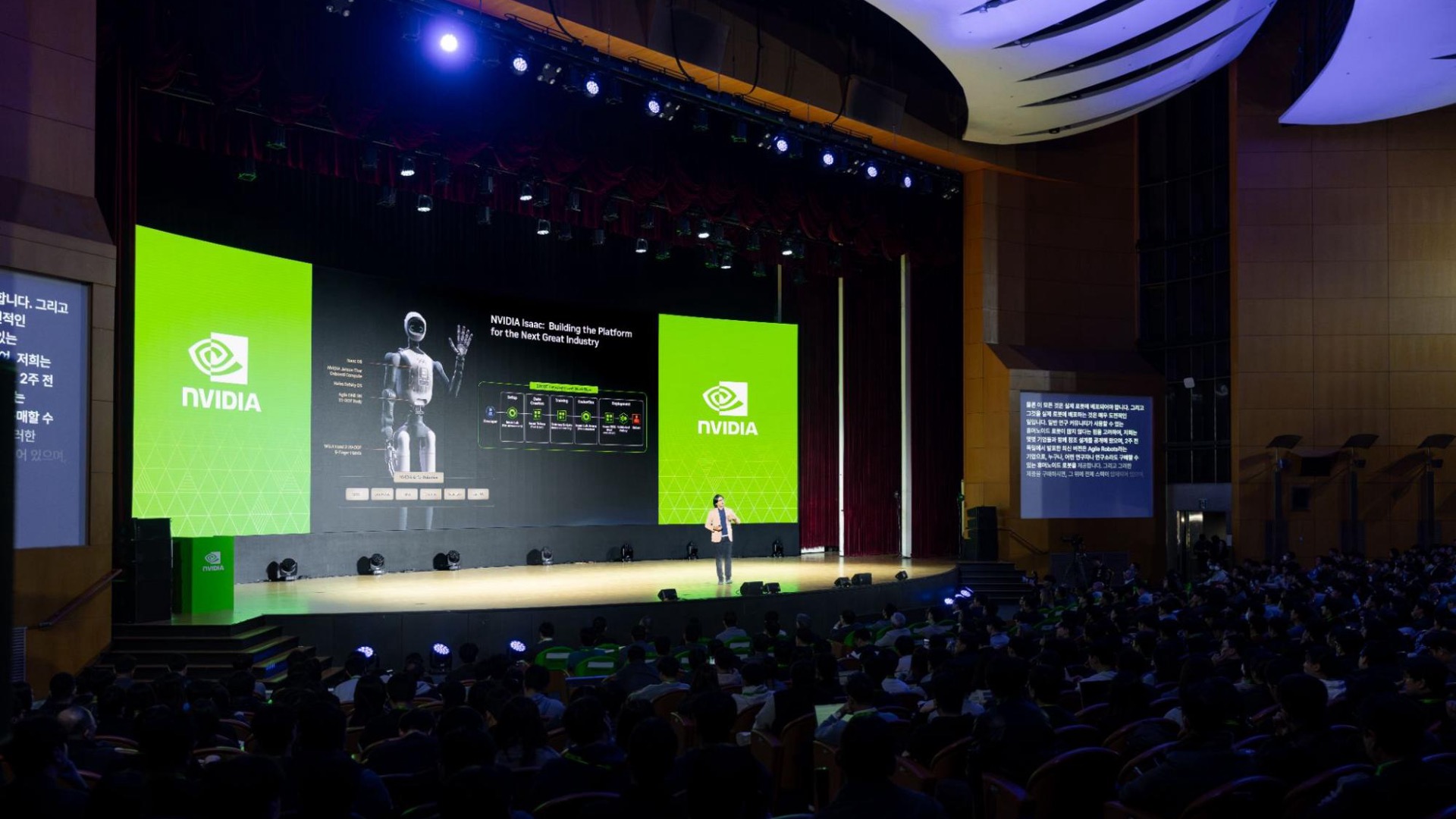
NVIDIA held AI Day Seoul over two days at the COEX convention center, drawing more than 2,000 attendees from Korean industry, startups and developer communities. The event focused on physical AI and AI agents. In plenary sessions, Deepu Talla, NVIDIA's vice president of robotics and edge AI, described Korea as punching above its weight, pointing to Doosan Robotics, Hyundai Motor Group, LG Electronics and SK Group, along with startups Real World and Luda Robotics, as organizations using NVIDIA platforms to bring general-purpose robotics into the real world.
Jonathan Cohen, vice president of applied research at NVIDIA, used his session to show how enterprises can build agents that they own and control. Breakout talks featured speakers from Coupang Intelligent Cloud, Doosan Robotics, LG AI Research, LG Electronics, NAVER Cloud, SK Telecom and Upstage. Hyunho Yang, a research engineer working on omnimodal foundation models at SK Telecom, described the event as a genuinely enjoyable time for candid conversations and said the passion of fellow AI developers was a source of inspiration.
The community track ran under the banner of the Agentic AI 10x Bootcamp Community Day and involved Pseudo Lab, Python Korea, PyTorchKR, HAERAE, Hugging Face KREW, Graph User Group, Womxn Who Code Korea, Dnol (Datayanolja) and other developer groups. A hackathon co-hosted with Fastcampus around Hangul Day produced five finalists who built agents trained on Korean language and culture using the OpenShell runtime. The winning team, FlyGate, received an NVIDIA DGX Spark system as its prize.
Hands-on training ran in parallel. More than 500 developers took part in full-day NVIDIA Deep Learning Institute workshops and NVIDIA Certification exams delivered in Korean. The workshops covered deploying and optimizing AI inference at scale, building end-to-end robotics workflows with the NVIDIA Isaac platform, and developing secure AI agents. The certification offering included the new AI Model and Application Development exam.
A separate Physical AI Startup Connect session featured pitches from 10 startups in the NVIDIA Inception program: AIM Intelligence, Avikus, GoLe Robotics, MOVIN, Neubility, ROAI, ROBROS, TESOLLO, TwelveLabs and XYZ. An AI for Science Forum brought together the Korea Institute of Science and Technology Information, Korean universities and NVIDIA Research. Session recordings are to appear on NVIDIA On-Demand.
Read together, the agenda maps onto the two themes NVIDIA has been pushing: embodied or physical AI, where models drive robots and autonomous machines, and agentic AI, where models act through tools on a user's behalf. Korea's chaebol-scale manufacturers give the first theme an obvious testing ground, since robotics and automotive programs already sit inside Hyundai, Doosan and LG. The second theme is more about software ownership, which is what Cohen's framing of agents that enterprises own and control speaks to. In practice, that framing matters for teams weighing hosted agent services against self-hosted stacks: control over data, model choice and deployment usually costs more operational work. This is my own reading of the emphasis, not a claim made at the event.
The hackathon detail is the most concrete signal for developers. Agents trained on Korean language and culture, built on a runtime called OpenShell, point to localization work that goes beyond translation into culturally grounded behavior. That is a harder problem than benchmark scores suggest, and events that reward it tend to surface datasets and evaluation gaps that generic model releases overlook.
The training numbers are also worth noting. More than 500 developers completing DLI workshops and Korean-language certification exams in a single event suggests certification is becoming a hiring signal in the region, and that NVIDIA sees credentials as a channel for spreading its toolchain, including Isaac for robotics, among practitioners rather than only among researchers.
Why it matters: developers and product teams building robotics or agent products in Korea now have a visible local stack of platforms, partners and trained practitioners to draw on, and the Korean-language agent work highlighted at the hackathon is likely to shape expectations for localization in the region. The startup pitch list gives a rough map of where early physical AI companies are concentrated. Recordings on NVIDIA On-Demand will let teams outside Seoul follow the technical sessions, which is inference on my part about their value rather than a stated outcome.
Based on reporting from the original publisher. Visit the source for full context and later updates.
Publisher excerpt
Over two days at COEX, more than 2,000 attendees converged for AI Day Seoul, bringing together Korea’s industry leaders, startups and developer communities advancing physical AI and AI agents. At the plenary sessions, Deepu Talla, vice president of robotics and edge AI at NVIDIA, said Korea is “punching above its weight,” with Doosan Robotics, Hyundai […]