30 Months on the Exponential (in Charts)
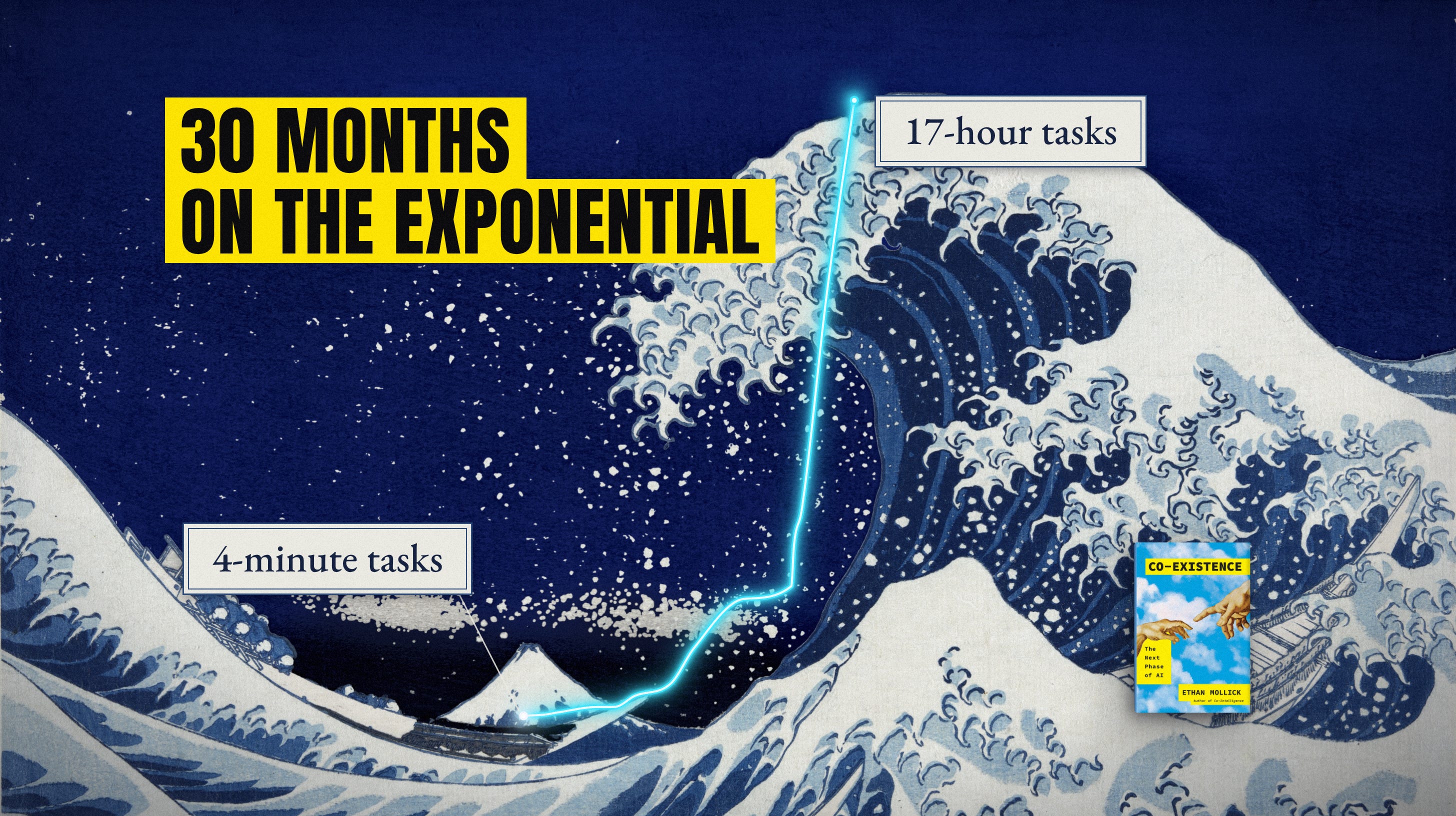
Ethan Mollick published his second book on AI, Co-Existence, on the day of this post, 30 months after Co-Intelligence appeared in early 2024. He uses the gap between the two books to measure how much the field has moved, and he made the charts in the piece by delegating the work to an AI agent rather than working through a chat window step by step.
The method is itself part of the argument. Mollick used Opus 5.5 inside Claude Projects, where a single orchestrator agent spins off additional agents as needed, passes them instructions and relays results back. He gave a few sentences of direction and got research, graphing, layouts, images and citations back in minutes rather than hours. Because the work was cheap, he asked for many options, gave loose reactions such as "make it better," and the model caught an error in his arithmetic. He had planned to call the post "28 months on the exponential" before correcting the count.
His framing for the era is that the leading model keeps changing hands. From early 2023 through early 2024, GPT-4 from OpenAI was the unambiguous best model in the world, the one that made ChatGPT the default assistant for many people and the one he had in mind while writing the first book. Since then, twenty different models have held the lead at some point, all of them from Anthropic, Google or OpenAI. That churn understates the shift: by his count 180 models now beat GPT-4 as it performed at release, many of them open weights and free to use or modify, and nineteen of those can run on a modern smartphone. This suggests the practical frontier for most teams is no longer a single vendor's flagship, since capable open models small enough for local hardware widen the design space considerably.
The headline evidence comes from the METR Long Horizon Benchmark, which measured how much human work a model could complete from one prompt with at least a 50% success rate. Mollick reports strikingly regular gains: work capacity doubled eight times between GPT-4's release and the end of the measure. In 2024 a model handled about a four-minute task; by April 2026, when he submitted the draft of Co-Existence, the figure stood at 17 hours of human work. Then the benchmark ran out, with METR saying its current methods could no longer measure task length accurately. Other studies he cites put the number at 17 weeks or more. In practice, the exhaustion of a respected benchmark is a familiar problem in fast-moving fields: once tasks exceed what a controlled evaluation can stage, the measurements become extrapolations, and the gap between what a chart shows and what a system reliably does widens.
Cost fell alongside capability. On the Google Proof Question and Answer Exam, which poses problems that regularly stump graduate students, a single correct answer used to cost 30 cents in model usage. The same result now costs four hundredths of a cent. That is roughly three orders of magnitude, and it changes what is worth automating: tasks that were uneconomical at 30 cents per attempt become plausible at a fraction of a cent, which is a likely reason agentic workflows that try many approaches have become practical.
Ability remains jagged. Mollick says long-form writing is still a weak spot, while math went from poor to superhuman over the same period. Even where models excel, small gaps create large needs for human oversight, at least for now. He also describes a shift in working style: the earlier book covered centaur work, split between human and AI, and cyborg work, blended between them, both of which keep a person in the loop. With real agents he adds a third mode, the conjurer, who summons agents, assigns work and judges what returns. He calls it the most powerful way to use AI and one that carries new risk, because the human loses visibility into how the result was produced. The charts, made by summoning agents and repeating vague instructions, are his demonstration.
His recurring image-generation test, the prompt "Otter on an Airplane Using Wifi," also moved on. Where Midjourney's best output 30 months earlier was a still image, he asked Opus 5.5 in loose, typo-ridden language for a video version, and with his subscriptions to Google and ElevenLabs services the model handled script, images, concept, music and the technical assembly without help. He acknowledges flaws in the result but treats the unaided production as the meaningful change.
Mollick argues the pace makes news-chasing futile for a book, so Co-Existence concentrates on trends: improvement that is exponential but uneven, and a shift from chatbots to agents doing real work. He locates remaining human advantage in deep knowledge, wide knowledge, taste and agency, and covers when to hand work over and when to keep it. The book's site was itself redesigned by Opus 5.5 on the instruction to make it better.
Why it matters: Developers and product teams planning around model selection should expect the leaderboard to keep reshuffling, with open and small models covering more of the work than a single flagship did two years ago, and falling inference prices make multi-attempt agent designs affordable. The conjurer pattern means more products will hand whole tasks to agents rather than assist inside a chat, which shifts design effort toward specifying outcomes and verifying results, since visibility into how the work was done drops. Treat the 17-hour and 17-week figures as benchmark estimates from a measure its authors say has reached its limits, not as guarantees of reliable autonomy.
Based on reporting from the original publisher. Visit the source for full context and later updates.
Publisher excerpt
My new book is out today... what happened since the last one