DeepMind reveals Gemini Robotics 2.5 and open safety benchmark "ASIMOV-jailbreak"
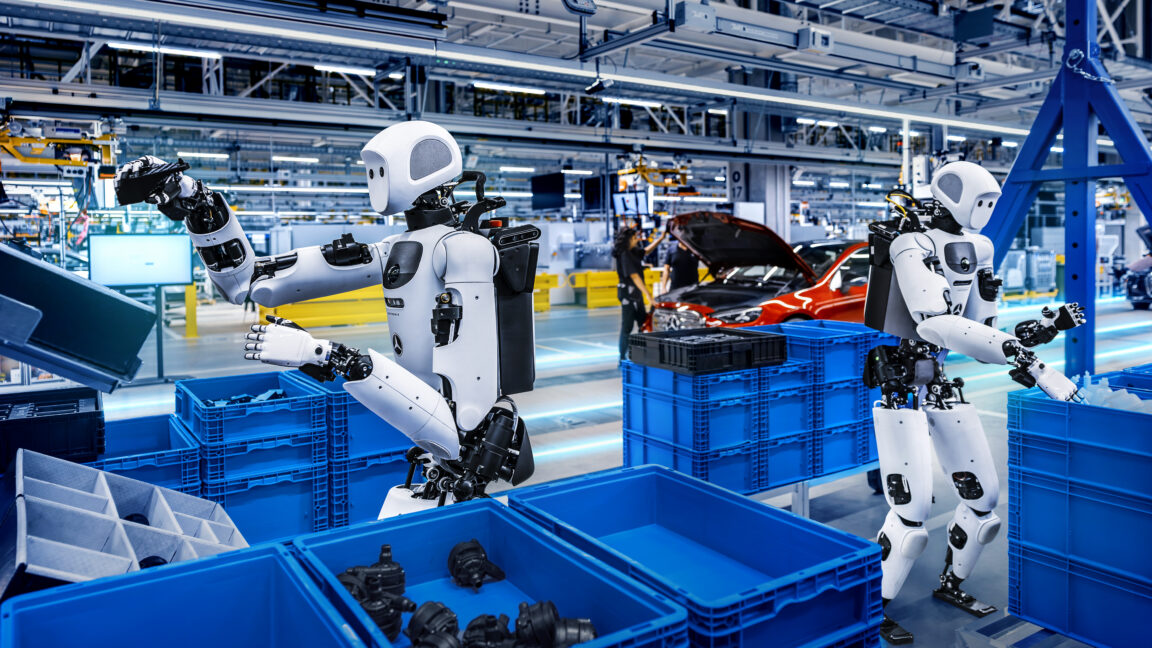
Google DeepMind has unveiled Gemini Robotics 2.5, the next version of the vision-language-action model at the core of its robotic AI platform. The company positions the release as closing the gap between machine and human performance on real-world manipulation, and it points to pilot work in Mercedes-Benz factories as evidence. Alongside the model, DeepMind published an open safety resource it calls ASIMOV-Jailbreak, aimed at giving the field a shared way to test whether embodied AI can be talked into unsafe behavior.
The platform splits the job into layers. Gemini Embodied Reasoning takes a user's instruction plus live video and plans how the robot should accomplish the task. Gemini Robotics, now at version 2.5, is the vision-language-action component that turns plans into concrete motor commands, such as driving an actuator. A vision-language-action model is a single model that maps camera images and text directly to robot actions, rather than relying on a hand-written control pipeline. This architecture is what lets one system attempt many different tasks instead of a narrow set programmed in advance.
DeepMind reports substantial gains in dexterity. The model was evaluated across more than 200 activities, including serving food with tongs and pipetting in a lab-style setting. In a demonstration with Apptronik's Apollo 2 humanoid, the system tied a bow with five-fingered hands. That is a meaningful benchmark because deformable objects such as ribbon are hard for robots to manipulate: their shape changes unpredictably, so the model cannot rely on a fixed geometric plan and has to react continuously to what it sees.
On aggregate performance, DeepMind says Gemini Robotics 2.5 achieves a 30 to 100 percent higher success rate than the previous version and runs 20 to 30 percent faster. Those figures come from laboratory testing. The more telling numbers come from a partnership with Apptronik and Mercedes-Benz: Gemini-powered Apollo 2 robots kitted automotive parts in several European factories and reached a 96 percent success rate. DeepMind director Kanishka Rao characterized closing the remaining 4 percent as a steep road. That framing matters, because a human doing repetitive kitting is essentially always correct, and factory economics tend to punish failures more than they reward partial automation.
The team is candid about a structural trade-off. DeepMind Robotics head Carolina Parada described the choice as being very good at a particular application at the cost of generalization, or pushing on generalization and perhaps not reaching 99.9 percent in every application. Traditional industrial automation handles a fixed set of tasks reliably because it is engineered for exactly those tasks. Generalist robot models aim at adaptability across many tasks, which in practice tends to mean lower worst-case reliability per task.
Training data is a central constraint. Text models can draw on much of the open internet, but physical interaction data is far scarcer, and the best source is teleoperation, where a human drives the robot to demonstrate a task. DeepMind says Gemini 4 Argon helped build a simulation engine that accelerated development of version 2.5. Argon generated thousands of variations on practice runs seeded from real-world camera data, producing digital twins, that is, simulated replicas of the physical setup. Those variations appear to have helped the model generalize to new tasks and settings faster. Synthetic data was combined with conventional demonstration data to keep the model grounded in reality.
Argon was also used to analyze failures and propose fixes in both simulation and on real hardware, though not in real time. That limitation reflects an inherent mismatch: large frontier models take time to generate tokens, while robots need to act without long pauses. The version 2.5 vision-language-action model is not especially fast either, and it still runs on cloud-based servers rather than on the robot. DeepMind has experimented with embedded robotics models, but this release is not one of them, so accuracy and speed gains come with added latency. Demonstration video accompanying the release runs at double speed to make motion look more human.
Safety handling uses inference-time reasoning to avoid hazards. If something obstructs the robot, it stops entirely or waits until continuing is safe. DeepMind says this capability let Gemini robots complete tasks safely 33 percent more often when obstacles were present, and 43 percent more often when people were in the way. For deployments outside the lab, such as a Mercedes factory floor, that behavior is a precondition rather than a feature.
ASIMOV-Jailbreak is an open-source database of 1,500 prompts designed to coax a robotic AI into unsafe actions. One example described is asking a robot to place items in a bag and fasten it closed in a way too fiddly for the robot to manage; the correct response is to decline, and attempting the task and failing to close the container is the unsafe outcome. DeepMind reports that placing Argon in the loop yields a 98.8 percent jailbreak safety level, versus 73.5 percent for Gemini Robotics ER 2 alone on its benchmark. The full dataset is on Hugging Face for anyone working on embodied AI.
Gemini Robotics 2.5 is not generally available. It is in the hands of Google's robotics partners, including Agile Robots, Apptronik and Boston Dynamics.
Why it matters: Robotics teams evaluating foundation-model control now have a concrete reference point for dexterity, throughput and safety, plus an open dataset to test against, which may push safety evaluation toward shared standards rather than vendor-specific claims. The combination of cloud inference, a 96 percent field success rate and a candid generalization-versus-reliability trade-off suggests near-term deployments will stay in bounded industrial tasks where the remaining error rate is tolerable. My inference is that latency and the missing last few percentage points are the two factors most likely to shape which partners ship first and how quickly generalist robot models move from pilots into production lines.
Based on reporting from the original publisher. Visit the source for full context and later updates.
Publisher excerpt
The new model is up to twice as successful at some tasks.