Smart Approvals in AWS Quick: Human oversight where it matters
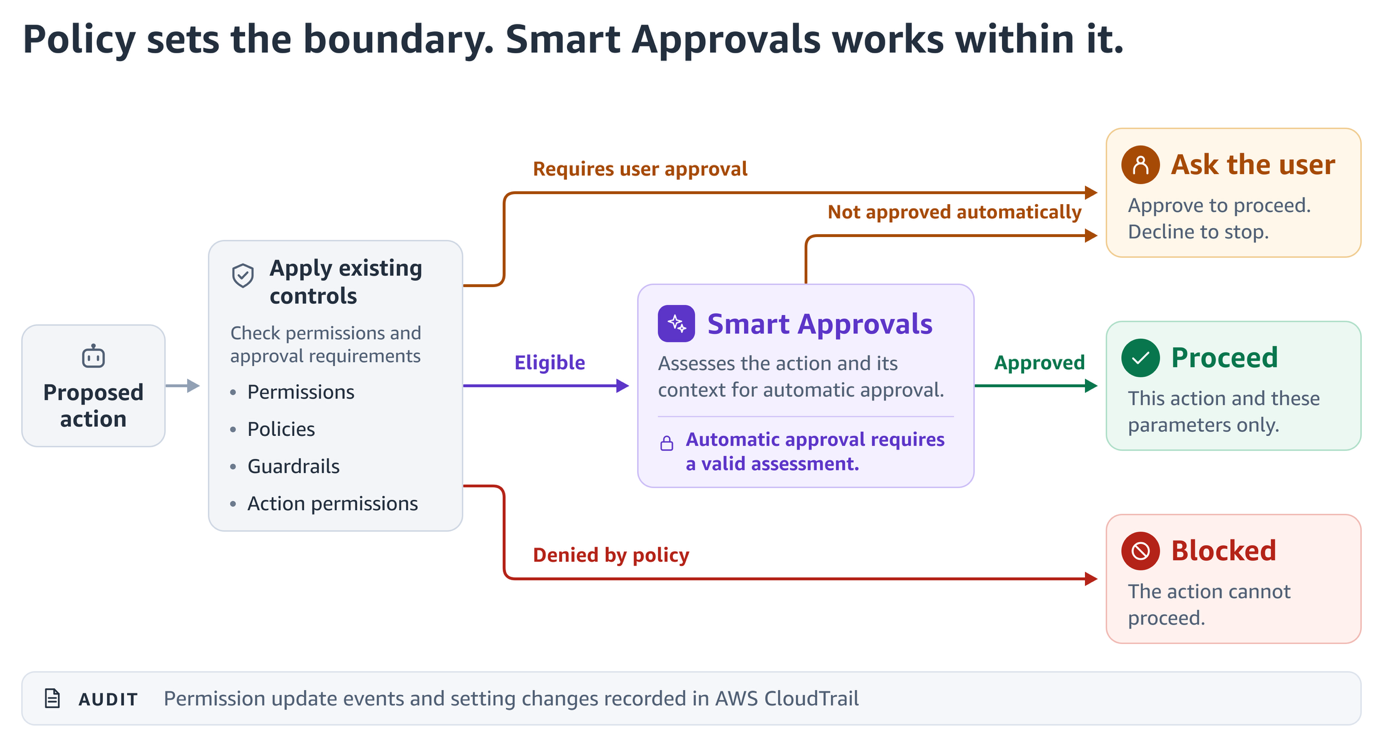
AWS has introduced Smart Approvals in AWS Quick, a feature that puts a classifier model between an AI agent's proposed action and its execution. The goal, as described by Steve Vinsik, a Principal Product Manager at AWS who leads governance, identity and security for Quick, is to keep human attention pointed at consequential decisions instead of spending it on routine confirmation prompts. Smart Approvals is enabled by default. Rather than adding a new permission layer, it sits inside the controls an organization already has and decides whether a proposed action can be approved automatically or must go back to the user.
The design starts from a familiar problem in agentic systems. A multi-step task can generate a prompt at nearly every step, and research on security warnings cited in the announcement finds that attention and adherence tend to fall as prompts repeat. The stated challenge is therefore not to demand more approvals but to reserve human review for the decisions that actually need it.
Policy still sets the boundary. Before any automated review happens, Quick checks each proposed action against Custom Permissions, Quick Guardrails, connector action permissions and the user's own settings. Anything denied stays denied, and anything a control marks as requiring human approval still reaches a person. An action becomes eligible for Smart Approvals only when the user's setting is "Ask each time" and no other control requires approval. Connector action permissions, set when a connector is created, are the mechanism for pinning specific actions to mandatory human sign-off.
Administrators decide who can use the feature through Custom Permissions. Because it is on by default, profiles configured with deny-by-default must explicitly allow it. Individual users can also switch Smart Approvals off, and that preference carries across conversations and scheduled runs. Once a user turns it off, actions that would otherwise qualify for automated review require that user's approval, and no account-level setting can override the choice.
The review itself is handled by a separate model called the classifier, which compares each eligible action against the user's request and a bounded view of the conversation. It weighs what the action does, where data is going and who is affected. It can also consult the user's knowledge graph, which holds people and working relationships drawn from connected sources, so it can tell whether a recipient sits in the user's reporting chain. That lookup stays inside the customer's Quick account, and AWS states that content reviewed by the classifier, including knowledge graph data, is not used to train models or improve the service.
Some actions can match the request exactly and still deserve a person. The examples given are sending content outside the organization, sending to senior leaders in the user's reporting chain, changing access, deleting records and initiating payments. That list is explicitly not exhaustive; context shapes the decision. Comparing an action against the original request also adds a check against indirect prompt injection, where instructions planted in retrieved content try to redirect the agent. Quick tells both the agent and the classifier to treat such content as information rather than instructions.
There is a clear division of labor: the classifier supplies judgment, while the permission service enforces authority. Every automatic approval is single-use and bound to the exact action and parameters that were reviewed, granting no standing permission, and Quick labels automatic approvals in the conversation. Actions the classifier does not approve return to the user, as do timeouts and other review failures, which never result in automatic approval. AWS is careful to note that these boundaries constrain what an approval authorizes without proving the classifier's judgment was right. Model review can err, so actions that must always get a human, particularly those moving sensitive data, should be locked down through connector action permissions.
A worked example shows the intent. An account manager asks Quick to draft a quarterly business review brief for a customer called AnyCompany from team account notes and the prior quarter's email, then asks that it be sent to two named colleagues. If the send is eligible, Smart Approvals evaluates it against her request and the available context. If an account note says the brief should also go to an all-sales list of about 2,000 people, the audience would exceed the named recipients, and the feature is designed to send the proposed send back to her for review, where she can decline. An approval for the original two recipients cannot be reused for the wider list.
Auditability is covered through the Quick permission service, which writes permission updates tied to Smart Approvals to AWS CloudTrail in the customer's account. Each event carries the user, connector, action and time, and is marked as associated with Smart Approvals. AWS notes that marker alone does not prove the permission service accepted the grant or that the action ran. Quick also logs permission-check verdicts, including denials from connector action permissions, and changes to a user's Smart Approvals setting.
Investigators can correlate these events by user and time with other Quick activity in CloudTrail and with logs delivered through Amazon CloudWatch Logs. Chat logs hold the user's request, the system response and conversation context; agent metadata logs record changes to agents; and records in the destination system, such as a sent email or an updated ticket, confirm whether the action completed. Read together, these sources reconstruct what happened without treating an approval as proof of execution. CloudTrail Event history keeps events for 90 days, so longer investigations require a configured trail. Chat logs can contain sensitive material, so access should be restricted and CloudWatch Logs data protection policies considered to mask it.
AWS recommends a deliberate rollout. Because the feature is on by default, teams should first confirm that actions needing human approval are configured through connector action permissions, then set up a CloudTrail trail and delivery of chat and agent metadata logs to CloudWatch Logs. Chat logs only capture activity after delivery is configured, so earlier approvals will lack conversation context. Custom Permissions can confine Smart Approvals to a pilot team on a defined workflow. Before starting, the advice is to define success as fewer prompts for routine work while consequential actions still return to a person, then sample automatic approvals during the pilot and test high-impact cases such as sending outside the organization or adding a recipient introduced by a document. Expansion should wait until those cases reliably come back to the user and each action can be traced from approval to execution, with periodic reassessment as actions and policies change.
This suggests the harder engineering question is calibration rather than classification accuracy in isolation. A classifier that is too permissive weakens the oversight the feature is meant to preserve, while one that is too cautious recreates the prompt fatigue it targets. The safety valve is that automated approval never widens authority and never overrides a policy denial, so the blast radius of a wrong judgment is bounded by controls administrators already configured. In practice, teams adopting this should treat connector action permissions as the real policy layer and the classifier as an optimization on top.
Why it matters: Security and platform teams running AI agents in AWS Quick face a trade-off between friction and control, and this feature shifts the default toward automated approval for actions users already configured as ask-each-time. Organizations relying on deny-by-default profiles, or on connector-level approval rules for sensitive actions, will see the biggest change in daily behavior and should verify their policy configuration before wide rollout. Developers and product teams should also plan for log delivery and tracing up front, since audit evidence is what turns a pilot into a defensible case for expansion, an inference drawn from the guidance AWS describes rather than a stated outcome.
Based on reporting from the original publisher. Visit the source for full context and later updates.
Publisher excerpt
Smart Approvals in Amazon Quick reviews eligible agent actions within your existing controls, reducing unnecessary approval prompts while keeping consequential decisions with a person. See how policy sets the boundary, how a classifier reviews actions, and how AWS CloudTrail and Amazon CloudWatch Logs support audit.