A single AI model simulates the behavior of many substances, from sliding sand to folding proteins
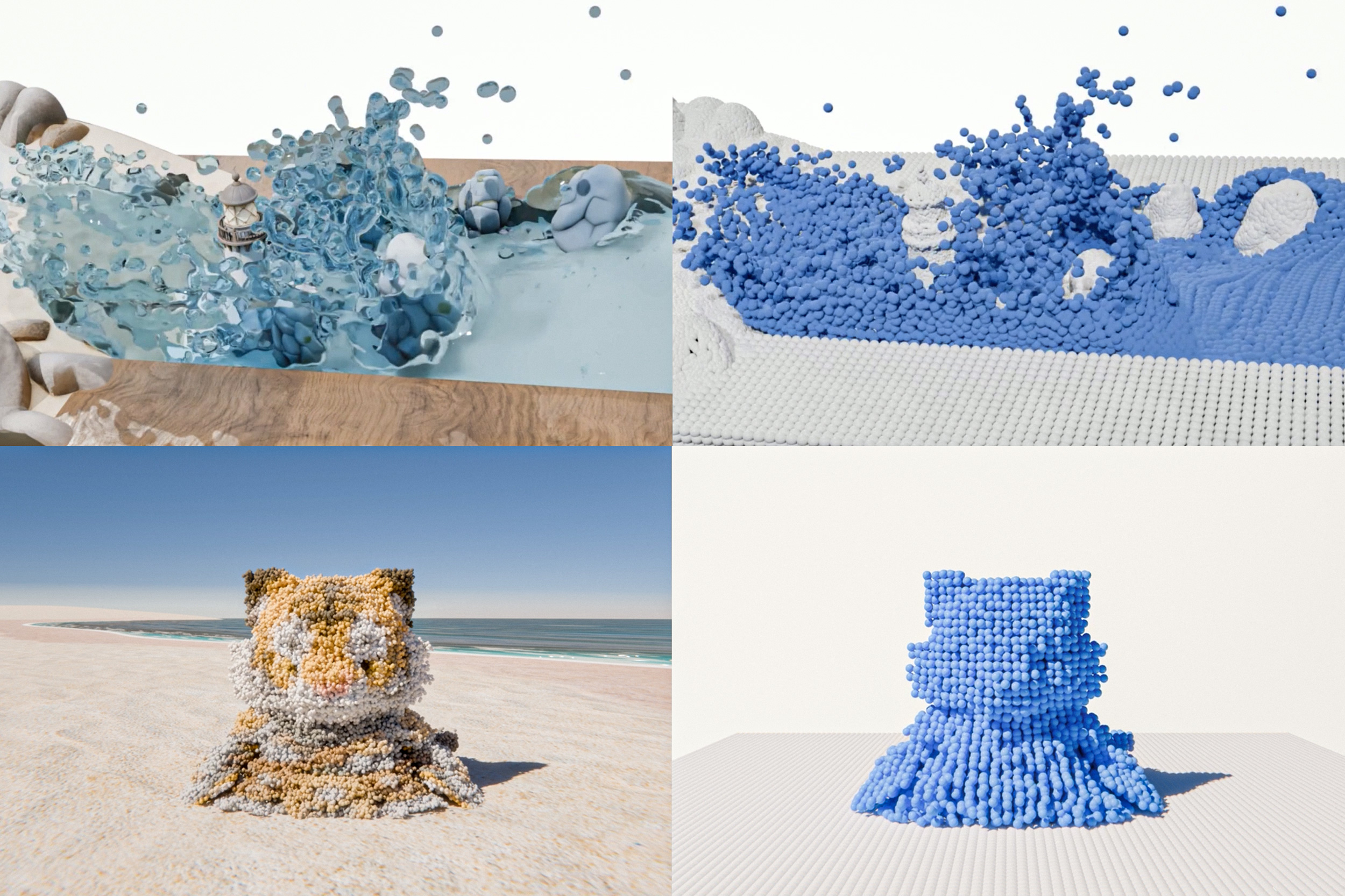
Researchers at MIT, the University of British Columbia and several other institutions have developed a single deep-learning system, called WorldParticle, that simulates many different physical materials through one unified architecture rather than a separate hand-coded solver for each phenomenon. The work is described in an open-access paper and will be presented at the ACM SIGGRAPH Conference and Exhibition on Computer Graphics and Interactive Techniques in Asia. Peter Yichen Chen, a former MIT postdoc now an assistant professor at UBC and a co-corresponding author, described the goal as wanting a GPT moment for simulation.
The team also includes co-corresponding and co-lead author Minghao Guo, an MIT postdoc; co-lead authors Caoliwen Wang and Siyuan Chen, UBC graduate students; and Wojciech Matusik, an MIT professor of electrical engineering and computer science who leads the Computational Design and Fabrication Group within CSAIL. Other contributors come from UBC, Georgia Tech, Inria, Meta, the University of Pennsylvania, the University of Utah, UCLA and the University of Hong Kong.
The problem the system targets is familiar to anyone who has worked with physics engines. Simulating flowing water, folding proteins or collapsing sand traditionally means picking a solver hand-coded around the governing equations for that specific process. Building a new one for each material or regime is slow and specialist work, and combining two regimes means coupling two separate tools.
WorldParticle instead represents any material as thousands or millions of tiny three-dimensional dots, a Lagrangian representation, and tracks their positions and velocities over space and time. A neural network takes the particles' 3D positions and physical properties as input and outputs their positions and properties for the next frame, predicting motion in one-second increments. Chen compared the architecture to ChatGPT: rather than predicting one word at a time, it predicts how particles move, one step at a time. Because the network learns the underlying dynamics rather than being programmed with an equation, the researchers say it can adapt to materials, forces and environments it never saw during training.
External forces are handled in a separate stage. Before each step, the system isolates forces acting on the physical system, such as the impulse of an ocean wave hitting a seawall. After predicting particle states, it integrates those forces back in and corrects the predictions, which is how the model generalizes across unseen materials, changing conditions and varied forces.
Scaling is the hard part. Breaking a complex object into millions of particles is computationally heavy, so the researchers added a merging technique that combines and compresses particles while preserving fine-grained behavior. Guo said the team needed considerable engineering and many architectural tweaks to make the framework genuinely generalizable and scalable.
The researchers demonstrated WorldParticle on six physical phenomena, including deformable objects, granular materials and proteins, reporting higher accuracy than numerical simulation methods. In one granular test, the model captured how a mass of sand collapses into a pile while some baselines left particles floating in the air. On proteins, Guo says the method modeled structural changes over time about 100 times faster than numerical simulators.
This suggests the practical appeal is speed and flexibility rather than replacing established solvers outright. Learned simulators trade the guarantees of a numerical method, such as conservation properties and predictable error behavior, for the ability to run fast and handle regimes that were not explicitly coded. Whether WorldParticle holds up in long rollouts, where small per-step errors can compound, is the kind of question any learned dynamics model has to answer, and the reported comparisons here are per-scenario rather than a broad benchmark sweep.
The intended applications span soft robot manipulation, where engineers want to know how sand or soil moves when a soft robot touches it; fluid-structure interaction, such as sloshing oil striking an elastic valve in a storage tank; RNA evolution; and astrophysical events like merging galaxies. Longer term, the team hopes the work supports discovering new materials and studying processes that existing simulation methods handle poorly, and they plan to extend WorldParticle to more physical systems and build toward a full general-purpose simulation pipeline for scientific discovery.
Why it matters: Teams building simulators, robotics planners, graphics tools or scientific pipelines currently pay for each new material or regime with a bespoke solver. A single learned model that transfers across materials could shorten that cycle and make coupled problems, like fluid against a deformable solid, tractable within one framework. The open question for adopters is trust: learned dynamics need validation for stability and physical fidelity before they can sit inside engineering workflows where a wrong prediction is costly, and that validation work is likely the next gate.
Based on reporting from the original publisher. Visit the source for full context and later updates.
Publisher excerpt
By learning how matter moves, the WorldParticle system could assist with developing soft robots, medicines, and more.