Jensen Huang resigns.
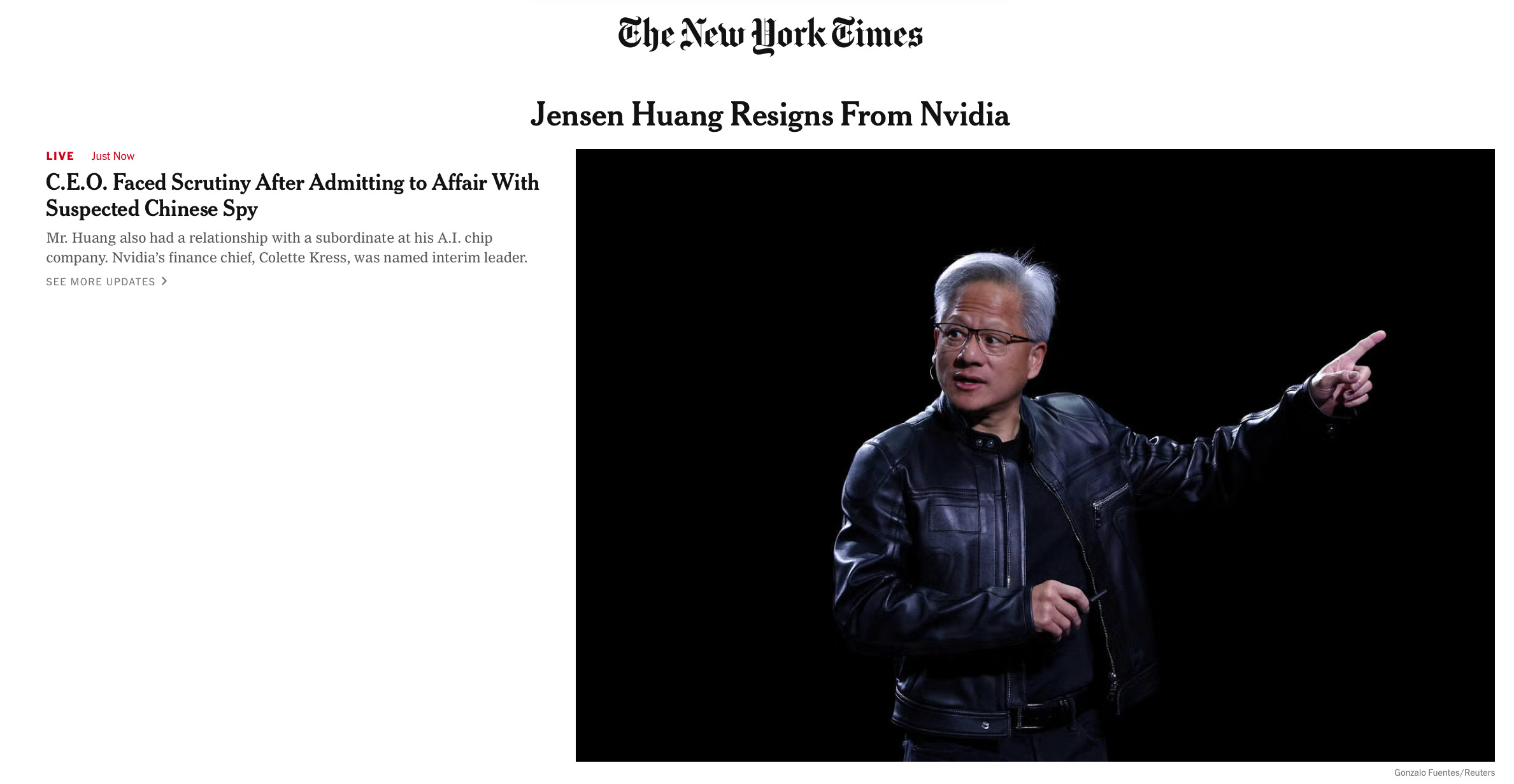
Gary Marcus wrote on his newsletter that Jensen Huang has resigned as CEO of Nvidia. According to Marcus, the board met and, in his reading, presumably told Huang he had to go; for the moment the company has been handed to CFO Colette Kress. Marcus reported that the stock was down 8% in premarket trading and 13% as of the opening bell on the day of the news. The account did not name a date beyond "yesterday" and "today," and no Nvidia statement or board comment is reproduced here. Treat the specifics as coming from Marcus rather than from confirmed company disclosure.
Marcus frames the departure as something he expected. The day before, he had written that if Huang was on his way out, all hell might break loose and the stock could fall sharply. He also raised a concrete question then that now sits at the center of the story: whether an Nvidia led by an acting CEO, possibly the CFO, would still go through with the billions it promised Anthropic around an IPO. That is the detail with the most direct financial consequence for anyone tracking Nvidia's balance sheet and its commitments to AI labs.
His stated reasons for the ouster are pointed. He argues Huang enabled and lobbied for Chinese AI, subverted US policy, and left himself open to blackmail and espionage. He says Huang showed blindness to conflicts of interest, or the appearance of them, and that this cost many people dearly and put the company, the industry and the country at risk. Marcus also points to exposure to endless litigation and investigation, which he suspects is part of why the board encouraged the exit despite Huang's talent. Separately, he says he had grown frustrated in recent years with Huang's tendency to hype and with the circular financing around the AI boom.
Notably, Marcus does not treat this as a simple fall. He calls Huang one of the greatest CEOs in history and recalls first meeting him around 2014, when Huang had already concluded that Nvidia's future lay in AI and was pushing hard to embed the company in the field. That pivot, from powering video games to powering the AI buildout, is the backdrop against which a CFO taking interim control matters. Nvidia's value rests on data-center accelerators, long supply commitments and relationships with cloud and model developers, and an interim leader inherits all of those obligations at once.
Marcus's forecast is broad. He expects congressional investigations to continue, the market to possibly crash, and China to be perhaps the biggest immediate winner. He predicts China hawks will come out in force, that the politics will be intense, and that Lutnick and Trump may be caught in the crossfire. His summary advice is to expect chaos. In practice, an acting CEO at a company this central to the AI supply chain creates uncertainty on several fronts at once: counterparties may pause on multi-year commitments, procurement teams may wait for clarity on export-license posture, and investors will watch whether the board names a permanent successor quickly. This is my own reading of the situation, not something Marcus states.
The Anthropic question is the one to watch most closely for product teams. Commitments tied to an IPO are the kind of thing a caretaker leadership team may slow down or renegotiate, and any change in Nvidia's willingness to fund customers could ripple into the compute plans of the labs that depend on it. Widely known context: Nvidia's scale makes it a de facto financier of the AI ecosystem, so leadership at the top affects the terms on which many others build. That is inference, not reported fact.
Why it matters: if the reported leadership change holds, developers and product teams that depend on Nvidia hardware, pricing and roadmap will be dealing with an interim chief and a falling share price, which tends to mean slower commitment decisions and more cautious capital allocation. The fate of the promised Anthropic funding is the concrete item to watch, and any pullback would reshape compute budgets across AI labs and startups. Expect volatility and wait for confirmation from Nvidia itself before acting on the numbers.
Based on reporting from the original publisher. Visit the source for full context and later updates.
Publisher excerpt
The future of Nvidia and the AI industry is uncertain