[AINews] High Taste Testers Ep. 1
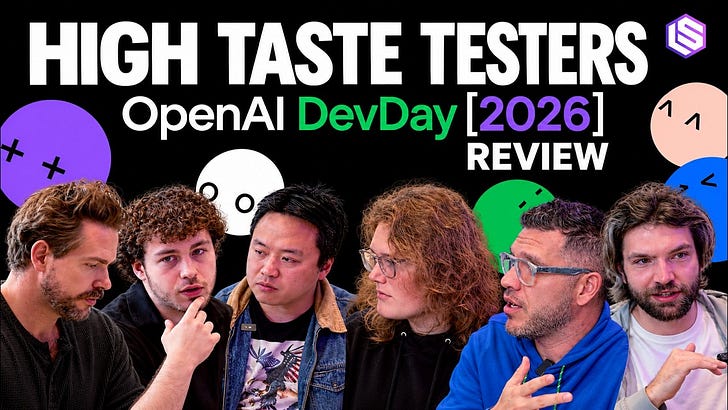
Latent Space used its 15–16 October 2026 AI News roundup to pilot a new show, High Taste Testers, and to cover a wave of open-weight and frontier releases. The headline item is Meta's Muse Spark Open, an 816B-total, 42B-active mixture-of-experts model released with open weights. Artificial Analysis scores it 39 on its Intelligence Index, which the roundup describes as the highest for a US open-weights model and 13 points above NVIDIA's Nemotron 3.5 Super VL at 26. Reflection also shipped Beam 1.0, a 501B-total, 23B-active MoE with 1M context under Apache 2.0, which AA scores at 30, second among US open models.
Muse Spark Open's architecture: 62 layers, grouped-query attention with 16 KV heads, and 8 of 256 experts active per token, plus a 1.8B Perception Encoder and 1M context. It accepts text, image, video and audio, and outputs text. BF16 weights run about 1.6TB; Meta's NVFP4 checkpoint quantizes only the experts, cutting weights to roughly 530GB. Meta says that fits on 4 Blackwell Ultra GPUs, 8 H200s or two 512GB M5 Ultra Mac Studios. Together, Fireworks and Baseten price it at $1.25/$4.25 per million input/output tokens, with $0.15 cached input.
Artificial Analysis puts the cost at $0.84 per index task, against $2.01 for GLM-5.3 and $0.27 for DeepSeek V4.1 Flash. It uses 40k output tokens per task, the fewest among the top nine open models; Vals counts 55.5M output tokens across its index, the fewest of any open model, but says input tokens drive most of its cost. The weak spot is agentic work: it ranks last among the top nine open models on AA's four agentic evals while leading open models on AA-Omniscience. Vals places it #12 among open-weight models and #38 overall, while Arena ranks it the top US open model on Code Arena WebDev with 1511 points, #13 among open models.
The license is Meta's custom Muse Model License, which requires a "Built with Muse Spark Open" attribution; model-as-a-service businesses with more than $20M in annual revenue need a separate agreement with Meta. That structure is a familiar pattern for open weights that are not fully permissive, and it matters for anyone planning to resell hosted inference. mlx-lm had day-0 support with vision, alongside an Apple post on RDMA-distributed inference across Mac Studios. vLLM served RL rollouts during Muse training and supports the release at launch, and SemiAnalysis added B200 configurations to InferenceX.
Reaction was mixed. @teortaxesTex called it "DOA" against the smaller, MIT-licensed DeepSeek V4.1 Flash, and speculated without evidence that Meta withheld Spark 1.3 over distillation from OpenAI; @alexandr_wang described MSL as having built "a machine that builds new models." Reddit discussion praised the breadth of inference-engine support, including SGLang, vLLM, TensorRT-LLM, MLX, llama.cpp and Unsloth, plus custom Helion kernels claiming 1.03–3.95× speedups and in-house-calibrated NVFP4 weights. Critics argued safety post-training had dulled benchmark results and would get in the way of security research, with one commenter ranking GLM 5.3 ahead on capability and openness.
Reflection Beam 1.0 packages BF16, FP8 and NVFP4 weights, a DFlash2 drafter, the open Mirror CLI harness it was trained on, and a safety report. AA scores it 30 using about 26k tokens per task; it reaches 48.5% on AutomationBench-AA but only 3.0% on Terminal-Bench 4.0, and on AA-Omniscience it answers 33% correctly while hallucinating at 47%. Arena places it #12 among open models in Agent Arena and makes it the only non-Chinese model in the top 25 open models on Code WebDev. Its architecture uses sliding-window attention with a 512 window in a 5:1 pattern, no RoPE, Llama-4-style global attention scaling, gated attention, QK-norm, sandwich norm, logit softcapping and no shared experts.
vLLM had day-0 support for Beam; on 4× B300 with NVFP4 at TP4 it measured 1,769 output tok/s at concurrency 16. SkyRL offers day-0 LoRA, full fine-tuning and MXFP8 RL, and reports +62% LoRA decode throughput (276→447 tok/s/GPU), which is a decode result rather than an end-to-end training speedup. Ollama is serving it free for a limited time, US-hosted with zero data retention. Other open releases in the window: StepFun's Step 5 Preview weights, Tencent's Hy Memory 2.0 with a claim that Hy-Memory-30B-A3B beats Opus 5 on memory frameworks, and Datalab's Indra, a 1M-parameter OCR model said to run 15× faster than Tesseract on CPU. NVIDIA's Nemotron 3.5 Bolt 74B-A9B also drew attention for landing a 74B model at roughly 24GB on disk via native 2-bit QAT.
On the closed side, Gemini 4 Argon reached Pro subscribers and AI Studio Build. The wide release raises the output limit to 1M tokens from 64K, shared with input, at introductory pricing of $2/$10 until Nov 30. Perplexity reports a new state of the art on its WANDR research benchmark, and Argon ranks #5 in Agent Arena at +13.2%. Anthropic's Haiku 5.5 costs $0.10/$0.50 for prompts up to 100K tokens, about 90% cheaper than Haiku 4.5, and scores 39.2% on Terminal-Bench 4.0 at max effort against 16.4% for GPT-6 Luna. An Opus 5.5 fast mode at 2.5× speed is reported, and Claude Code now gzips the conversation payload every turn to cut latency. GPT-6 Astra Pro in ChatGPT runs multiple agents on parts of a task in parallel, GPT Live 1.1 improves multilingual voice with nine presets recorded by native-speaking actors, and Elorian's Glimpse claims to match or beat Astra on 5 of 12 benchmarks at 17× lower token prices.
The roundup also tracks calibrated one-pass classifiers as a category. Liquid d1-ultra tops AA's Decision Index at 65, ahead of Jev 1.14 at 57; its non-hallucination rate rises to 85% from 2% for d1 while accuracy falls to 32% from 41%, at 92ms per task and $0.042 per million input tokens with output free. Perplexity's pplx-decider v1.2 ships open weights in a 27B model at 2¢/M and a 4B Flash at 1¢/M, adding reranking, single-pass multi-question inference up to 5× faster, and -latest slugs. OpenAI's Live API added a Decisions API for fast tool delegation. In one experiment, swapping Jev into Recursive Language Model sub-calls was half the cost and 6× faster than Haiku 5.5 on OOLONG at 1M tokens.
Hardware results: SemiAnalysis reports TPUv7 on AgentX at 1.42× better perf per dollar than GB300 NVL72 FP4 on an external, non-Google cost basis, and 2.5× versus MI355X; it is up to 3.16× better than disaggregated GB200 at medium to high interactivity, while GB200 FP4 keeps a 1.2× edge at low interactivity. Vera Rubin NVL72 reached up to 5.7× GB300's throughput per MW on DeepSeek V4 Pro, falling to 2.8× on Kimi K3, with the peak-throughput gap narrowing to 1.14–1.45× and a record 906 tok/s per user on V4.1 Flash; NVIDIA submitted all these results. Eight MI355X delivered 24.4% more throughput than HGX B300 on Kimi K3 at 50 tok/s per user and 87.4% more tokens per dollar.
Why it matters: teams picking open weights now choose between a large, capable but restrictive US-licensed model in Muse Spark Open and a fully Apache-2.0 alternative in Beam 1.0, which is notably weak on terminal-style agent work. Inference cost, quantization artifacts and license terms are becoming deciding factors as much as benchmark rank, and the decision-model tier shows a separate path where a fast, cheap classifier handles routing and tool calls instead of a frontier model.
Based on reporting from the original publisher. Visit the source for full context and later updates.
Publisher excerpt
a quiet day lets us pilot a new show