Detecting signs of hypertension using wearable sensors
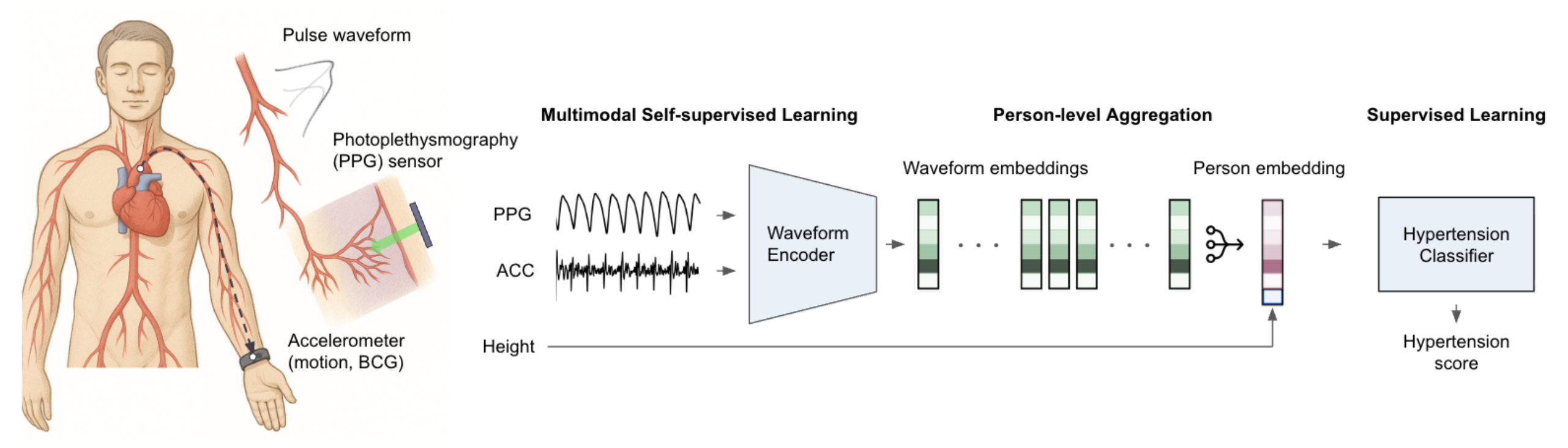
Google Research has published a study in Nature describing an AI system that uses ordinary consumer smartwatch sensors to passively detect signs of high blood pressure, with no cuff calibration required. The work is credited to staff research scientist Paolo Di Achille and senior staff research scientist Ming-Zher Poh, and was carried out with Beth Israel Deaconess Medical Center and Harvard Medical School. The research informed the blood pressure trends Health Guardian feature in the Google Health app, though the authors describe the methods as exploratory and explicitly not indicative of any existing or upcoming commercial product feature or device capability.
The clinical problem the system targets is awareness. Hypertension affects more than one billion people worldwide, and more than half of adults who have it do not know, because it rarely produces obvious symptoms and is usually caught only through incidental screening. The awareness gap is described as especially severe among adults aged 18 to 44. Existing cuffless wearable products, according to the post, generally need periodic calibration against a traditional arm cuff, which means they track relative change from a baseline rather than identifying an absolute hypertensive state.
The design choice that separates this system from blood pressure estimation is a reframing of the task. Rather than predicting point-in-time systolic and diastolic values, which the researchers say are highly sensitive to transient environmental noise, the model tries to identify a person's underlying, persistent hypertensive state by pooling passive physiological signals over several days. It draws on two sensors already present on modern smartwatches: photoplethysmography, an optical sensor that reads blood-volume changes at the wrist and captures pulse wave contours, and accelerometry, which identifies periods of stillness and picks up the ballistocardiogram, the faint wrist vibration produced by blood being ejected from the heart into the aorta.
Training happens in two stages. First, a one-dimensional deep convolutional neural network was pre-trained with self-supervised contrastive learning on a large unlabeled corpus: 492,347 hours of sensor data from 2,109 consenting participants. The model learned to place overlapping 15-second PPG and ACC waveform segments from the same individual close together in a latent space, which let it discover vascular and cardiac-mechanical features without hand-engineered features or medical labels. Second, those 15-second embeddings are mean-aggregated for each user across multiple days of wear, which washes out short-lived noise such as sudden movement or temperature shifts. The resulting person-level embedding is combined with the user's height, treated as a proxy for arterial path length, and passed to a regularized logistic regression classifier that outputs a continuous hypertension probability score.
Validation was prospective and multi-center, across five US sites, with 196 consenting participants who were free of known cardiovascular disease and not taking blood pressure medication. The benchmark was 24-hour ambulatory blood pressure monitoring, the clinical gold standard for diagnosis. Results were assessed under two scenarios. For initial screening, the smartwatch reached 65.8% sensitivity and 90.0% specificity, giving a positive predictive value of 80.6%; initial office-based screening in the same framing showed 55.3% sensitivity and a PPV of 77.8%. For confirmatory testing, the researchers looked at the 48 participants with elevated initial office blood pressure. There the smartwatch system achieved 78.4% sensitivity, 90.9% specificity and a 96.7% PPV, against 67.6% sensitivity, 63.6% specificity and 86.2% PPV for return office measurements, and competitive with multi-day home monitoring at 89.2% sensitivity, 81.8% specificity and 94.3% PPV.
The sensitivity figures are the number to watch. A screen that misses roughly a third of true cases in the initial-screening setting is not a replacement for a cuff, and the authors say as much: the system is positioned as a scalable, passive tool for opportunistic screening that nudges at-risk people into a clinic, not a standalone diagnosis. In practice, an 80.6% PPV means a meaningful share of positive flags would be false positives, which matters for how such a feature is worded and routed inside a consumer app. Specificity near 90% in both scenarios is the stronger result, and the confirmatory numbers, where PPV reaches 96.7% in a pre-screened subgroup, suggest the approach may fit best downstream of an existing clinical signal rather than as a first touch.
The researchers also examined what the model responds to by comparing average pulse waveforms from users with the highest and lowest predicted probabilities. Higher-risk waveforms showed slightly narrower pulse width, consistent with stiffer arteries that expand less; a slower systolic upstroke and a lower d/a ratio, a measure comparing the forward pulse wave with the reflected wave returning from the vascular network; and accelerometer-captured ballistocardiogram differences, notably deeper K waves and wider IJK complexes. These observations are interpretive rather than mechanistic proof, and this reader would treat them as a sanity check that the model latches onto vascular physiology rather than artifacts.
Why it matters: developers and product teams building on smartwatch platforms should note that this is feasibility research published in a peer-reviewed journal, not a shipping capability, and Google states the methods are exploratory with no announced product. The more durable signal is architectural: passive multi-day aggregation of PPG and accelerometer data, paired with a simple classifier on top of a self-supervised encoder, can approach cuff-based workflows on a screening task without calibration. For teams weighing health features, that points to ambient sensing and careful sensitivity/PPV trade-offs as the design space, while any clinical claim would still depend on regulatory review and prospective validation beyond 196 participants, which is this reader's inference rather than a stated result.
Based on reporting from the original publisher. Visit the source for full context and later updates.
Publisher excerpt
Health & Bioscience