The Curve Bends You
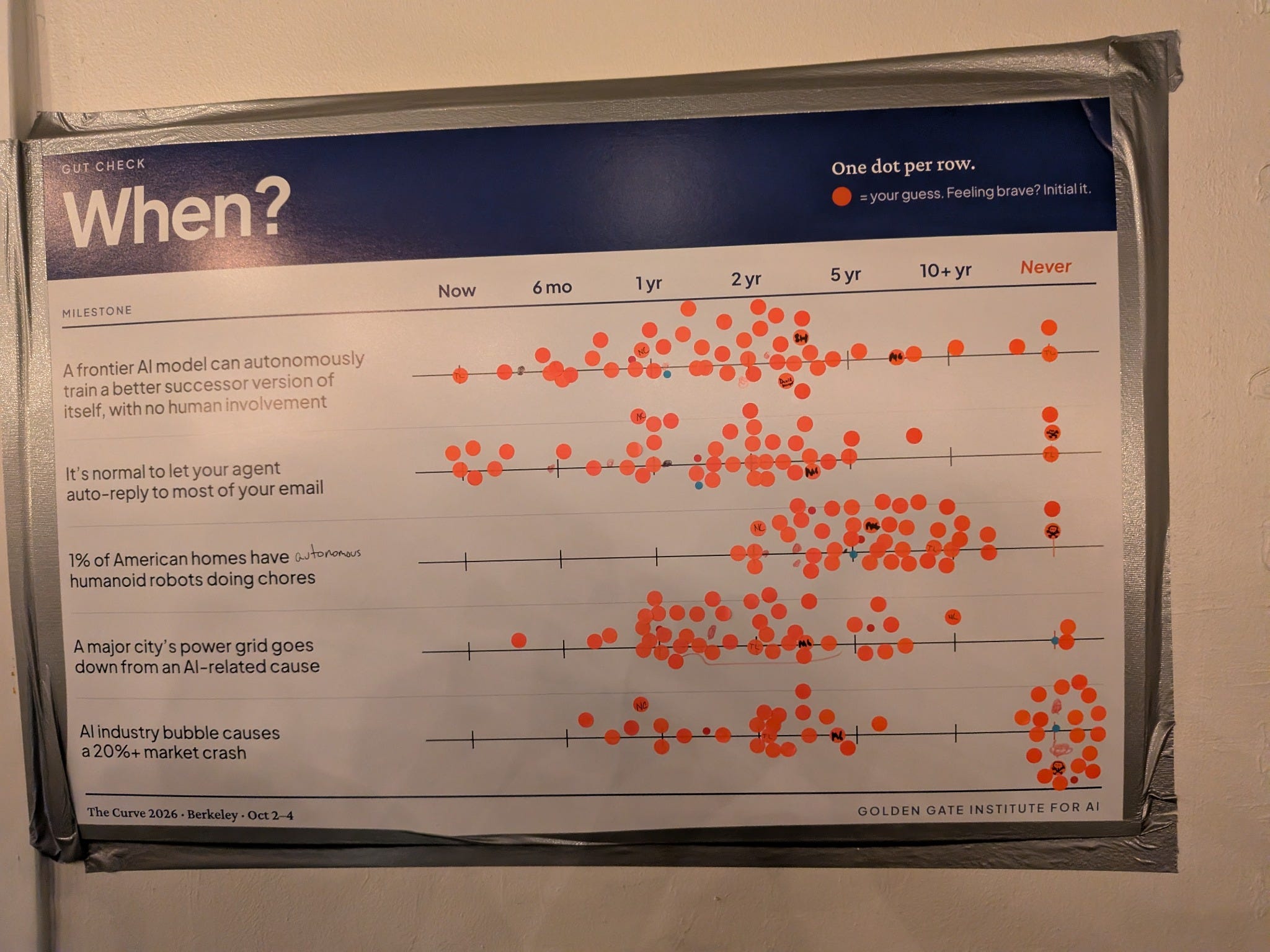
Zvi Mowshowitz's account of the third The Curve conference describes a field that, in his telling, is pursuing what he calls "No Plan": solve prosaic issues through operational excellence, then have current AI perform automated alignment research, then profit. He writes that the labs remain terrified things are moving fast enough that they cannot reliably execute even the first step of this approach, and that no better plan has emerged.
The conference defaulted to Chatham House rules, meaning attendees may report what was said but not who said it or their affiliations. Mowshowitz says he had an editor check his write-up for compliance.
On risk perception, he reports a shift from the previous year. Where attendees mostly rated AI risk at 10 on a scale, this year there were at least five dots in the high 8s and more 9s, a drop he describes as about 0.23 points when the scale is capped at 10. He argues only 10 or above is defensible.
Predictions diverge sharply. Mowshowitz cites survey medians from the prior year, including 90% of code written by AI by roughly 2028, 90% of remote work done more cheaply by AI by about 2031, most US cars lacking human drivers by around 2041, and a Nobel-worthy AI discovery by roughly 2032. He says one forecast, an instant Fields Medal and a solution to Navier-Stokes, was settled "yesterday" with 2026 as the answer. On code, he disputes Claude's 2028 estimate and puts it at 2026 or 2027, noting that counting discarded code would already exceed 90%.
This year's survey asked when AI would train a superior successor on its own, which he identifies as full recursive self-improvement (RSI, where a system improves itself without human help). Most respondents expected it within two years and many within six months, a result he finds hard to square with continued 9-out-of-10 risk ratings. At least five of the top-8 ratings changed from "solved and easy" to "prosaic but not succeeding."
He attributes renewed urgency to the HuggingFace Incident, Jacob Coxon and surrounding events, which he says left lab employees alarmed, prompted labs to speak up and accelerated public and Washington awareness. OpenAI, he writes, has been trying to implement No Plan and has had misalignment problems, including HuggingFace and the need not to release GPT-6.1 Astra. Anthropic is credited with better operational excellence but also reported internal disagreement over whether alignment is easy.
On pacing, he says compute thresholds remain the only workable rule, proposing a flat limit on compute for frontier training that would bind only the top labs and could be adjusted over time. Percentage allocations, he worries, invite gaming and would have to cover hyperscalers such as Google.
Why it matters: For developers and product teams, the debate centers on whether frontier training will be paced by compute limits that could constrain only the largest labs, and on automated alignment research whose failure modes the author describes as unrecoverable.
Based on reporting from the original publisher. Visit the source for full context and later updates.
Publisher excerpt
The plan is no plan.