Reinforcing the value of human understanding at MIT
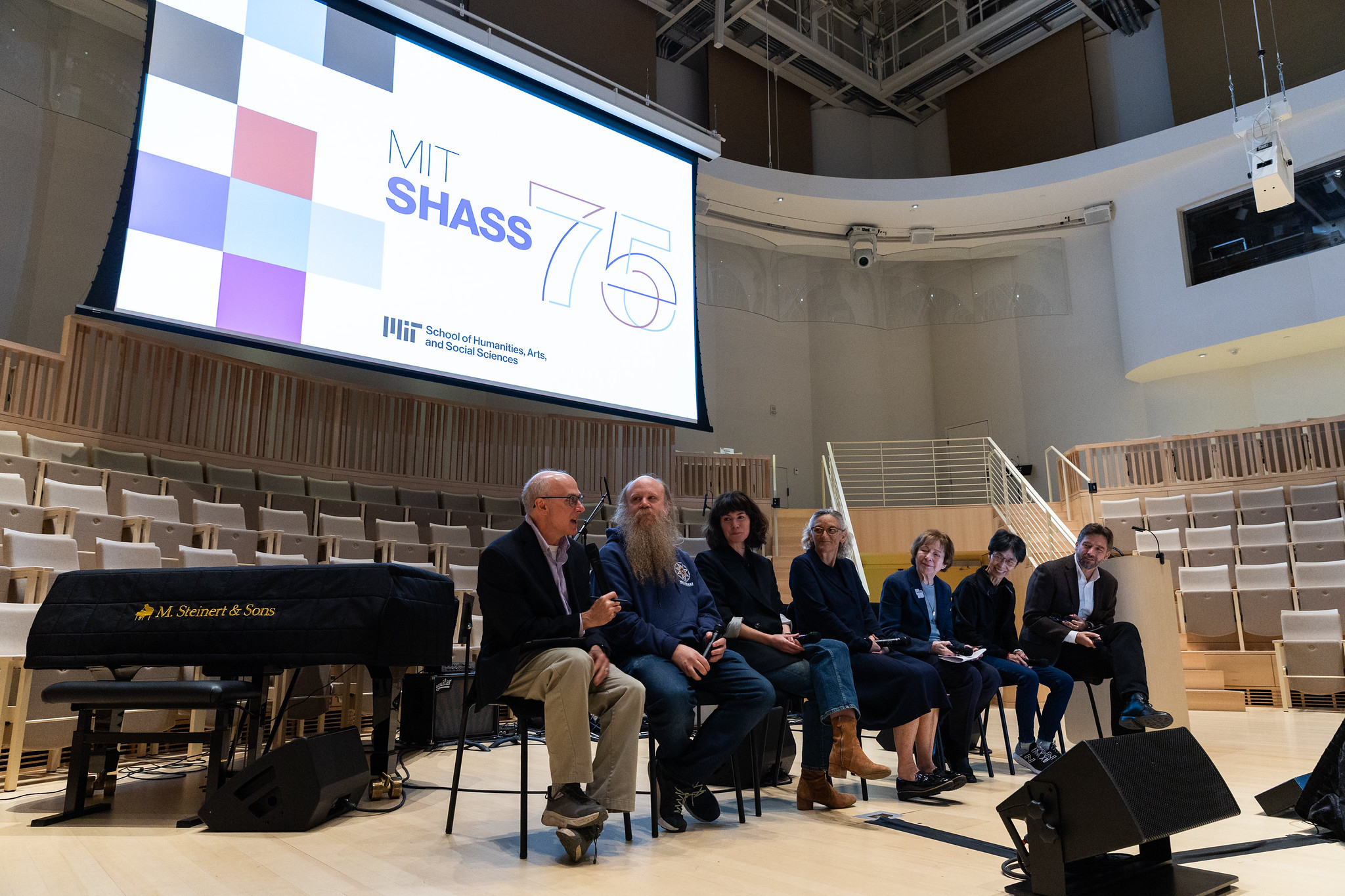
MIT's School of Humanities, Arts, and Social Sciences (SHASS) held its 75th Anniversary Symposium on Sept. 24-25 in the Linde Music Building's Thomas Tull Concert Hall, gathering scholars, students, staff and alumni for two days of talks, panels and performances. The event opened with remarks from MIT leadership and was organized around a double focus: honoring the school's history while examining how artificial intelligence is reshaping teaching, research and society. David Kaiser, Germeshausen Professor of the History of Science and professor of physics, chaired the planning committee and framed the gathering as forward-looking rather than retrospective, describing it as a showcase of current work and of what participants aim to tackle next.
President Sally Kornbluth drew a parallel between the postwar moment that produced the school and the present. SHASS traces its origins to the Lewis Committee Report, commissioned by MIT and published in 1949, which urged closer integration of scientific and technical subjects with humanistic scholarship and teaching. Kornbluth said the world now faces comparable uncertainty over AI's broad implications, remarking that AI has arrived with enormous consequences for research and education, and that MIT needs the school's insight and guidance more than ever.
Provost Anantha Chandrakasan argued for a human-centered approach to technology that weighs both efficacy and impact, and highlighted research emerging through the MIT Human Insight Collaborative, a strategic initiative launched in 2024. He said that technical mastery alone is insufficient for contributing to solutions to global challenges. Chancellor Melissa Nobles, who served as SHASS dean from 2015 to 2021 and is a professor of political science, said student feedback in SHASS course assessments showed how much the school's teaching matters, noting that MIT students hold interests their STEM professors may not see. Dean Agustín Rayo, the Kenan Sahin Dean of SHASS and a professor of philosophy, cautioned against judging the school's research purely by practical application, arguing that education should also help people ask what is worth doing, what we owe one another, and what makes a life worth living.
A first-day session on teaching and learning showcased SHASS programs including the MIT Indigenous Languages Initiative Master's Program, the Master in Data, Economics, and Design of Policy (DEDP), and MISTI, MIT's hub for global experiences. Stephanie Seed, associate professor of literature, described efforts to bring classic books back into coursework, arguing that MIT's future orientation makes reading the past especially important. Eric Klopfer, professor of Comparative Media Studies/Writing and a co-author of MIT's recent report on AI and instruction, said instructors must reassess how courses are taught, suggesting the shift goes beyond curriculum changes to rethinking the educational experience itself.
A computing and society session offered competing perspectives on human-technology relationships. Professor D. Fox Harrell discussed seeing "selfness" in machines, arguing that what makes an AI system is not only code or algorithms but the fact that people narrate it as intentional. Professor Sherry Turkle, of the Program in Science, Technology, and Society, offered a skeptical view, calling AI chatbots "intimate machines" and contending that if social media competed for attention, chatbots now threaten the capacity for attachment, which she called deeper and more troubling. David Autor, head of the Department of Economics, said the pace of change has no close analogy and that the stakes feel very high.
The first day closed with a Music and Theater Arts showcase. It opened with an excerpt from Stan Lai's play "A Dream Like A Dream," directed and performed by students and instructors in class 21T.100 (Theater Arts Production). Dan Safer, senior lecturer and director of dance programs, choreographed "Variations on the Theme of SHASS 75," blending movement, lighting and music. Rambax MIT, the MIT Concert Choir and the MIT All-Star Jazz Combo performed, alongside renditions of "Madrigal," composed by Vice Provost for the Arts Keeril Makan, and "Prayer for Peace."
Alumni took the stage on day two. Jessica Coon PhD '10, now a linguistics professor at McGill University, discussed MIT Linguistics' role in preserving endangered languages and credited her MIT training with preparing her to continue that work, saying SHASS teaches researchers to communicate impact to varied audiences. Ankita Reddy '19, who double-majored in anthropology and biology and is now an MD/PhD student at the University of Pennsylvania, cited 21A.308 (Global Mental Health) as among her most influential courses, saying it forced her to consider how good health care differs across social systems and cultural practices, and that SHASS made her more comfortable with complexity.
The closing session turned to AI, art and the risks facing creatives whose work can be co-opted and copied. Associate professor of literature Sandy Alexandre questioned what it means to be an "upgraded human being" alongside upgraded technology. Philosopher Justin Khoo characterized AI's role in art as a giant paint brush with limited user control, and predicted the emergence of human-only, AI-infused and purely AI art sub-genres. He urged students to take a broad humanistic education seriously, arguing that widely applicable concepts are needed more than ever.
The symposium's framing places AI squarely within a humanities agenda rather than treating it as a purely technical problem. This suggests an institutional bet that questions of attachment, authorship and intentionality will shape how AI products are received, not just how they perform. A likely trade-off for builders is that capability gains may increasingly be judged against cultural and ethical criteria that engineering benchmarks do not capture.
Why it matters: Product and research teams working on conversational agents and generative art tools are the immediate audience, since the critiques raised here — simulated intimacy, unattributed copying, ambiguous authorship — map onto concrete design and policy decisions. If institutions like MIT push human-centered evaluation alongside technical metrics, developers may face expectations to document social impact, not just performance. That is an inference from the stated themes, but it points to where academic guidance on AI is heading.
Based on reporting from the original publisher. Visit the source for full context and later updates.
Publisher excerpt
During the School of Humanities, Arts, and Social Sciences’ 75th Anniversary Symposium, President Sally Kornbluth said “MIT has never needed your particular insight and guidance more than we do now.”