New in AWS Quick: More capable flows, an updated web experience, and agents that work together
AWS announced a set of updates to Quick, its AI workspace for workplace tasks, in a post on the AWS Machine Learning Blog. The release covers four main areas: more capable flows that can be built and refined through conversation, a redesigned web app, multi-agent orchestration, and new data connectors, plus governance controls and additional interface languages. AWS says the features are available today in all Regions where Quick is available.
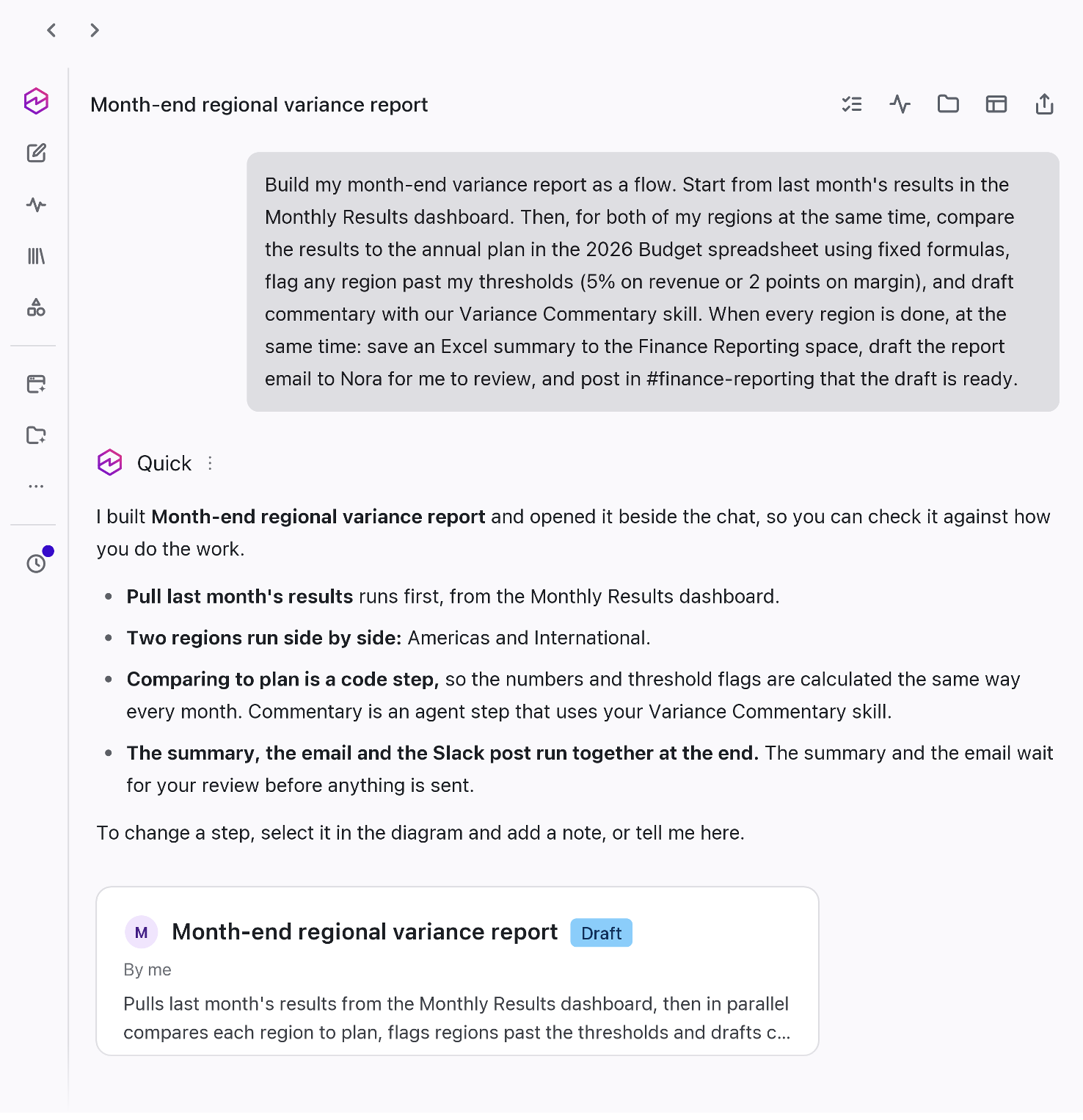
Flows are Quick's mechanism for automating and standardizing business processes. Previously they existed, but the new release lets users build, run and refine them entirely in chat. A user describes a process conversationally, the way they would explain it to a new employee, and Quick generates a flow that orchestrates agents, skills and tools with access to structured data, knowledge and apps. A diagram appears beside the chat showing each step so the user can check it against how they actually work, and tests and refinements happen in the same conversation.
AWS says the new flows add deterministic steps, meaning fixed calculations and checks that produce consistent, verifiable results rather than leaving every step to a model's judgment. This suggests a hybrid design: agents handle drafting and analysis, while defined formulas and thresholds govern the numbers. Such an approach is a common pattern in enterprise automation, because it limits the blast radius of model error on calculations that auditors or finance teams will scrutinize. AWS also says flows now support longer-running workflows and larger data volumes.
The blog walks through a fictional finance example in which a planning and analysis manager at a retailer standardizes a monthly cost-and-margin report. On each run the flow pulls prior-month results from a Quick dashboard, processes multiple regions in parallel, compares each region against an annual plan spreadsheet using set formulas, flags regions that moved beyond thresholds she configures, drafts commentary with a team skill, writes an Excel summary to a shared Space, prepares a report email, and posts a Slack notice. She publishes it, a teammate then runs it from the desktop app using a spreadsheet of regional adjustments stored locally, reviews why regions were flagged, requests changes in chat and approves. A new hire later runs the same flow and gets the same output.
AWS cites Pomelo, a Latin American fintech provider for card issuance, processing and payment operations, as a customer. Rodrigo Marini, Head of Data at Pomelo Fintech Services S.A.S., is quoted saying nearly four times as many people now work with data each month without the team growing, and that a single use case already saves 80 hours of work per month. He describes the change as moving from a few people building solutions for many to an organization where everyone can create and experiment.
The web app has been reworked. The home screen surfaces items needing attention along with a new daily briefing that collects email and messages in priority order; users can ask Quick about an item or have it draft replies for review. A reorganized left navigation groups agents, flows, skills, knowledge and connectors under a Customize section, and includes agents and skills built on desktop as well as those shared by colleagues. Existing dashboards, topics and spaces behave as before with nothing to enable.
Background execution is a notable addition: tasks and longer requests keep running after the browser tab closes, and results plus any agents waiting on input appear in a feature called Mission Control. A Library view collects recent work, favorites, pinned items and files created in Quick. Conversations, agents and files sync across web, desktop and mobile, and the desktop app can reach files stored on the local machine.
Multi-agent orchestration lets one prompt engage several specialized agents simultaneously, each working on the part it knows best, with the originating agent merging their output into a single response that shows what each contributed. Each agent keeps its own instructions, knowledge and context, so the teams that own a domain can maintain its agent. AWS's illustration is a question about rising shipping costs in one region, answered by combining a forecasting agent built on planning data with a procurement agent built on vendor contracts. In practice this is a delegation model rather than a single large agent with broad access, which keeps knowledge boundaries clearer and lets permissions follow team ownership.
Two connectors are new. One links to Meta's ads Model Context Protocol server, letting users create, manage and analyze Meta ad campaigns in natural language and combine that data with first-party and third-party sources. Quick asks for permission before any write action such as creating a campaign or changing a budget. The other connects to Amplitude through its MCP server for questions about product usage, customer behavior and conversion. Connectors honor existing permissions, so each person sees only what they already have access to, and administrators choose which connectors teams may add. MCP is an open protocol for exposing tools and data to AI applications, so connecting through it means Quick is consuming a standard interface rather than a bespoke integration.
Other additions include skills in the web app, where reusable instructions for tasks such as contract review against a checklist or project updates in a company format can be browsed, installed, created and managed as on desktop. Guardrails for prompts are in preview: administrators can filter content, block denied topics and words, detect prompt attacks and protect selected personal-information types in user prompts, test a policy in detect-only mode, then apply it to users, identity provider groups or the whole account. Group-based permissions and limits let administrators assign custom permissions and limit profiles to identity provider groups, for example barring a finance group from creating agents or capping agent hours per member. Administrators can also control which data source types people may create, update or share, such as allowing Amazon Redshift while blocking file uploads. The guardrails, group permissions and data source controls are available to Professional and Enterprise plan subscribers. Quick now supports Japanese, German, Chinese in Simplified and Traditional scripts, and Vietnamese.
Why it matters: Teams evaluating AI workspaces will read this release as a push from individual productivity toward governed, shareable automation, and the group-level permissions, prompt guardrails and permission-respecting connectors are the pieces administrators will scrutinize first. Developers integrating through MCP should note that Quick now consumes third-party MCP servers, which likely lowers the cost of adding further connectors, though write actions gated by user approval may limit fully unattended campaign or budget changes. The deterministic steps and background execution are the features most likely to decide whether flows can be trusted for recurring reporting work, and that is an inference from the described design rather than a stated result.
Based on reporting from the original publisher. Visit the source for full context and later updates.
Publisher excerpt
AWS Quick is the AI workspace built only for work. Today we're releasing updates that help your team get more done: build and run business-process flows in chat, triage your day in the updated web app, get more complete answers from multiple agents at once, and connect new data sources like Meta ads and Amplitude.