Q&A: Rethinking how innovation happens
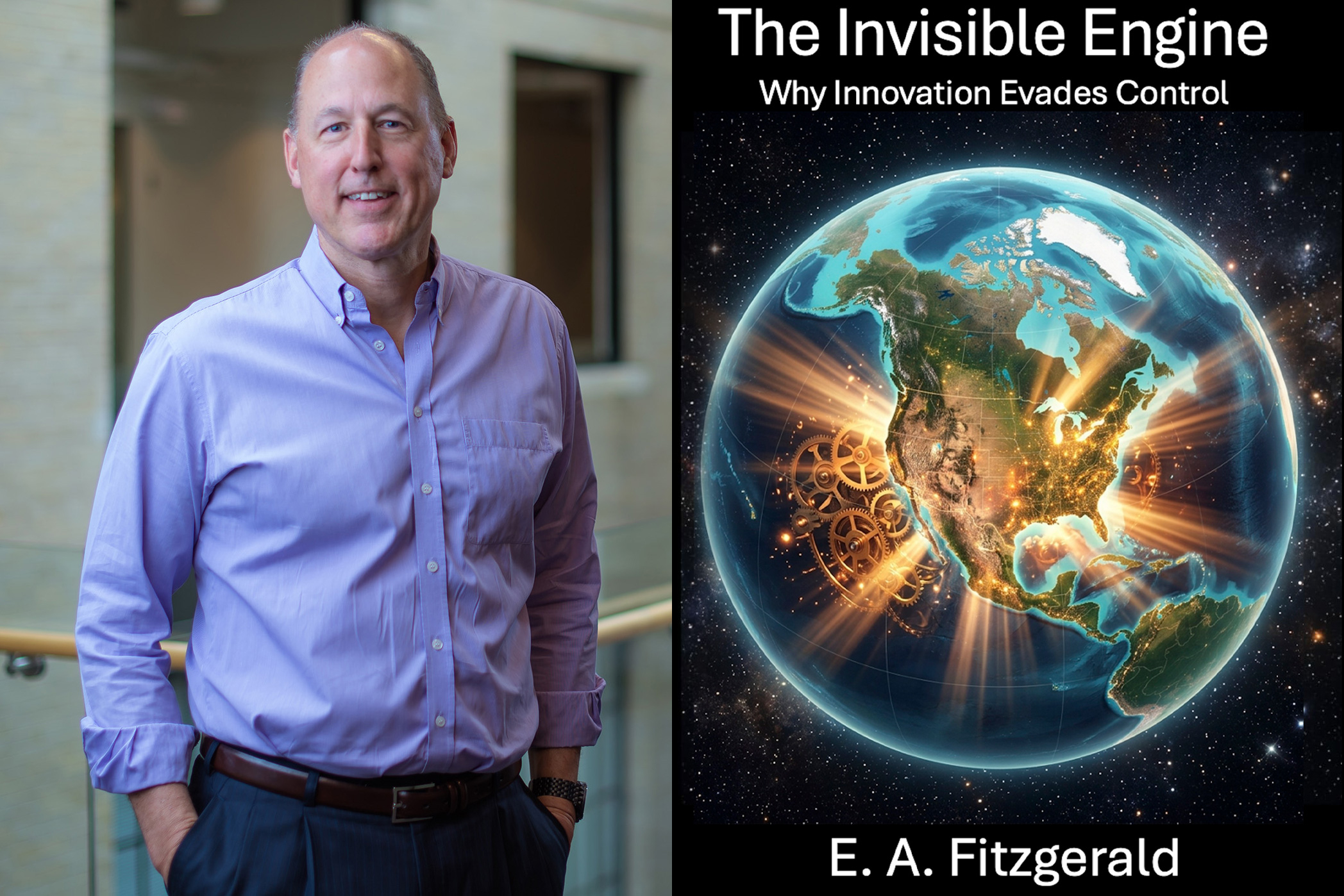
Eugene Fitzgerald, the Merton C. Flemings SMA Professor in MIT's Department of Materials Science and Engineering, has published a new book, "The Invisible Engine: Why Innovation Evades Control," and discussed it in an MIT News interview. The book draws on a decade of work leading international research programs, including the MIT and Masdar Institute Cooperative Program and the MIT-Singapore Alliance for Research and Technology, where he explored innovation as the integration of market applications, technology, and implementation.
Fitzgerald describes the "invisible engine" as a decentralized collective intelligence of different actors — people and companies — that eventually create surprise in the marketplace. He attributes the concept of "surprise" to economist Frank Knight, whose answer to what entrepreneurs do was that they take on uncertainty and earn profit as the first to discover an opportunity.
Discussing his semiconductor experience, Fitzgerald said he and a colleague at AT&T Bell Laboratories in the 1990s found a way to strain silicon in thin-film form with very few defects, which had not been done before. He said the industry later discovered strained silicon was needed to extend Moore's Law, and that he eventually reached a settlement with Intel over a patent dispute. He described the path from Bell Labs to MIT to a startup and then to industry adoption as the innovation process itself.
Fitzgerald argues the biggest misconception is that innovation is about an idea. He identifies three categories of research investment: altruistic science, whose purpose is to produce educated people; strategic research, organized around a goal such as the F-35; and fundamental innovation, which he says involves technology, implementation, and market converging over 10-, 15-, or 20-year horizons. He said the fundamental innovation stream is not purposely being funded.
He wrote the book for individual innovators and students, researchers and faculty, corporate leaders, research funders, and policy-makers. He said involvement in the innovation process makes people T-shaped, with technical depth in one area and broad working knowledge of many, and called for universities and government to target "third places" that bring participants together.
Based on reporting from the original publisher. Visit the source for full context and later updates.
Publisher excerpt
In his latest book, Professor Eugene Fitzgerald examines the forces that turn breakthroughs into value — and why innovation resists simple formulas.