Singer or clanker? YouTube Music will tell you with new gen AI labeling.
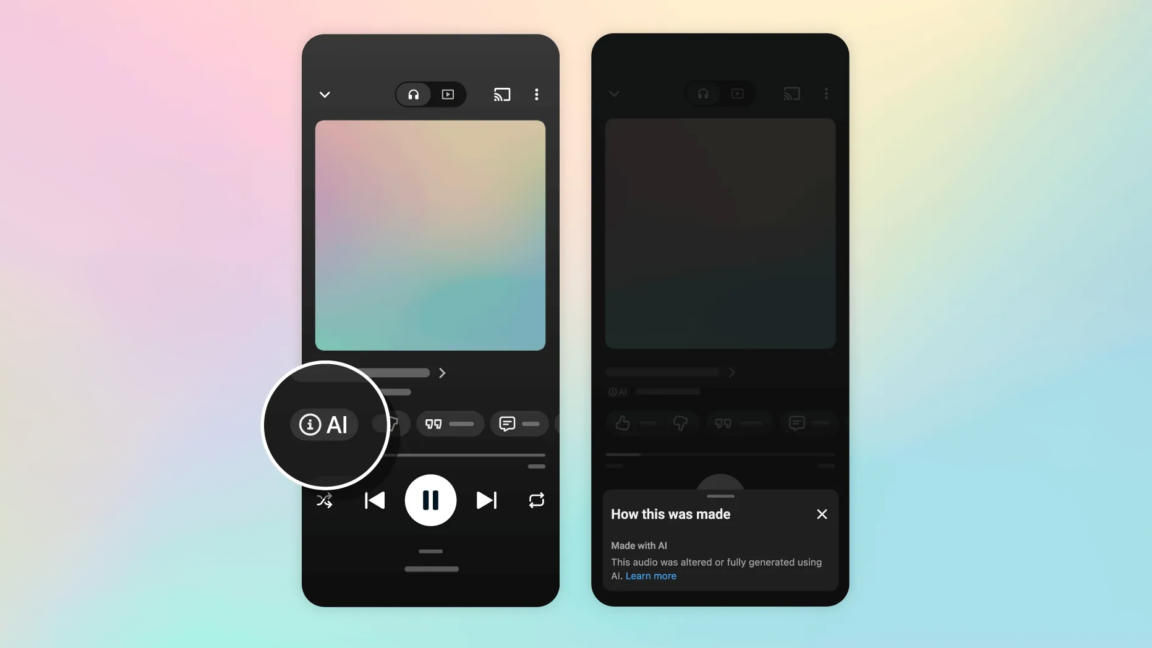
Google has begun rolling out a generative AI label in YouTube Music, appearing in both the mobile app and on the web, the company said in a blog post. The label builds on similar disclosure work Google already applies to AI-generated videos in the main YouTube app, which began earlier this year. The rollout is live now, and Google says AI music uploaded as YouTube videos will receive the same treatment soon.
The label shows up on the player page. Tapping it opens a menu with more information about the track. It applies to songs that were created entirely with generative AI or altered significantly by it. Google is not banning AI music and isn't criticizing it: the company frames generative AI as opening new ways for artists to create, experiment and share music, while acknowledging that listeners want to know whether a song came from generative tools.
A key question is how Google decides a track warrants the label. The approach mirrors the detection setup used for YouTube videos. Google says it works with partners and uses its own detection tools. When publishers upload content, they can indicate how much generative AI was involved, choosing among three tiers: fully generative AI, partially generative AI, or no generative AI. That disclosure is optional, not mandatory.
Detection can also happen without voluntary disclosure. For tracks made with Google's own AI tools, SynthID watermarking can indicate whether something was generated or edited with AI. Google may additionally rely on C2PA metadata, a provenance standard that many other AI music makers use. SynthID embeds a signal directly into generated output, while C2PA attaches signed metadata describing a file's origin and edit history. The two approaches are complementary: watermarking can survive some processing, whereas metadata travels with the file and can be stripped or lost when content is re-encoded, re-uploaded or converted between formats.
Even with those tools, the absence of a label should not be read as proof that a track is the product of human talent. That caveat applies to AI labeling of all content types, not just music. There are simply too many ways to use AI tools, and many leave no identifying mark in the finished file. Uploads that skip the optional disclosure and don't carry a watermark or provenance metadata can pass through unlabeled.
Labeling AI tracks is a step in the right direction, but it may be less useful in music than in video. On YouTube, viewers are typically looking at the screen, so a label is hard to miss. That often isn't true when listening to music. A listener would have to suspect something is off and then check a phone or a background tab to confirm whether what they're hearing is AI-generated. There is also no option to block labeled AI tracks from appearing in playlists.
In practice, this makes the label an informational signal rather than a control. A developer building on Google's platforms, or a product team shipping a music feature, can treat the label and the underlying disclosure tiers as one more provenance input, but should not treat unlabeled audio as verified human-made. A likely trade-off is that optional disclosure keeps friction low for creators while leaving coverage uneven, and the reliance on watermarks and metadata means detection quality varies by which tools produced the track.
Why it matters: listeners on YouTube Music get a visible indicator on the player page, but they cannot filter labeled AI tracks out of playlists, so the label informs rather than blocks. Artists and labels uploading to the platform now face a voluntary choice about declaring generative AI use, and the three tiers give them a way to be explicit. For product and developer teams, the rollout signals that provenance metadata and watermarking are becoming part of mainstream distribution pipelines, with coverage that is useful but incomplete. Treat unlabeled AI tracks as a known gap rather than an assurance of human authorship.
Based on reporting from the original publisher. Visit the source for full context and later updates.
Publisher excerpt
The AI music labels are rolling out now in YouTube Music and will come to YouTube soon.