PolyAI Dialog-RSN-1 is now on Amazon SageMaker JumpStart
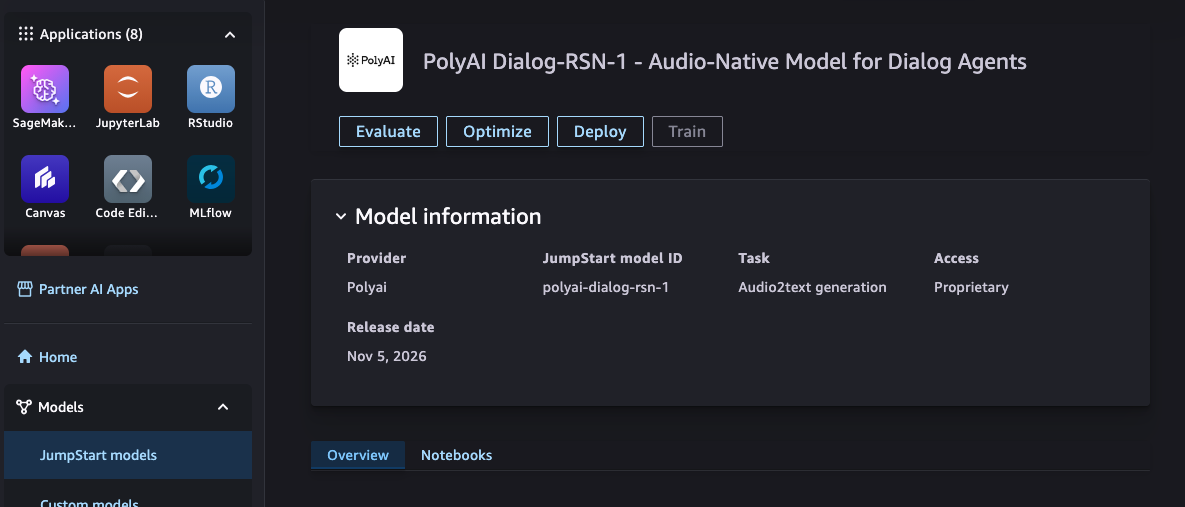
PolyAI's Dialog-RSN-1, a reasoning model built for real-time complex dialog, is now listed on AWS Marketplace and Amazon SageMaker JumpStart, AWS and PolyAI announced. It is the first PolyAI model offered through AWS Marketplace. Customers can subscribe through the marketplace and run the model as a SageMaker endpoint inside their own AWS environment, or launch it from the SageMaker JumpStart catalog in the Amazon SageMaker AI console.
The deployment model is the headline for platform teams. Inference happens inside the customer's account boundary: the endpoint sits in the customer's VPC, is reached through their IAM roles, and is logged and measured through their existing Amazon CloudWatch setup. Billing flows through the AWS account. PolyAI keeps responsibility for the model itself, while the customer retains orchestration, telephony integration and business logic. This suggests the intended buyer is a contact-center or voice-agent team that already runs workloads on AWS and wants call audio to stay in an environment it governs, which matters for data residency and auditability requirements.
On the interface side, the endpoint speaks the OpenAI Realtime protocol. An existing Realtime client can connect through PolyAI's bridge by changing its base URL rather than rewriting integration code. Audio input is 16-bit PCM mono at either 16 kHz or 24 kHz, so G.711 or Opus streams from telephony need transcoding first. Connections are capped at 30 minutes, and the model is English-only for now. Those are the constraints to design around: long calls will need session handoff or reconnection logic, and non-English deployments are not yet possible.
The architectural bet is that Dialog-RSN-1 works directly on the caller's audio in a single pass, with no separate speech-to-text stage feeding a reasoning model. That removes handoffs between components. PolyAI argues three practical consequences follow: barge-in keeps functioning under call-volume spikes instead of being disabled to protect performance; responses keep pace with the conversation rather than lagging while the model reasons; and transcripts are generated from the audio itself. The company says the model is already handling live calls in production, though the announcement does not give customer names, call volumes or benchmark figures.
JumpStart adds a one-click path. From the Model Hub in the SageMaker AI console, a user selects Dialog-RSN-1 from the catalog and chooses Deploy; JumpStart stands up a real-time inference endpoint on a serving stack it has pre-tuned, so there is no container selection or instance sizing to do by hand. The same deployment can be scripted in a few lines of the SageMaker Python SDK, which makes it wireable into CI/CD pipelines. A sample notebook streams recorded caller audio and prints turn decisions, replies and transcripts, letting a team test on its own calls before committing to infrastructure spend.
Before deploying, users pick an optimization profile rather than tuning infrastructure directly. Latency optimized minimizes Time to First Token for interactive calls; throughput optimized maximizes tokens per second for high volume; cost optimized minimizes infrastructure cost per request; balanced splits the difference. JumpStart also surfaces P50 latency, Time to First Token and throughput estimates up front so the ml.* instance can be right-sized without manual benchmarking. For a voice agent, Time to First Token is close to the whole product experience, so the latency profile is the likely default; the trade-off is that the other profiles buy cost or volume at the expense of responsiveness.
The framing of a speed-versus-understanding trade-off is familiar in voice AI. Conventional stacks chain speech recognition, a language model and speech synthesis, and each hop adds latency; the end-to-end speech-native approach, popularized by models such as OpenAI's Realtime API, collapses those hops but gives up some modularity and observability. With Dialog-RSN-1, transcription is an output of the model rather than an independent service, so teams lose the ability to swap in a specialized recognizer or inspect an intermediate transcript stream in the usual way. That is a plausible trade-off to weigh against the latency and tone-awareness gains PolyAI describes.
Why it matters: teams building voice agents on AWS can now procure a real-time dialog model through their existing marketplace account and run it inside their own VPC without managing serving infrastructure. The OpenAI Realtime-compatible interface lowers switching cost for anyone already building on that protocol, and the 30-minute connection cap and English-only support are the immediate limits to plan around. The larger shift, by inference, is that frontier voice models are becoming consumable like other cloud services, with governance and billing handled by the platform team rather than a separate vendor contract.
Based on reporting from the original publisher. Visit the source for full context and later updates.
Publisher excerpt
PolyAI Dialog-RSN-1, a reasoning model built for real-time complex dialog, is available today on AWS Marketplace and Amazon SageMaker JumpStart. Discover it, evaluate it on your own data, and deploy it to a secure SageMaker endpoint in your own AWS account.