AI Ambition: ArtCraft Cloned Photoshop and Now Wants to "Rebuild Everything"
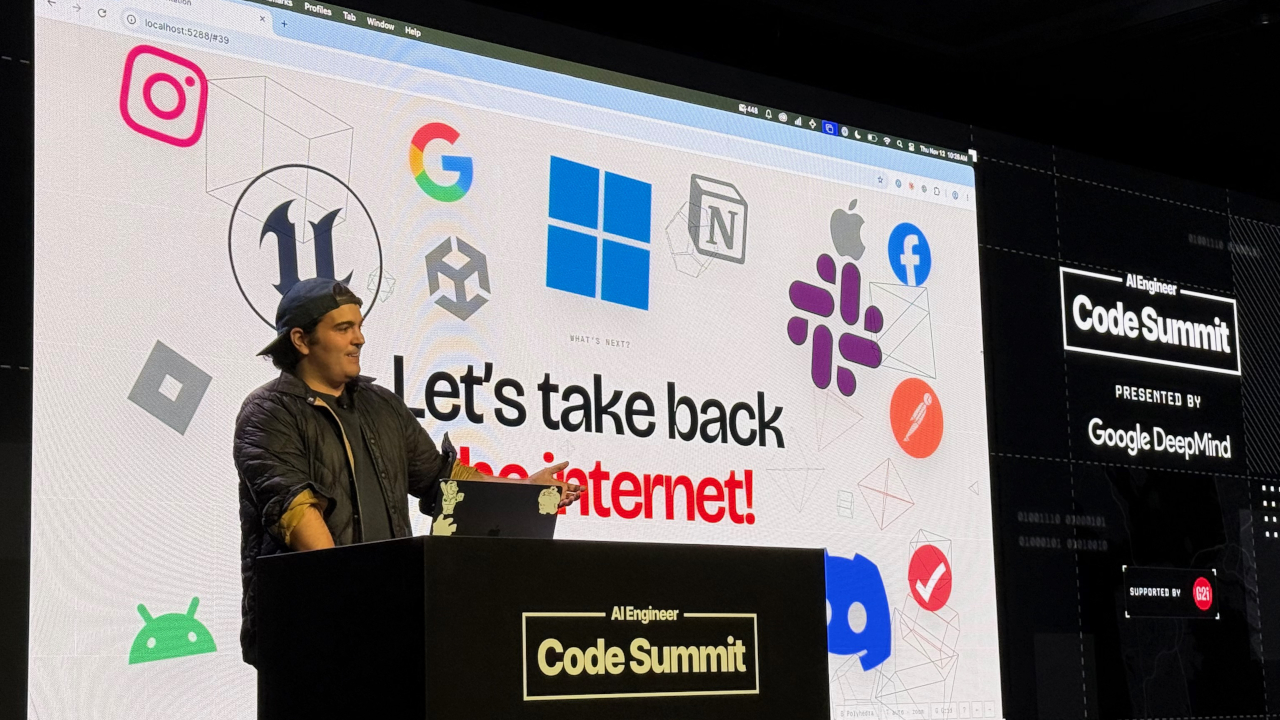
ArtCraft founder and CEO Brandon Thomas used his day-two talk at the AI Engineer Code Summit in San Francisco to present what amounts to a manifesto for AI-assisted open source software. The fledgling company has so far released 17 open source versions of well-known tools, beginning with PhotoCraft, a Photoshop alternative written from scratch in Rust. Thomas told the audience the company had also cloned Adobe Acrobat as PdfCraft, a line that drew applause. During the presentation, held in the morning, he closed with calls to take back the internet and rebuild everything, which were met with cheers from the room.
Thomas framed the project as a response to how the web changed after Web 2.0. He described the early internet as a place where users could build freely, citing IRC as an example of chat software people could run on their own servers, and Flash as a tool that let young people make animations. In his account, broadband and smartphones brought everyone online but narrowed the freedom to build on leading applications, as APIs were withdrawn and distribution came to be controlled by large providers. He also described being charged an unexpected fee after cancelling a monthly Adobe plan, and argued the web had become an extractive, owned and rent-seeking environment. That experience, he said, motivated ArtCraft's founding ethos of building everything as open source, a message he claims even people skeptical of AI have embraced.
The product lineup mixes clones of Adobe applications with a Figma clone, a Microsoft-style word processor called WordCraft, and community projects such as SolidCraft, a CAD tool distributed through ArtCraft's launcher. Thomas stressed that the applications are fully open, including not just the desktop software but the underlying infrastructure. The near-term strategy is to reproduce familiar tools closely enough to preserve what he called the muscle memory of artists who use Adobe, matching its interface and look and feel directly. Only after reaching that parity does ArtCraft intend to build new applications with interfaces designed around agents.
PhotoCraft's construction was itself an AI exercise. The team gave a model a detailed prompt describing Photoshop's tools, data structures and file importers, then followed with a much larger prompt instructing it to build out the application. The work was made MCP and CLI compatible along the way. Within 24 hours, according to Thomas, the result was a reasonably close approximation of Photoshop. MCP, the Model Context Protocol, is a widely adopted way for AI models to call external tools and data sources; making the app compatible means an agent can drive it programmatically rather than only through a GUI. CLI support points in the same direction. This suggests ArtCraft is designing for a workflow where much of the editing is scripted or agent-driven, not mouse-driven.
Parity is still incomplete. Thomas said PhotoCraft has just passed 60% and that the internal goal is to get as close to 100% as possible. The project's GitHub page puts feature breadth at roughly 76% and professional readiness at about 46%, a reminder that a demo that impresses in 24 hours and a tool that survives professional production work are different milestones. The gap between feature coverage and readiness is the interesting number here: breadth can be generated quickly, while reliability, color accuracy, file-format edge cases and performance under large documents tend to take longer and are harder to prompt into existence.
The reception has been larger than the company expected. Thomas said the New York Times requested an interview, the open source community has grown to about 4,000 developers, and the apps are being downloaded at roughly 1.7 million per day, a rate he described as still accelerating. Beyond the 17 official apps, around 300 are in development by the community. He attributed the response to people feeling mistreated by Adobe and other technology companies.
Rust, Thomas argued, was central to the products' performance. He claimed PhotoCraft opens ten times faster than Photoshop and said that while others have built similar tools in Electron, high-quality creative applications need something native. Rust is a systems language known for memory safety without a garbage collector, which makes it a plausible choice for a responsive desktop editor, though it raises the bar for contributors used to JavaScript or Python. Thomas downplayed that barrier, saying engineers do not need to know Rust to work with it because agents can drive the language fine.
The build process has had friction. Thomas listed problems with permissions, GitHub, scaling and continuous integration, saying CI was falling over and the team had begun spinning up its own infrastructure and found a good source of RAM on co-located servers. The team has settled on a division of labor: humans handle backend work and anything requiring schema migrations or API design, while agents are pointed at desktop apps, games and other largely immutable targets with full confidence. ArtCraft also plans to open source AutoCraft, which Thomas described as a completely autonomous software factory.
The closing pitch went beyond individual apps. Thomas said the company can open source the entire world and urged the audience to own its apps, infrastructure, protocols and models. If download growth continues, the comparison to Linux-scale impact is one observers are already making. A more grounded reading is that the human contributor community, not the agent-generated code, is the durable asset: agents can produce a first draft of an editor quickly, but maintaining 300 community projects and closing the readiness gap requires review, testing and governance that agents do not supply on their own.
Why it matters: Developers building creative or productivity tools now have a concrete example of an agent-first build pipeline, including a claimed 24-hour path to a working Photoshop approximation and a split between human-owned backend work and agent-owned application code. Product teams should watch whether parity and professional-readiness numbers converge, since that determines whether these clones become credible replacements or remain demos. If ArtCraft's download rate holds, it is reasonable to infer that expectations for native performance, CLI and MCP access in desktop creative software will rise.
Based on reporting from the original publisher. Visit the source for full context and later updates.
Publisher excerpt
ArtCraft used AI to rewrite Photoshop as open source software. For CEO Brandon Thomas, the vision is even bigger: to take back the internet!