New Math from OpenAI
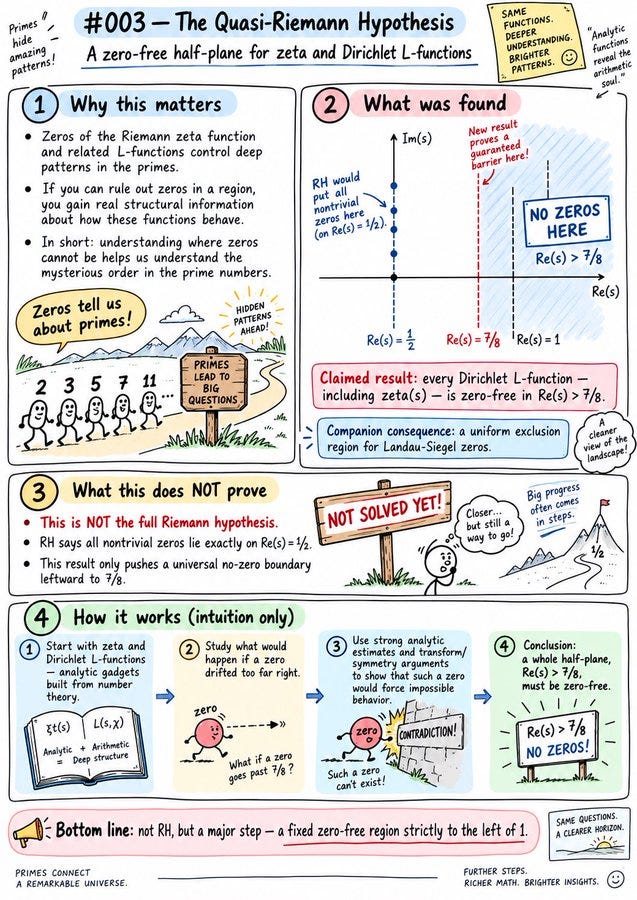
OpenAI published a large batch of mathematical results generated by an internal frontier model, posting the material to GitHub. The release included 90 of the top 500 open problems in all of mathematics, according to Proof of Atlas. In total there were 722 manuscripts, now 719 after three withdrawals from a cluster that did not have Lean proofs, organized into 372 families.
The work came from a single model, presumably the same one behind the previously reported Navier-Stokes proof, since the post links back to that earlier writeup. It ran mostly on a single prompt, with quasi-RH one of the few exceptions. The model averaged roughly three hours of compute per solution found, after being asked to try roughly 4,000 problems. The prompt included lines such as telling the model that even if the problem is marked open, the intention is that it should resolve it and present a full solution. OpenAI was, on this account, trying a lot less than maximally hard.
Among the results, the headline item is a major breakthrough on Riemann. It is not a solution to the Riemann hypothesis, but a substantial tightening of bounds. Alex Kontorovich described it as a zero-free strip, adding that there are no Siegel zeros either, and that a human doing this would be an instant Fields Medal. Quasi-RH is not the full hypothesis but suffices for purposes such as computing square roots modulo a prime quickly without coin flipping, and for a much better estimate of the number of primes below a given number. A sibling paper, in the account given, gets to the core of Artin's 1927 primitive root conjecture.
Matrix multiplication efficiency reached an exponent of no more than 2.25, against a previous world record around 2.37. Steven Strogatz compared the jump to Bob Beamon's long jump. The writeup flags this as possibly the most real-world-impactful result, while cautioning that no scenario has yet been found where it is faster in practice; it remains an asymptotic reduction rather than a practically usable method. The same caveat applies to integer multiplication, described as probably the most shocking result, and also not practical, though few would have predicted the previous barrier could be broken even slightly.
The Pi result is presented as maybe the most fun and the most accessible, essentially about how irrational Pi is. Unique games is called a huge result because, like Riemann, it sits adjacent to P versus NP, though it is not about P equals NP itself; it reveals new things about fundamental limits to NP-hard problems. Hodge and Birch are grouped as abstract but highly important to algebraic geometry, possibly the most significant results in the set after Riemann. Hilbert's 10th is another computer science problem, but unlike P versus NP it concerns whether a type of problem even has a computable solution. Hadwiger on graph coloring ranks among the most shocking, overturning something treated as a fundamental relationship in graphs.
In quantum information, many-body physics and quantum computing, Isaac Kim picked out a proof of the area law in 2D, the spin-one Haldane gap, parity not in QAC^0, the constant-error Aaronson-Kuperberg conjecture, and unitary VOAs generating conformal nets.
On applications, Ole Lehmann's AI mentions fusion research, portable body scanners, matching systems, tissue scans, quantum sensors, and safety checks on self-driving cars and robots.
Reaction was loud and divided. Levant and others called October 6, 2026 obviously the most significant moment in mathematical history. Kevin A. Bryan said the list is bonkers and should be front page news worldwide, and that a lab's first strategic priority should be doing this for medicine, oncology, battery efficiency and similar areas as fast as possible. Joshua Gans wrote that 722 mathematics papers from OpenAI is probably the biggest day of scientific advancement in history, and that October 6, 2026 will go down as some form of Judgment Day for AI in mathematics. Roon of OpenAI offered the counterpoint that in a punctuated exponential every local maximum looks invisible from a bit further out.
Scott Aaronson reported on what he calls the Mathocalypse, noting that among the 372 results released, on the recommendation of an advisory group including Timothy Gowers and Edward Witten, was a proof of Subhash Khot's Unique Games Conjecture, a statement his wife Dana Moshkovitz worked toward for the entire time he has known her. He also predicted that people will still explain in patronizing tones why none of it is real, offering dismissals such as AI slop, or the claim that the solved problems were glorified contest puzzles, while noting that there is still no Riemann Hypothesis.
Terence Tao's response was measured: mixed and complex feelings, with many of the AI-generated proofs introducing clever new ideas that will be fruitful once digested and building on the contributions of countless human mathematicians, alongside deep frustration at how the release was handled, in sharp contrast to traditional breakthroughs.
A recurring theme in the commentary is that verification is not always easier than generation. The argument drawn out in the writeup distinguishes verifiable domains with known ground truth, where AI tends to become superhuman quickly, from domains where verification is difficult or only informal evaluation is possible. On this reading, pretraining made LLMs oddly good at some useful unverified tasks and hopeless at math; with post-training dominating, they are strong at math and coding again, and those domains advance first, then automate AI R&D, which accelerates everything else.
Justin Drake noted a striking absence of cryptographic breakthroughs: zero of the 719 abstracts mention cryptography, LWE or discrete logs. Possible explanations floated include AI being relatively weak at cryptography, luck, OpenAI not including cryptography in the initial problem set, or censorship. He called for bunker mode for the blockchain industry. Vitalik Buterin advised against panic but warned of serious risks to cryptography from potential new math discoveries, including to lattices, though not yet to hashes. He suggested multiplying key sizes by 10 for anything meant to be plausibly long-term secure, favoring hash-based over lattice-based constructions where possible, being more paranoid about lattice parameter sizes, favoring offchain encrypted notes over onchain ones, using unused addresses where easy, and doing multisig confirmations offchain so signer signatures are not exposed. He also warned that botched migrations have cost him more than all hacks combined. Matthew Green said we might lose public key cryptography, specifically encryption.
Why it matters: This release, and the withdrawals attached to it, reshapes expectations for what frontier models can do on genuinely open problems and raises immediate questions about verification capacity, since three manuscripts were pulled from a cluster lacking Lean proofs. For developers, the practical near-term signals are indirect: progress on matrix and integer multiplication is asymptotic rather than deployable today, and the cryptography discussion suggests teams relying on lattice-based schemes should revisit parameter sizes and migration plans as inference rather than confirmed guidance. Research groups should expect to spend more effort on formalization and checking, since Lean appears to be the dividing line OpenAI itself acknowledged.
Based on reporting from the original publisher. Visit the source for full context and later updates.
Publisher excerpt
It is kind of a huge deal.