Introducing Reflection Beam: an open-weight model for agentic coding on AWS
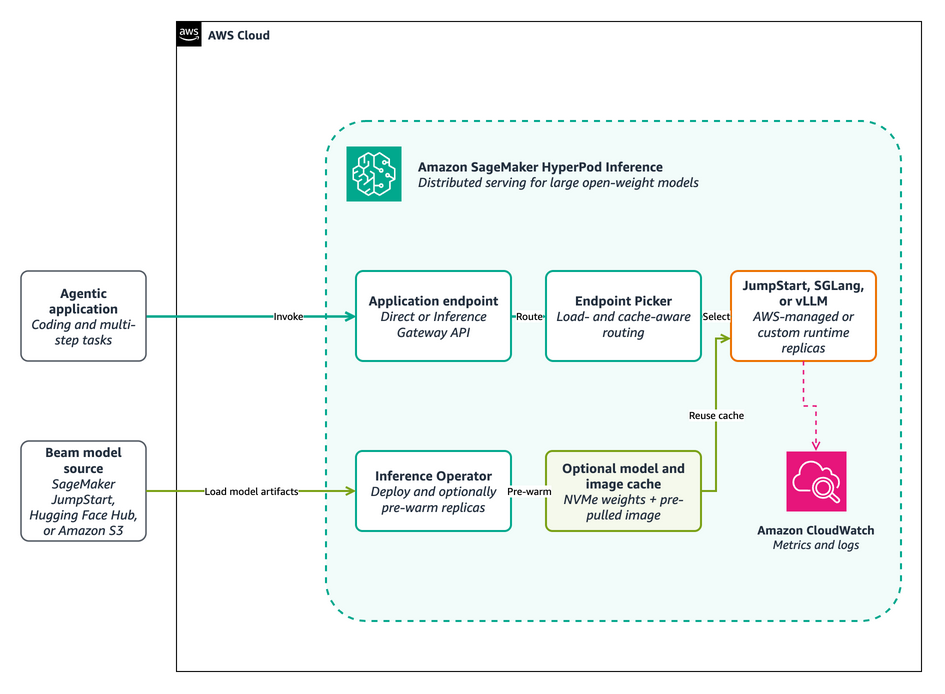
Reflection AI has introduced Beam, an open-weight model built for agentic coding and long-horizon tasks such as maintaining code, using tools, interpreting intermediate results, and completing multi-step workflows. The weights are released on Hugging Face under the Apache 2.0 license. At launch, Amazon Web Services makes Beam available through Amazon SageMaker JumpStart in the US East (N. Virginia) and US East (Ohio) regions, and the AWS Machine Learning Blog published a deployment walkthrough covering both a managed endpoint path and a Kubernetes-based path.
Beam is a sparse mixture-of-experts model. It carries 501 billion total parameters but only 23 billion active parameters per token, and Reflection reports an effective context length of 1 million tokens. The gap between those two numbers is the defining characteristic of the architecture: a routing mechanism selects a small subset of experts for each token, so per-token compute tracks the active parameter count while total weight memory tracks the full parameter count. In practice this separates two sizing problems — how much GPU memory is needed to hold the weights, and how much compute each request consumes.
Reflection ships Beam 1.0 in three checkpoint variants: BF16, FP8, and NVFP4. These differ in memory footprint and hardware compatibility. BF16 carries the largest weight-memory requirement and generally needs a multi-node configuration with enough aggregate GPU memory for both weights and runtime overhead. FP8 targets NVIDIA H100 GPUs on ml.p5.48xlarge, or H200 GPUs on ml.p5e.48xlarge and ml.p5en.48xlarge. NVFP4 targets NVIDIA B200 GPUs on ml.p6-b200.48xlarge.
There are two main serving paths on AWS. The first is a SageMaker JumpStart real-time endpoint, which packages the model, container, and invocation API behind a managed deployment workflow without requiring the operator to run Kubernetes. The second is SageMaker HyperPod Inference, which exposes the cluster and serving runtime for control over distributed execution, caching, routing, and scaling; HyperPod clusters are orchestrated by Amazon EKS. Within the HyperPod path, deployment can use the AWS-managed JumpStart container and model configuration, or a custom SGLang or vLLM runtime when the team needs control over the serving image, runtime arguments, quantization, or parallelism.
Model sourcing is flexible: Beam can be pulled through SageMaker JumpStart, from Hugging Face Hub, or from an optional Amazon S3 mirror. For production deployments and model caching, the walkthrough recommends copying the checkpoint to Amazon S3 or Amazon FSx rather than pulling it at deploy time.
Prerequisites for either path include an AWS account with permissions for the chosen SageMaker deployment path plus supporting IAM, networking, and storage resources; access to Beam through JumpStart or a Beam 1.0 checkpoint repository on Hugging Face; acceptance of the model terms; the AWS CLI; Python 3.11 or later; and GPU quota and capacity for a supported configuration.
The fastest route is the JumpStart real-time endpoint. AWS published a sample repository at github.com/aws-samples/sagemaker-genai-hosting-examples with a variant-aware command that supports all three model IDs. The bounded lifecycle script deploys a variant, sends a short request, prints the response, and tears the endpoint down. The variant flag accepts bf16, fp8, or nvfp4; NVFP4 is the default when the flag is omitted.
For Kubernetes-native control, the HyperPod path requires kubectl access to an EKS-orchestrated HyperPod cluster running the HyperPod Inference Operator and required add-ons, plus the cluster VPC, subnets, security groups, access to the selected Beam and runtime artifacts, and local NVMe capacity if model caching is enabled. A pinned Beam revision from Hugging Face Hub is suggested for development and experimentation. HyperPod model and image caching can preload weights onto node-local NVMe storage and pre-pull the serving image. The HyperPod Inference Gateway presents an OpenAI-compatible interface and routes requests across replicas, and HyperPod Inference also supports managed tiered KV caching and intelligent routing — capabilities AWS lists among its 2026 SageMaker Inference launches.
Deployment through JumpStart on HyperPod can be done from the SageMaker Studio model catalog by selecting Beam under All public models, choosing SageMaker HyperPod as the target, selecting the cluster and Kubernetes namespace, entering an endpoint name, and deploying. For infrastructure-as-code workflows, AWS provides a manifest template and a helper tool that validates configuration, renders and applies the JumpStartModel resource, and waits with a configurable timeout. The helper is designed not to write populated release values to disk. SGLang and vLLM deployments follow the same shape with their own manifest templates and a runtime argument that switches between the two.
Invocation differs by path. JumpStart endpoints use the released model request schema, while SGLang and vLLM deployments can be exercised with a bounded smoke test that selects a ready worker, opens a temporary port-forward, checks endpoint health, sends a request, and closes the port-forward. The walkthrough suggests starting sampling settings of temperature 1.0 and top-p 0.7 for that smoke test.
On performance, the guidance is to test each serving path with repeated, representative coding and tool-use requests at expected concurrency, and to record the model version, image digest, instance type, precision, context length, parallelism, serving arguments, cache state, and test repetitions so results are reproducible. Recommended metrics include request success rate, p50 and p95 time to first token, time per output token, end-to-end latency, and aggregate output tokens per second. Batch size, KV cache allocation, replica count, autoscaling, and caching should then be tuned from those measurements. Reflection's effective context length claim of 1 million tokens is a notable figure, but long context has a direct cost: KV cache scales with context length and concurrency, so context sizing and replica sizing compete for the same GPU memory budget. That trade-off, rather than raw parameter count, is likely to dominate capacity planning for anyone running Beam at scale. Output quality should be rechecked whenever precision or quantization changes, since the NVFP4 and FP8 variants are not numerically identical to BF16. AWS also advises deleting resources after testing — endpoints, dedicated HyperPod or EKS clusters, cached weights, mirrored artifacts, load balancers, log groups, temporary IAM roles, and captured inference data — to avoid ongoing charges.
The availability picture at launch is limited: two US East regions through SageMaker JumpStart. Teams needing other regions would need to plan for the HyperPod or self-managed paths, and would need GPU capacity of the H100, H200, or B200 class that the released checkpoints target. It is also worth noting that Beam is one of several recent open-weight coding models positioned for agentic workloads; what distinguishes this release is not just the weights but the pairing with AWS managed deployment options, which lowers the operational barrier for teams already on SageMaker.
Why it matters: teams building coding agents now have an Apache 2.0 licensed model with open weights, three precision formats, and two supported AWS serving paths, so the deployment decision shifts from whether the model can be hosted to which trade-off between operational simplicity and runtime control fits the workload. Developers already on SageMaker can reach a managed endpoint quickly, while those needing custom quantization or distributed execution retain the SGLang and vLLM routes on HyperPod. The main practical constraint at launch is regional and hardware availability, and any team planning production use should validate memory, latency, and output quality with its own workload before committing capacity, since inference about real-world performance cannot be drawn from parameter counts alone.
Based on reporting from the original publisher. Visit the source for full context and later updates.
Publisher excerpt
Reflection AI's Beam is an open-weight model for agentic coding and long-horizon tasks. This post shows how to deploy Beam on AWS: start with an Amazon SageMaker JumpStart real-time endpoint, or use Amazon SageMaker HyperPod Inference with JumpStart, SGLang, or vLLM for Kubernetes-native control over distributed GPU infrastructure.