Looking beyond natural sequences
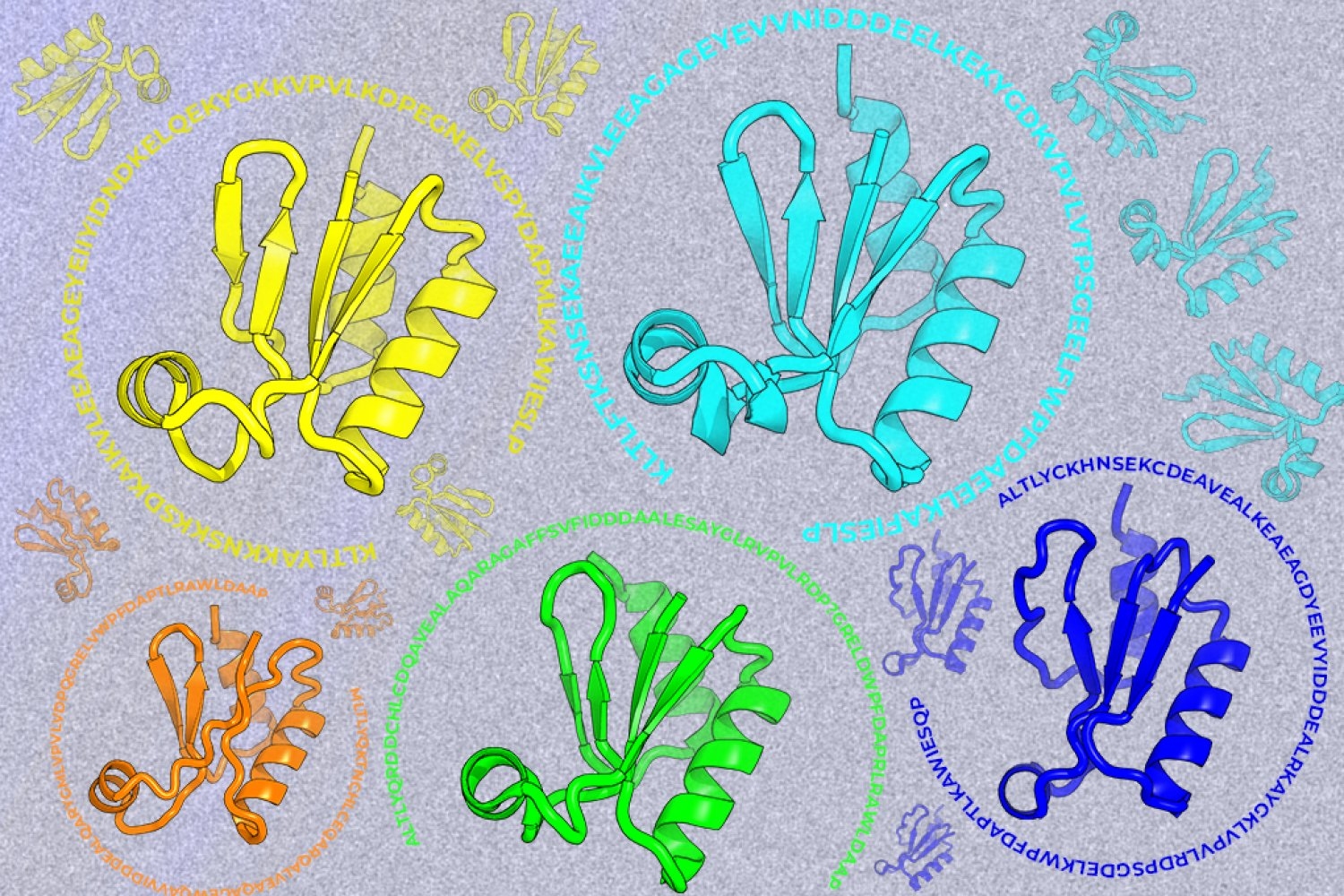
Researchers in MIT's Department of Biology have developed a machine-learning framework called PottsMPNN that incorporates the physical principles governing protein structure and stability, according to a paper recently published in PNAS. The work was led by graduate student Foster Birnbaum, with Amy E. Keating, head of the Department of Biology and Jay A. Stein (1968) Professor of Biology and professor of biological engineering, as senior author.
Many methods for designing novel proteins follow a two-step process: a structure is specified first, and a machine-learning framework then generates sequences that could potentially adopt it. The new framework is reported to improve sequence generation and the ability to predict how mutations affect a protein's stability, giving the model a better understanding of the sequence-energy landscape, meaning the relationship between the identity of each amino acid and the stability of the protein.
Keating said the field has for years measured success by asking whether a model can reproduce the protein sequence that evolution happened to select, and that the work shows this is not the best metric for protein design. Birnbaum said that for a completely novel designed structure there would be no native sequence to compare it to, and that what matters is how likely generated sequences are to fold into desired structures, how well the model understands the sequence-energy landscape, and how well it predicts mutation effects on stability.
According to the researchers, PottsMPNN uses a pairwise distribution to capture interactions between amino acids, accounting for physical interactions between all 20 possible sequence options at a pair of positions in the protein. Birnbaum also described adding variations, or noise, to a protein structure during training, which decreases the tendency of the model to overly mimic native sequences and increases the diversity of structures for which it can generate sequences. Sets of evolutionarily related sequences were also introduced into training. Birnbaum acknowledged that incorporating evolutionary information is in some ways still a reliance on native sequences, but said PottsMPNN demonstrated that as the model depends less on native sequences, structural compatibility and energy prediction, including for novel proteins, improve.
Birnbaum said the model could be further improved and fine-tuned for a specific task, which has in the past led to better predictions, for example, on the outcome or consequence of a particular mutation. Keating said the methods move the field toward designing useful new-to-nature proteins for diverse applications while providing a stronger foundation for future advances.
Based on reporting from the original publisher. Visit the source for full context and later updates.
Publisher excerpt
A new machine-learning framework aims to improve the success rate of computational protein design while moving away from results that reproduce sequences found in nature.