How I built this
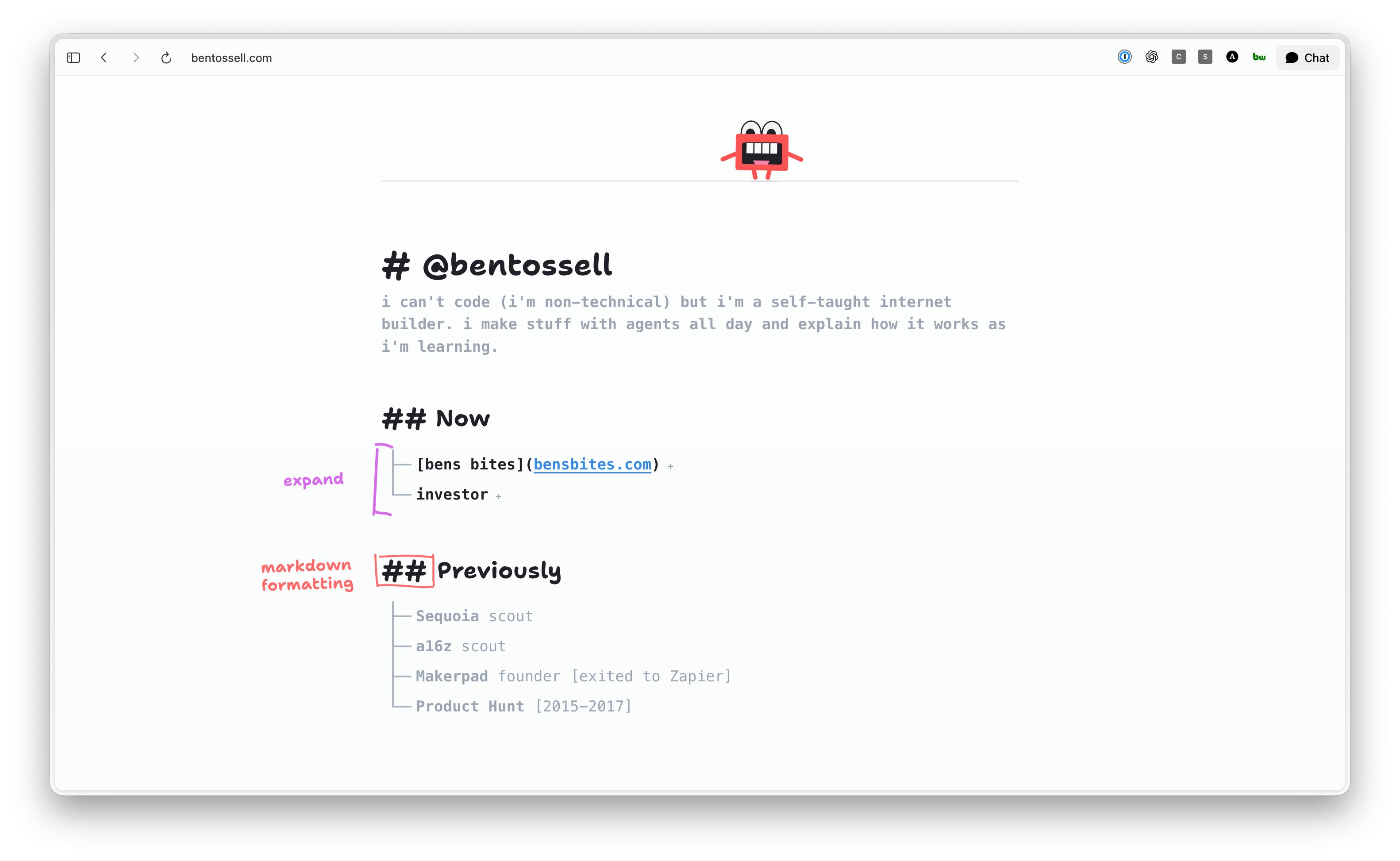
Ben Tossell, writing for Ben's Bites in a post dated to a long weekend, described rebuilding his personal website with AI coding agents. The project went through two main design directions: an initial "agent app" interface and a later, simpler canvas-style layout that he ultimately deployed to bentossell.com.
The first concept made the site resemble an agent application, with a left sidebar of threads, a central chat interface, suggested prompts, and a right sidebar. Tossell gave Codex an image of the Ben's Bites app and asked it to build a prototype. The rough shape was there, but many design quirks needed fixing. His AGENTS.md file included an instruction to always create three design versions he could flick through, which in this case produced mostly themes. He took a screenshot of the best option, annotated it in tldraw, and sent it back to Codex with a short instruction to implement the changes. This screenshot-and-annotate loop dominated the session. Tossell observed that Claude models seemed better at inferring intent from design work, while GPT models were more rigid and required more specific feedback.
He also tried a design-review skill created by designer Emil Kowalski. Tossell generally dislikes agents invoking skills unless explicitly asked, so he disables that behavior on all his skills with an instruction to make skills user-invokable only. After a few more back-and-forth tweaks, the agent-interface version reached a decent state.
Next, Tossell wanted each thread's content to come from its own Markdown file so he could edit content easily. He intended everything to live in ~/repos/bentossell, but forgot he already had a project for his current site. The agent found the existing project and started building a new version around it, whereas Tossell wanted a replacement. He then moved to mobile and wanted the site deployed to a URL he could visit. He uses here.now for quick builds that don't involve complex data flow or databases, and he is an investor in the company. The service works by giving an agent instructions; it installs a skill and publishes sites, with paid accounts available for persistent URLs and custom domains.
Tossell explained that localhost is only available on the builder's computer, while deploying hosts a copy on a server with a public address. His site is static, meaning everything shown is in the files, as opposed to dynamic sites that pull from APIs or databases.
Scope creep set in. He ran another design review focused on animation and had the agent address findings. He created a to-do file grouping ideas by complexity: minor interface fixes alongside larger changes such as adding a real AI model, letting visitors send messages, showing real thinking and tool calls, and creating artifacts or canvas previews. He had Codex use a different agent, Droid, to run some work with Grok because GPT models weren't delivering the interface he wanted. After committing and redeploying, by about 10pm he had a long list of potential features, including letting people install a skill, real agent chats, and an animated pet of his dog Nero that could be dragged around. He slept on it and hated the result. It was too complicated for a personal site, and he realized that if it looked like a real agent, he would want to make it one, leading to endless buttons and Easter eggs. He scrapped it, noting that he often doesn't know what he wants until he sees and uses a version, which is why his design instructions ask for three versions.
He returned to an earlier idea of making the site feel like a canvas, inspired by his frequent use of tldraw. He made a rough mock-up with handwritten notes and small previews, where hovering over text could reveal an arrow or annotation. He also borrowed a file-tree structure as a timeline from Daniel White's personal site, showing current and previous work as nested items. The agent produced three versions of this direction, which he found unimpressive. He went back to screenshots and annotations to tweak small design details like auto-expand behavior, collapse states, and smoothness of open/close animations. He moved page content into Markdown again, removed the old agent-interface files and unused dog animation frames, and deployed the simpler version with here.now.
For the domain, Tossell wanted bentossell.com rather than a temporary address. His domain is managed through Vercel, so he instructed the agent to use Chrome, add the domain in here.now, and update DNS records in Vercel. DNS records tell browsers which server answers for a domain, and changes can take time to propagate. The agent handled setup and the site went live; the domain change took about 20 minutes to settle, which he noted is normal. He checked whether here.now required the project to be on GitHub; it did not. The agent published files directly from the local project folder, creating a site, uploading files, and making that version live. He still used Git for version history, with commits saved locally, and pushing to GitHub as optional for backup and change tracking.
With the simpler site, small details mattered more. Tossell drew a little mascot in the canvas, inspired by another personal site (Noah's) where a character bounces across the top of the page. He wanted his to waddle similarly. The first animation was rough: eyes needed to sit behind the face, arms disappeared, and the image flipped at screen edges, which looked strange, so he asked for a crab-like sideways walk. He adjusted legs, size, and shadow, then asked the agent for ways to improve the animation. He added keyboard controls: up arrow makes the mascot jump, left and right make it move faster. Hovering reveals a tooltip, and clicking does something useful. He also used the mascot as the favicon.
He still liked the annotations from the first canvas idea. He used Rough Notation, a small library that draws animated underlines, boxes, circles, highlights, and brackets around parts of a web page. He had seen another site use brackets with handwritten explanations. He drew over a screenshot to show where a bracket should sit and what it should explain: one marks Markdown formatting, another points out that a section can expand. On smaller screens, the text moves below the content instead of being squeezed beside it. The first responsive version had problems: expanding a section was faster than its bracket animation, and some brackets stretched far beyond the content. He annotated those details and asked for brackets to stop at content width, then narrowed the page, cleaned up animation, and deployed again. Later that evening he added light and dark themes, then removed the theme switch entirely and let the site follow the visitor's system setting.
The final site is much simpler than the first. Content lives in editable files, the tree expands, annotations move with it, and the mascot wanders across the top. Tossell still has things he wants to add, but now each addition has room to matter. In the agent-interface version, there were so many controls that he could have spent forever adding Easter eggs without improving the site's purpose. He acknowledged that some readers may prefer the agent design and encouraged them to build their own. He framed the session as part of his learning process, showing that he isn't doing anything special to get agents to work for him, just figuring out what things are. The current site is live at bentossell.com.
Why it matters: This account illustrates a practical workflow for developers and product teams using AI agents in design and deployment: rapid prototyping with screenshots and annotations, versioned design instructions, and careful scoping. It also shows that agents can handle deployment and DNS setup, lowering the barrier to shipping personal projects. The main takeaway is that agent-assisted development still requires human judgment to avoid scope creep and to recognize when a simpler solution better serves the goal.
Based on reporting from the original publisher. Visit the source for full context and later updates.
Publisher excerpt
Ben’s session #4