llm-gemini 0.37
Simon Willison has published version 0.37 of llm-gemini, the plugin that connects his LLM command-line tool and Python library to Google's Gemini models. The release follows Google's launch of Gemini 4 Hydrogen, described as the lowest-cost member of the Gemini 4 family, which also includes Gemini 4 Carbon and Gemini 4 Argon.
The pricing is the part Willison flags as confusing. Carbon and Argon are listed at $2.00 per million input tokens, $0.10 per million cached input tokens and $10.00 per million output tokens through November 30, 2026, after which they rise to $4.00, $0.20 and $20.00 respectively. Hydrogen sits at $1.50 input, $0.075 cached input and $7.50 output. So today the budget model is only about 25% cheaper than its larger siblings, but from December 1, 2026 that gap widens to roughly 75% once Carbon and Argon double in price. Willison's reading is that Hydrogen's pricing makes far more sense after that date than before it.
Two quirks stand out. First, Carbon and Argon cost exactly the same, which raises the question of why Google ships both. Google's stated answer, as relayed in the post, is that Argon delivers Gemini 4 intelligence with faster responses and lower token spend per turn than Carbon, so equal per-token prices can still produce different costs per completed task. Second, Hydrogen is not cheap in absolute terms. Willison notes Claude Haiku 5.5 and GPT-6 Luna are both priced at $0.10 input and $0.50 output per million tokens, making Hydrogen roughly 15 times more expensive on input and output than those budget-tier competitors.
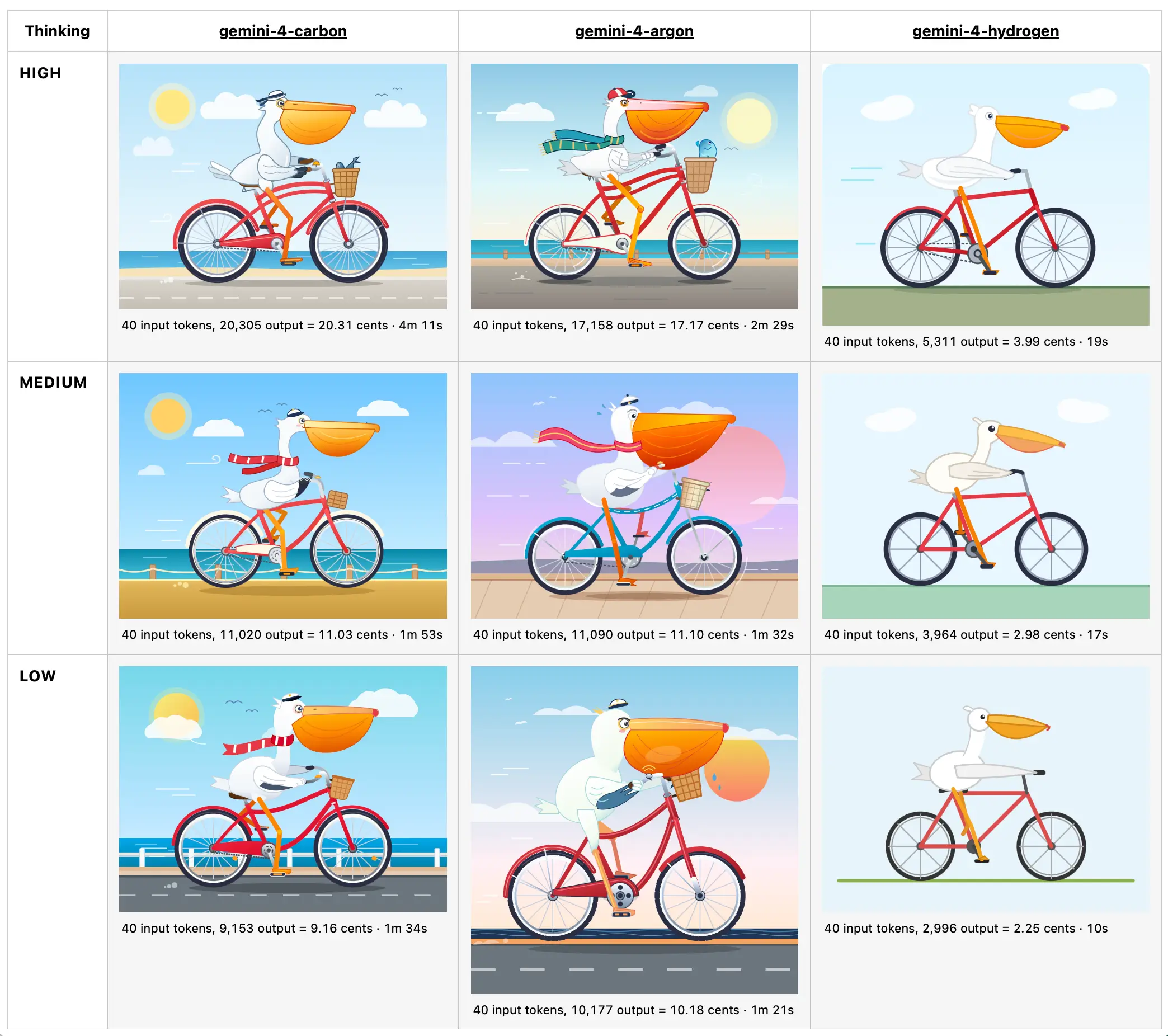
Willison also ran his customary pelican-on-a-bicycle test across all three Gemini 4 models at each of their three supported effort levels, and reports that the difference in output quality for Hydrogen is quite stark given how close the prices are. That test is a rough creative-generation smoke check rather than a benchmark, but the visual comparison is the kind of practical signal developers use when a discount is only 25%.
Google's framing, quoted in the post, positions Hydrogen as an execution model: teams lean on frontier models like Carbon and Argon for architectural judgment and subtle debugging, while Hydrogen handles writing code, running tests and verifying changes. It can work alone for everyday tasks or sit alongside the larger models as a high-efficiency part of a multi-model workflow. Two additional details matter for reach: Hydrogen is the new free-tier model, and it will power AI features in Google Search. That free-tier placement is how many developers will first encounter it, and Search distribution means its behavior will be visible well beyond people who call the API directly.
For LLM users, the immediate change is that llm-gemini 0.37 makes Hydrogen selectable through the plugin, so existing prompts and scripts can be pointed at it without switching tooling. This suggests the practical comparison for a team is not sticker price alone but tokens consumed per finished task, since Argon's claimed efficiency could offset its equal headline rate. A likely trade-off is that Hydrogen's cost advantage is muted until the December 2026 price change, so anyone optimizing spend now may find the larger models closer in effective cost than the model names imply.
Why it matters: developers building on Gemini get a new budget option plus a plugin update to access it, and the free-tier and Search roles signal Hydrogen is aimed at high-volume, low-stakes work. The pricing schedule also creates a planning decision: workloads that look pricey today become relatively much cheaper after December 1, 2026, which in my reading argues for keeping model choice configurable rather than hard-coded. Teams comparing against Haiku 5.5 or GPT-6 Luna should benchmark cost per completed task, not per token.
Based on reporting from the original publisher. Visit the source for full context and later updates.
Publisher excerpt
Release: llm-gemini 0.37 Google launched Gemini 4 Hydrogen today - the lowest cost member of the Gemini 4 family. It's actually not too far off the price of its much bigger siblings, Carbon and Argon. I'm finding Gemini 4's pricing really confusing. Here's the pricing scheme: Model Dates Input ($/M) Cached input Output Gemini 4 Carbon Through Nov 30, 2026 $2.00 $0.10 $10.00 From Dec 1, 2026 $4.00 $0.20 $20.00 Gemini 4 Argon Through Nov 30, 2026 $2.00 $0.10 $10.00 From Dec 1, 2026 $4.00 $0.20 $20.00 Gemini 4 Hydroge