Korea Advances Physical AI Across Industries With NVIDIA
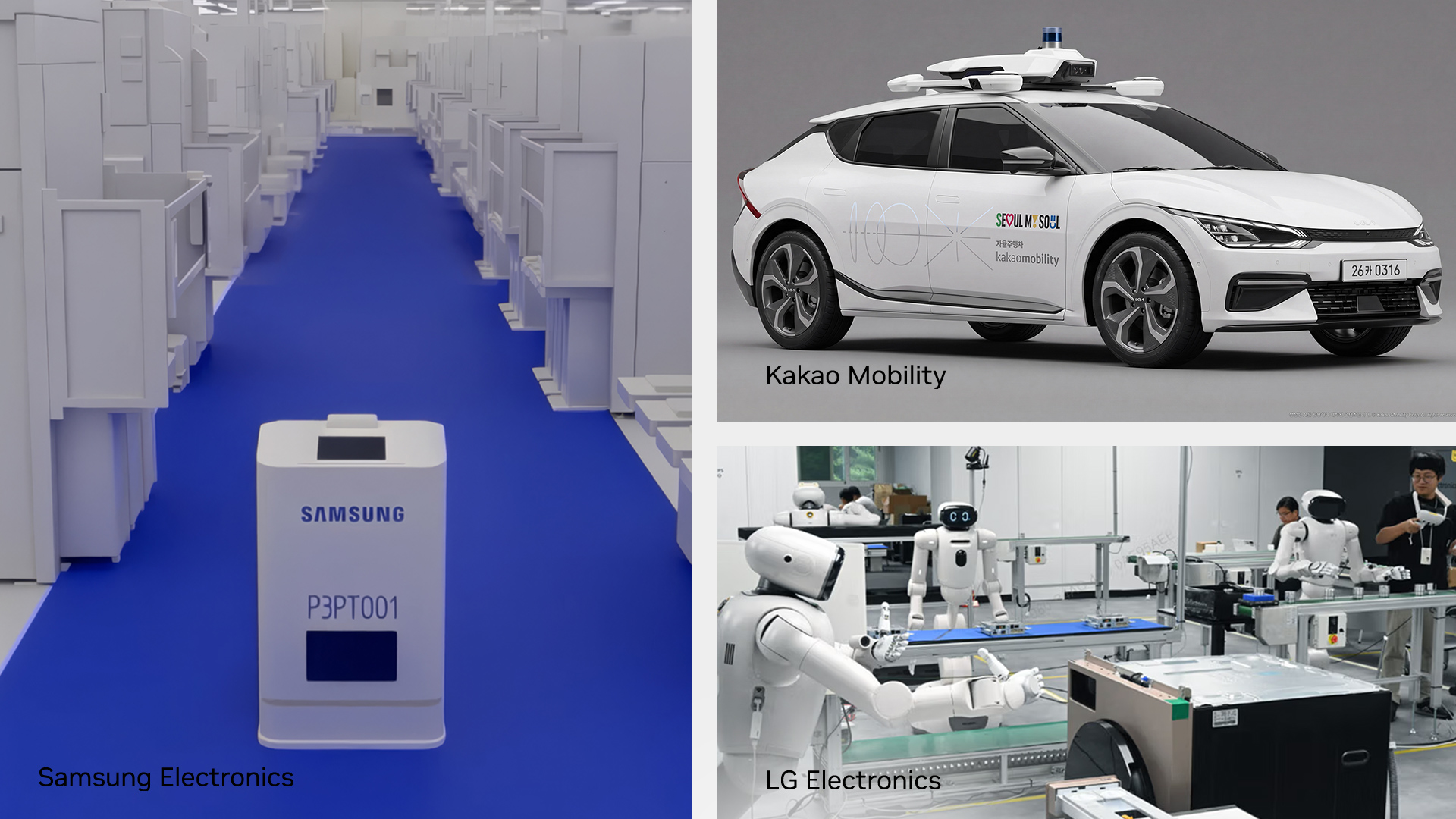
NVIDIA published an account of physical AI work with three Korean industry leaders — Samsung Electronics, Kakao Mobility and LG Electronics — spanning semiconductor engineering, autonomous driving development and robot learning. The post describes applied accelerated computing, AI and simulation moving from development into production settings, drawing on Korea's manufacturing and engineering base. Each collaboration is at a different stage: Samsung is expanding existing work, Kakao Mobility is planning a level 4 autonomous driving system, and LG has already demonstrated robotic tasks in a real manufacturing environment.
Samsung's expanded collaboration with NVIDIA covers materials research, process development and device engineering. In technology computer-aided design, Samsung is working with NVIDIA cuISS and cuDSS to speed up computations involving sparse linear systems, and the collaboration also extends to GPU acceleration for process and optical simulations. This is a familiar pattern in chip design: TCAD and related solvers lean heavily on sparse linear algebra, where direct solvers such as cuDSS and iterative ones such as cuISS are the standard workhorses, so GPU offload targets exactly the stage that tends to dominate run time.
In materials research, Samsung's sMOL platform has run selected quantum chemical calculations up to 5x faster end to end with NVIDIA cuEST. Samsung is also exploring cuEquivariance to accelerate tensor operations used in training and inference for atomistic AI models — the equivariant neural network architectures now common in molecular and materials machine learning, where the specialized operations are a known bottleneck. For chip-scale thermal and mechanical analysis, Samsung is developing workflows with NVIDIA PhysicsNeMo. In one AI homogenization case, combining AI-predicted effective material properties, coarser grids and GPU acceleration produced a roughly 1,600x speedup: simulation time fell from about 18 hours for a fine-grid solve on a 32-core CPU to 41 seconds for a GPU-accelerated coarse-grid solve. In practice, that figure reflects a stack of changes rather than raw hardware alone — replacing a fine mesh with a coarse one and substituting learned material properties changes the problem being solved, so the comparison is best read as an illustration of what surrogate modeling plus GPU acceleration can do to turnaround times, not as a like-for-like solver benchmark.
NVIDIA also points to its Agent Toolkit as a possible way to connect these simulation tools and AI models, so future engineering agents could run analyses and compare design options. That is presented as a forward-looking possibility rather than an active deployment.
Kakao Mobility plans to build a level 4 autonomous driving system on NVIDIA's vehicle computing and safety technologies, pairing its own driving software and its operating experience in Seoul's Gangnam district with NVIDIA's platform. Level 4 means the system handles driving without human intervention within a defined operational domain; dense urban districts like Gangnam, with complex traffic and pedestrian patterns, are a demanding domain to target. Kakao Mobility plans to use NVIDIA Hyperion, a reference platform for vehicle sensors and compute powered by DRIVE AGX Thor, and NVIDIA Halos to support safety across development and validation. Initial development is planned around Kia purpose-built vehicles, integrating Kakao Mobility's software with NVIDIA's technology, with the aim of supporting future level 4 mobility services in Korea. The emphasis on a reference sensor and compute platform and on a safety stack suggests the near-term work is integration and validation rather than a finished service; no timeline or service footprint is stated.
With LG Electronics, NVIDIA says the two successfully demonstrated Isaac GR00T-powered robotic manipulation and manufacturing tasks using LG's CLOiD robot in an actual manufacturing environment. The collaboration built a physical AI data flywheel linking real-world data collection, Cosmos-based data augmentation, GR00T model training, Jetson AGX Thor onboard computing and simulation-based evaluation. The teams describe this as establishing reusable workflows for continuing development and validation of CLOiD's capabilities, and are using it to refine a repeatable process for training, evaluating and improving manufacturing robots. The data flywheel idea is central to current robot learning: real demonstrations are expensive to gather, synthetic augmentation multiplies them, and simulation-based evaluation lets teams test policies before deploying them on hardware. A likely trade-off is that augmented and simulated data can diverge from real factory conditions, which makes the evaluation loop as important as the training step.
Why it matters: For developers and product teams, these collaborations show NVIDIA positioning a broad toolchain — cuDSS, cuISS, cuEST, cuEquivariance, PhysicsNeMo, Hyperion, Halos, Isaac GR00T, Cosmos and Jetson AGX Thor — as the common substrate for industrial AI in Korea. Teams in semiconductor engineering, autonomy and robotics may increasingly be evaluated against GPU-accelerated and AI-surrogate workflows, though the headline speedup figures are best treated as case-study results until independently reproduced. The Kakao Mobility and LG efforts are early-stage or demonstration work, so concrete service dates and production scale remain to be seen.
Based on reporting from the original publisher. Visit the source for full context and later updates.
Publisher excerpt
Tapping into the country’s strengths in manufacturing and engineering, NVIDIA is helping advance Korea’s physical AI ecosystem. The country’s industry leaders are applying accelerated computing, AI and simulation to everything from semiconductor manufacturing to robotics and autonomous vehicles. These efforts are helping bring physical AI from development into real-world production. Samsung Advances Semiconductor Engineering With […]