Co-Existence and the End of Co-Intelligence
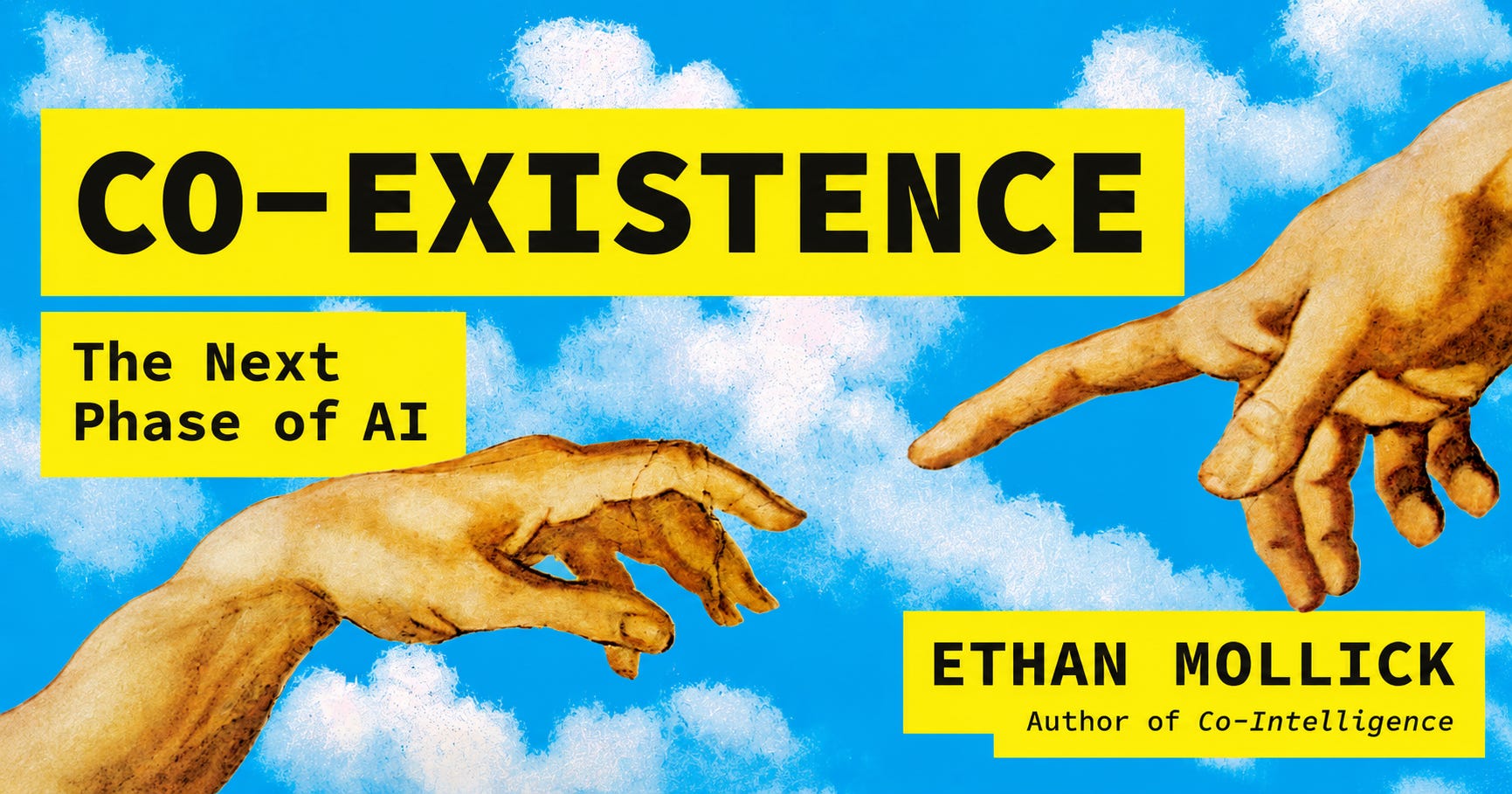
Ethan Mollick, writing on his One Useful Thing newsletter, announced a new book titled Co-Existence, scheduled for release on October 20, with pre-orders open. The announcement comes two years after his previous book, Co-Intelligence, which he describes as a New York Times bestseller translated into more than 25 languages, with the Netherlands and Korea as its largest markets. He frames the new book as a response to a shift in how people actually work with AI, and he pairs the announcement with an account of how he used AI tools, unevenly and often sparingly, while writing it.
The premise rests on a change in the technology itself. Co-Intelligence, in his telling, described a world of chatbots where work with AI was a cooperative back-and-forth: the human prompted, supplied context and skepticism, and stayed at the center while the model helped. That arrangement, he argues, was never what AI companies were building toward. He points to the OpenAI charter's language about "highly autonomous systems that outperform humans at most economically valuable work" as the long-stated goal, meaning self-directed agents rather than assistants. That goal felt remote until recently.
The turning point he identifies is late 2025, when the first real coding agents arrived. In the days before publication, he cites two data points on their impact. One study suggested the agents led to seventeen times more code being written. Separately, Anthropic reported that AI now writes 80% of its code, with each developer shipping 8x more. Those figures are reported as claims from those sources; Mollick presents them as evidence that software development is already being reshaped, and he expects the same pattern to reach many other fields.
His position is not that humans are being displaced wholesale. He describes a jagged frontier of AI capability, meaning competence varies sharply and unpredictably across tasks rather than improving evenly, and he pairs that with the practical difficulties of adoption and the technology's remaining limitations. From that combination he draws the book's central claim, reflected in its subtitle: work with AI that is sometimes, but not always, better than you. The value, in his framing, lies in humans using AI not merely to compete but to thrive alongside systems that beat them on some tasks and fail on others.
The cover, which he revealed in the post, contains a reference to recent AI history that readers are invited to spot.
On authorship, Mollick states plainly that he wrote every chapter draft himself, complete with the parentheticals and jokes associated with his style. He gives two reasons. One is a contract with readers: people buy the book to learn what a human researcher thinks, and he writes to express his own views in his own voice, an expectation he considers more important than what the models can do. The other is craft. He argues AI is not a strong long-form writer, citing difficulty telling good stories, obvious textual tells, and dullness over long stretches.
AI still entered the process, with limits. He had AI readers review each chapter for feedback, alongside human readers and editors. He had a council of AI models check facts, and he says he read every paper and citation himself. He used AI to get unstuck at dead ends. He judges the book better for it, but names costs: intellectual struggles possibly resolved too quickly, the chance his thinking was subtly redirected, and smaller oddities. His previous book, he notes, contained 128 em-dashes; this one has far fewer, which he attributes to an effort to keep proving the text was human. That detail is a useful window into how authors may start contorting style to signal human origin, a signal that grows less reliable as models mimic punctuation and voice.
The website went the other way. The Co-Intelligence site, built on pre-made templates, took hours; the new one was generated by prompting Claude Code with Opus 4.8, a few instructions, a copy of the book and the cover. He still had to iterate on changes, but he reports minutes rather than hours and says he loved the result. For developers, this is a familiar division of labor: agentic coding tools handle bounded, greenfield, visually checkable work well, while judgment stays with the person reviewing the output.
The most unusual element is audience-targeted content. The site carries a banner addressed to software agents, saying that if a reader is an AI working on behalf of a human, a version was written just for it, with a link for agents to click. Mollick's reasoning is that AIs will increasingly read his work and decide whether to recommend it to their users, so he wants to make the material agreeable to those systems too. This suggests a coming practice in which publishers and product teams optimize not only for human readers but for the retrieval and ranking behavior of agents that summarize on a user's behalf. A likely trade-off is transparency: writing separately for machines raises questions about what the human-facing text is really conveying, and agent-directed persuasion can shade into manipulation if it is not disclosed.
Why it matters: developers and product teams building on agents are the audience most directly affected, since the coding-agent numbers cited here are the clearest public signal that autonomous tools have moved from demo to default in at least one discipline. If Mollick's reading holds, teams should expect the same jagged pattern elsewhere: large productivity gains in well-specified tasks, uneven quality elsewhere, and review burden shifting to humans. His experiment with agent-directed website content is worth watching as a template, and as a caution, for anyone whose work will increasingly be read first by a model.
Based on reporting from the original publisher. Visit the source for full context and later updates.
Publisher excerpt
Also: how pitch a book to an AI!