Robo-soldier startup backed by Eric Trump misses payroll, may collapse
Foundation Future Industries, a Silicon Valley humanoid robotics startup that has courted attention for promising combat-ready robots, failed to pay employees for the payroll period ending October 30, according to CNBC reporting based on anonymous people with direct knowledge of the matter. The missed payroll followed a funding shortfall, and insiders worry the company could soon collapse unless it secures additional money. Eric Trump, the president's son, holds an equity stake in Foundation and was announced as its chief strategy advisor in March 2026, according to the Financial Times.
The reported payroll failure is compounded by staff anger over how company money has been used. CNBC's sources said co-founder and CEO Sankaet Pathak had borrowed $4.6 million in company funds about a year ago to buy a luxury home overlooking San Francisco Bay. Foundation's leadership, including Pathak, is still trying to raise funding to support a $3 billion valuation, pitched on the promise of a humanoid robot ready for combat duty and able to wield various weapons.
Foundation has demonstrated a humanoid robot called the Phantom MK-1 and is promoting an upcoming model, the Phantom MK-2. The company has touted its machines for warehouses and other workplaces, but has drawn media coverage by claiming it is developing robots for battlefield use, with testing described in roles from Ukraine to Gaza.
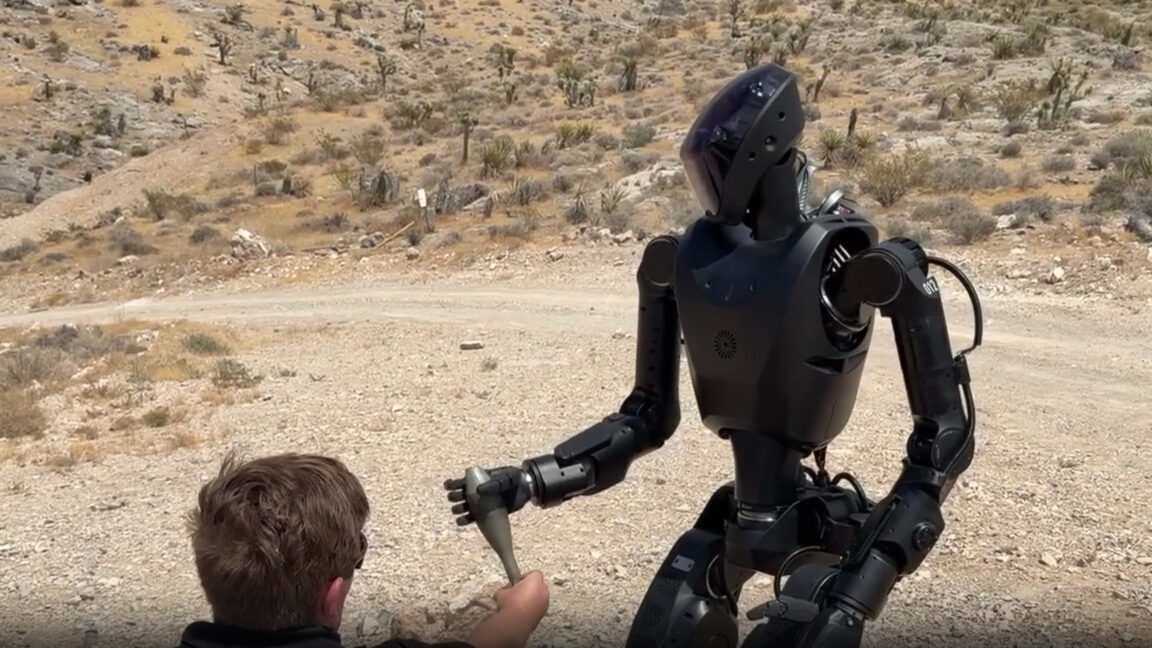
Those battlefield claims are contested. Foundation president and co-founder Mike LeBlanc told the Financial Times on November 11, 2026 that the company was in talks with the Israeli military about supplying humanoid robots for patrol and combat duties in Hamas tunnels beneath Gaza, and described bringing a Phantom MK1 along to tour some of the tunnels. The Israeli defense ministry declined to comment to the FT. LeBlanc had previously said two Phantom MK-1 units went to Ukraine in February 2026 for frontline reconnaissance and logistics testing. Independent journalist Craig Smith, host of the Eye on AI podcast, said he accompanied a delivery of Phantom robots toward Ukraine and that they never entered the country because they were stopped at the border with Poland. When questioned, LeBlanc said only that Foundation had run a pilot demonstration at an undisclosed location and walked back a claim that the robots had been shown to the Ukrainian organization Brave1. A promotional "mortar demo" video dated May 2026 on the company's website shows a person handing a mortar shell to a robot, which slowly lowers it over the muzzle before dropping it in, a sequence that does not by itself establish readiness for combat.
Public records also complicate the company's government-contract narrative. After Trump said in a Fox Business interview in April that Foundation had "just secured a $24 million contract with the Pentagon," Sen. Elizabeth Warren (D-Mass.) wrote on social media asking whether the Pentagon is "just a cash machine from Trump's kids now" and calling it "corruption in plain sight." Federal spending records show Foundation holds no publicly listed contracts, according to The San Francisco Standard. Instead, Boardwalk Robotics, a company Foundation acquired in late 2024, received four contracts worth $3.22 million. The Institute for Human & Machine Cognition, a Florida nonprofit research partner to Boardwalk, secured a $24.8 million Navy contract in 2025. Separately, CNBC reported that in 2024 General Motors pushed back on Foundation's claims that it was about to receive an investment from the automaker. Investment funds linked to Eric Trump and Donald Trump Jr. are involved with multiple military technology companies that have received Pentagon loans and contracts worth more than $3.2 billion as of July 2026, according to The Washington Post.
This suggests a gap between Foundation's public positioning and its operational footing. Humanoid robots remain largely unproven as general-purpose machines; companies have only begun testing and deploying them in relatively controlled settings such as factories and warehouses. On actual battlefields, humanoid robots have had no meaningful impact so far. Ukraine, a pioneer in robotic warfare, has concentrated on unmanned ground vehicles, wheeled or tracked robots used for risky supply runs, casualty evacuation and, increasingly, armed or explosive-laden missions. In 2026, Ukraine has sent armed ground robots into combat through amphibious landings and airdrops, including dropping military robots from drones behind Russian lines. A likely trade-off for Foundation is that combat robotics demands reliability, logistics and field validation that promotional videos cannot substitute for, and a funding shortfall leaves little room for that kind of iterative testing.
Why it matters: Developers and product teams building robotics or defense-adjacent hardware should treat Foundation as a cautionary case about valuation and contract claims outrunning verifiable deployment. For investors and partners, the missed payroll and leadership's reported use of company funds raise governance questions that can freeze hiring and procurement. The broader signal is that ground-based unmanned systems, not humanoids, are where military robotics adoption is actually happening, so teams should weigh near-term demand accordingly.
Based on reporting from the original publisher. Visit the source for full context and later updates.
Publisher excerpt
Robotics startup misses payroll a year after CEO used funds for luxury home.