Full Fine-Tuning (FFT) on SageMaker AI Serverless Model Customization
Amazon SageMaker AI Serverless Model Customization now offers Full Fine-Tuning (FFT), a mode in which every weight in a pretrained model is updated during training. The capability runs on the service's serverless infrastructure, so teams do not provision GPUs, set up clusters or write distributed-training configuration; they specify a base model, dataset and hyperparameters, and the service handles compute allocation and checkpoint management. AWS published the announcement along with a set of controlled experiments comparing FFT against Low-Rank Adaptation (LoRA) on code-generation tasks.
The core argument is about where LoRA stops scaling. LoRA freezes the pretrained weights and injects small pairs of low-rank matrices into model layers, which sharply cuts the number of trainable parameters and the GPU memory needed. AWS's experiments find that as tasks grow more complex and datasets pass tens of thousands of examples, LoRA hits an accuracy plateau that raising the rank does not close. The company attributes this to rank deficiency itself, not merely to fewer trainable parameters: a low-rank update cannot capture the full weight change a deep adaptation requires. FFT instead modifies the weight matrix uniformly across its full representational capacity. The claimed result is stronger convergence, better alignment of activations across layers, and a model that absorbs domain knowledge while retaining more of its pretraining.
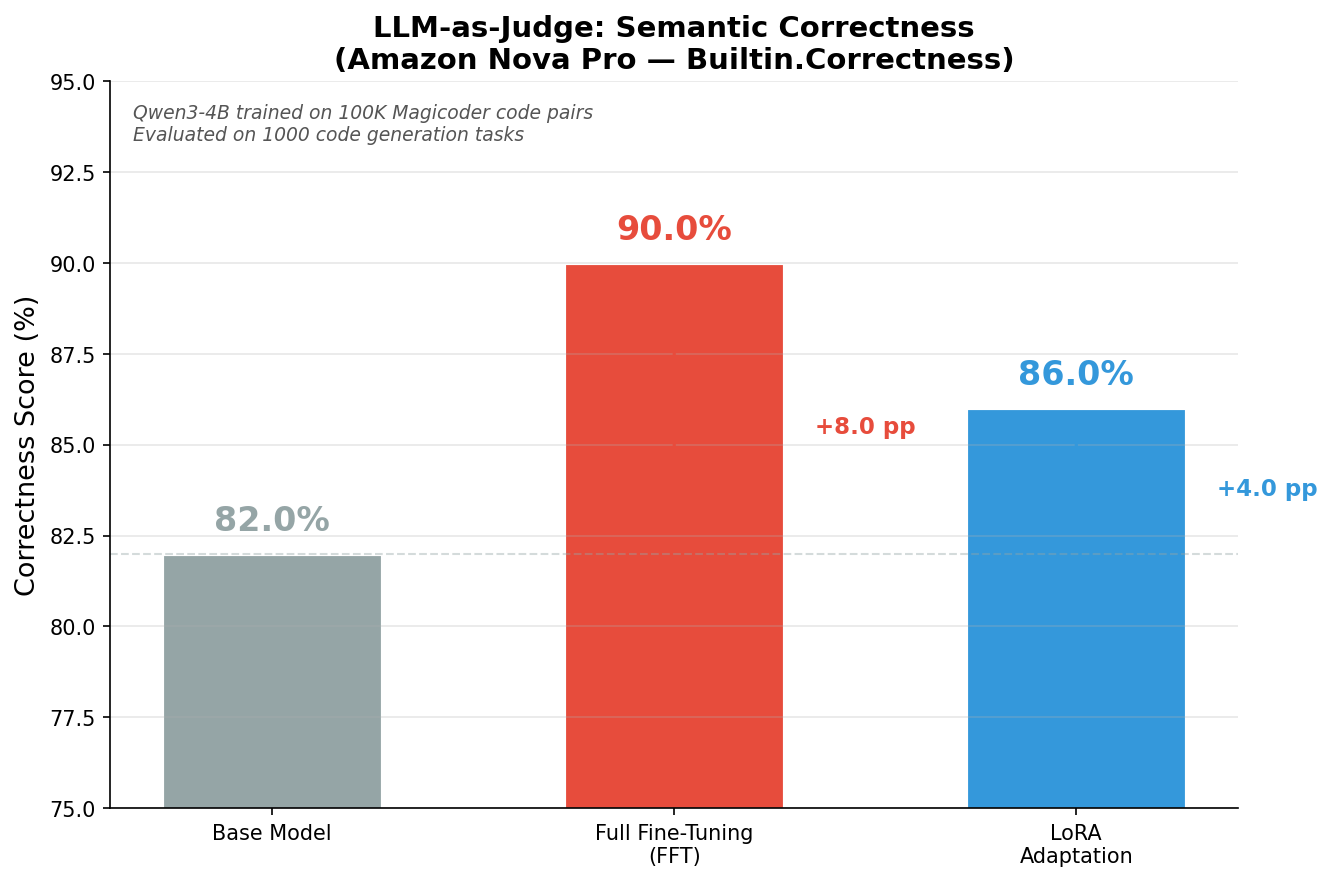
The headline number: at 100,000 or more training examples on code generation, FFT reached 90.0 percent on an LLM-as-Judge semantic-correctness metric. A radar comparison across quality dimensions placed the base model innermost, LoRA in the middle, and FFT outermost, with the largest gaps on BLEU and ROUGE-2.
The experimental setup is worth knowing for anyone weighing replication. All runs used supervised fine-tuning on Qwen3-4B, a base model available in SageMaker AI Studio, and all customization jobs ran through Serverless Model Customization in both LoRA and FFT modes, with identical prompts, targets and evaluation code in each pair. The dataset was Magicoder-Evol-Instruct-110K, a curated corpus of 110,000 coding instruction-response pairs covering algorithm design, debugging, data structures and systems programming. It was split 90/5/5: 99,000 records for training, 5,500 for validation to monitor convergence and loss, and 5,500 held out for final evaluation. Across a short window AWS ran tens of experiments spanning Qwen3-4B, DeepSeek-R1-1.5B, Nemotron-30B and Gemma-4-26B, sweeping learning rate, batch size, warmup ratio, epoch count and dataset scale. Each job, from submission to evaluation results, completed within a few hours, and finished models were registered automatically in SageMaker Model Registry as versioned Model Packages.
Three built-in evaluation methods were used, each aimed at a different quality dimension. LLM-as-Judge uses a frontier model, here Amazon Nova Pro, to read generated code next to the original prompt and judge logical correctness; it can score the customized model against the base model. PRIMECODE is a custom scorer computing deterministic text-similarity metrics — BLEU for n-gram precision, ROUGE-1/2/L for recall-oriented overlap, and F1 — which makes it reproducible and suited to ablation studies. MMLU, covering 57 academic subjects, served as a forgetting guardrail: because fine-tuning on code can overwrite general capabilities, tracking MMLU before and after quantifies how much broad knowledge is sacrificed for code gains.
The API surface is compact. Using the SageMaker Python SDK, an SFTTrainer is constructed with a model, a training type, a model package group, training and validation datasets, an S3 output path, a session and a role. Setting training_type to TrainingType.FULL runs FFT; switching to TrainingType.LORA is the only change needed to run the other method, with the rest of the code identical. In the example, hyperparameters were a learning rate of 2e-5, global batch size of 8, 2 epochs and a warmup-step ratio of 0.1. Jobs can be launched asynchronously, and training metrics appear in a linked MLflow app.
Hyperparameter guidance from the sweeps: learning rate governs how aggressively every weight moves, and unlike LoRA, too high a value can permanently overwrite pretrained knowledge — 2e-5 on a large dataset (over 100,000 examples) was the safe zone. Epoch count is framed as a forgetting question rather than a loss-curve one, since validation loss can look healthy while untrained capabilities degrade; correctness peaked at 90.0 percent at 3 epochs and every variant got worse beyond that. Batch size trades noise for step count: at a fixed learning rate, small batches behave like a higher learning rate and raise forgetting risk, while large batches may underfit.
The post is candid about limits, and these matter more than the headline. FFT is not universally better. Both methods underperformed the base model on MATH exact match, showing reasoning can suffer from domain fine-tuning either way. Aggressive learning rates (5e-5 and above) were destructive, dropping MATH scores to 2–3 percent and MMLU accuracy to 3.6 percent — textbook catastrophic forgetting. LoRA slightly beat FFT on LLM-as-Judge at 81.5 percent versus 79.5 percent, suggesting parameter-efficient methods can still hold an edge on subjective quality judgments. The configuration that best preserved general knowledge was warmup at 5 percent, batch size 8 and learning rate 2e-5.
My reading is that the practical decision is now a cost-and-data question rather than a capability one, since both methods sit behind the same API call. FFT spends far more compute per job and, per these results, only pays off past roughly 100,000 quality examples on a genuinely complex task — and it demands disciplined learning-rate and epoch choices, because the failure mode is silent loss of general ability rather than a visible training error. A sensible workflow is to prototype with LoRA, watch whether accuracy plateaus as rank rises, then move to FFT with a conservative learning rate and a forgetting guardrail like MMLU in place. A likely trade-off AWS does not quantify here is wall-clock and spend per job, which will matter for teams running many sweeps.
Why it matters: Teams that have hit a LoRA accuracy ceiling on large, domain-specific datasets can now attempt full-rank tuning on SageMaker without standing up GPU clusters or writing distributed-training code, and can A/B it against LoRA by changing one enum. The same experiments show the risk: aggressive settings can gut general reasoning, so product teams should budget for evaluation harnesses alongside training jobs. Inference economics are the implied payoff — a smaller specialized model matching a frontier model on a narrow task — but that is an inference from the setup, not a measured result in the published benchmarks.
Based on reporting from the original publisher. Visit the source for full context and later updates.
Publisher excerpt
Amazon SageMaker AI Serverless Model Customization now supports Full Fine-Tuning (FFT). This post explores when FFT outperforms LoRA across key benchmarks, examines the spectral properties of model weight matrices behind the quality gap, shares practical hyperparameter tuning guidelines, and shows how to get started.