Documenting the tech worker movement
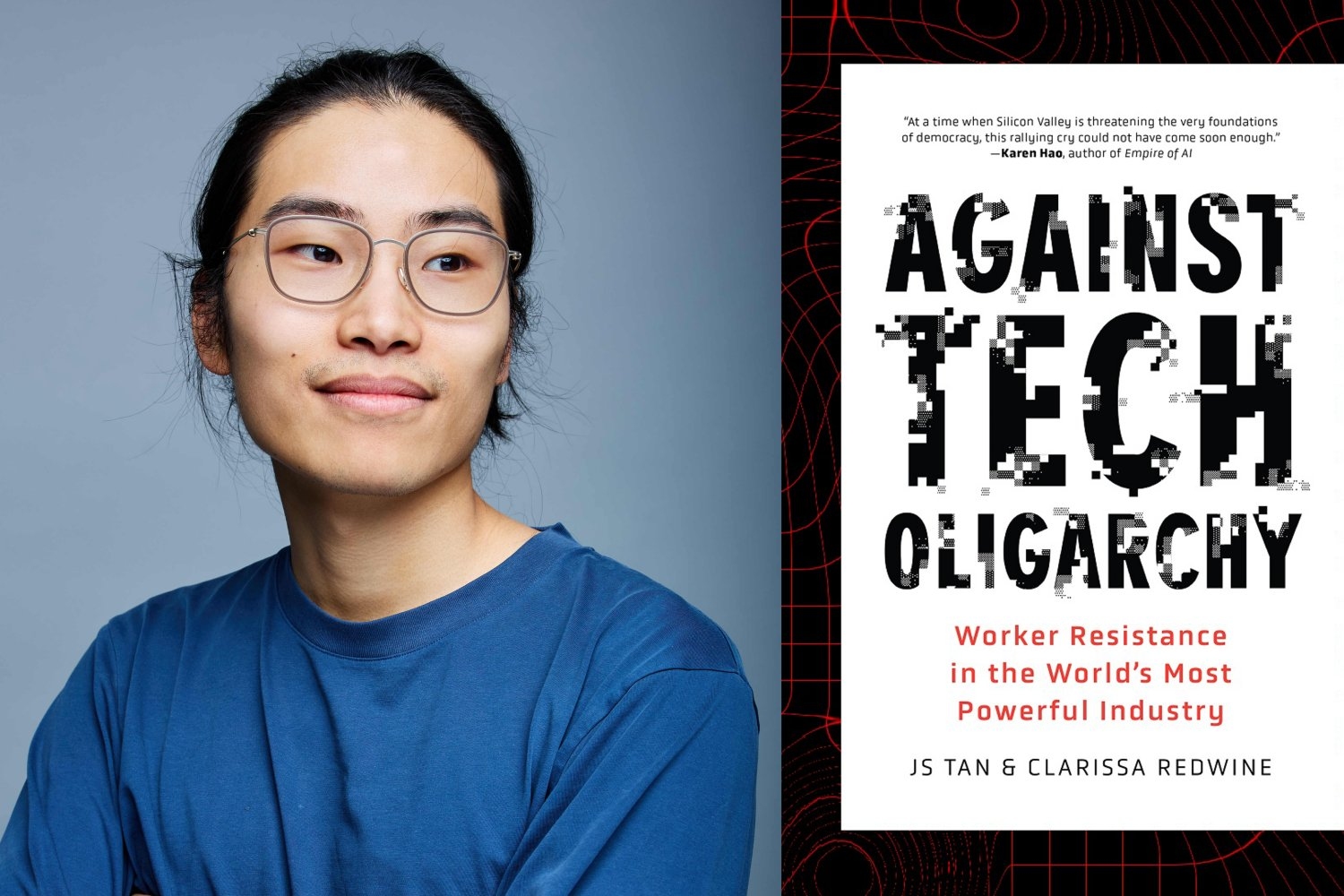
MIT doctoral student JS Tan SM '22 and his former tech industry colleague Clarissa Redwine have published a book examining the rise and fall of the tech worker labor movement. "Against Tech Oligarchy: Worker Resistance in the World's Most Powerful Industry" (Haymarket Books, 2026) chronicles how tech employees organized, the strategies they used, and the movement's effect on Silicon Valley labor politics over the past decade. Tan is a PhD student in MIT's Department of Urban Studies and Planning, focusing on the political economy of the tech sector; he earned a master's degree at the MIT Media Lab after enrolling in 2020. The Department of Urban Studies and Planning will co-host a book launch and discussion on Oct. 26.
The narrative turns on a contrast between two moments at Google. In 2018, after employee protests, the company decided not to renew its contract for Project Maven, a Pentagon initiative that used artificial intelligence to analyze drone surveillance footage. Nearly 4,000 employees signed an open letter to their CEO stating that Google should not be in the business of war. Earlier this year, by contrast, more than 600 employees signed an open letter urging Google's CEO to reject classified AI work with the Pentagon, citing concerns about potential uses including lethal autonomous weapons and domestic surveillance. Tan characterizes the response this time as the company saying it was committed to working with the Pentagon regardless. That shift, in his account, reflects how Google has repositioned itself politically toward its workforce.
The book traces the movement's origins to 2017, when Tan was working at Microsoft and Redwine at Kickstarter. President Donald Trump signed an executive order suspending entry into the United States for nationals from seven predominantly Muslim countries for 90 days and suspending Syrian refugees indefinitely. Tan says the tech sector broadly pushed back. He notes that OpenAI co-founder Sam Altman joined airport protests against the ban, having written the day before that the industry needed to take a stand against the Trump administration and particularly its immigration policies.
The Jan. 28, 2017, blog post from Altman argued that tech companies go to extraordinary lengths to recruit and retain employees, giving those employees leverage, and that if employees push companies to act, the companies will have to. It called for companies to take at least a public stance while cautioning that talking alone is only somewhat effective, and urged employees to push their companies toward concrete action. Tan credits those words with inspiring tech workers across the industry to voice opposition publicly. Over the following years, workers staged walkouts and protested employer contracts with U.S. military and immigration enforcement agencies, as well as workplace policies they considered sexist. Tan describes that period as one in which many tech workers felt their companies were walking back the values they had initially promised.
The book's explanation for the movement's decline has two main threads. The first is economic. Following interest rate hikes in 2022, the tech industry lost hundreds of billions in market valuation and moved to cut costs, with employee salaries among the most significant targets. In Tan's reading, the labor market soured on tech workers, giving employers an opening to reclaim control. The second thread concerns artificial intelligence: Tan points to agentic AI coding systems, which he argues have deskilled workers and heightened anxiety about job security. Without a union or a mechanism to coordinate across workers and bargain collectively, he suggests, tech workers faced these shocks on their own and lacked the leverage to push back effectively.
The authors bring direct organizing experience to the subject. Redwine was a prominent organizer in the union drive at Kickstarter. She was fired from the company in 2019; Redwine said her dismissal was retaliation for her organizing activity, while Kickstarter denied that claim. Tan and Redwine began writing the book in 2024, aiming to understand why, within roughly eight years, the tech worker movement had reached what he calls a state of paralysis. Tan says tech workers want a say in how their technologies are designed and want guardrails around what they build. This is his first book, and he describes writing it as exhilarating, tying the work to his attraction to academia and his belief in the power of research and writing.
It is worth noting that the account is explicitly authored from inside the movement it describes. The claims about deskilling, about the souring labor market, and about the reasons for the movement's decline are presented as Tan's arguments and interpretations, not as settled findings, and the Kickstarter dismissal remains disputed. Readers should weigh the book as a participant history, with the strengths and the framing that entails. The Maven episode and the recent Pentagon letter, however, are concrete, dated events, and the gap between the two — thousands of signatures translating into a contract cancellation then, hundreds of signatures meeting a firm refusal now — is the sharpest illustration in the book of how the terrain has changed.
Why it matters: For engineers and product teams, the book offers a case study in what employee leverage looks like when hiring slows and AI tools reshape job content, and in how quickly a company's stated values can shift when its bargaining position improves. Product and policy teams at firms doing defense or government AI work may find the Google comparison directly relevant, since internal dissent over such contracts is likely to recur. The Oct. 26 launch makes the argument accessible to those weighing whether organizing, or simply internal advocacy, can still influence how AI products are built and sold — a question the book treats as open rather than settled.
Based on reporting from the original publisher. Visit the source for full context and later updates.
Publisher excerpt
Writing as a participant and researcher, PhD student JS Tan SM ’22 has co-authored a new book about the rise of tech worker protests and the employer backlash that followed.