Meta Extends Confidential Computing to AI Glasses with Private Processing
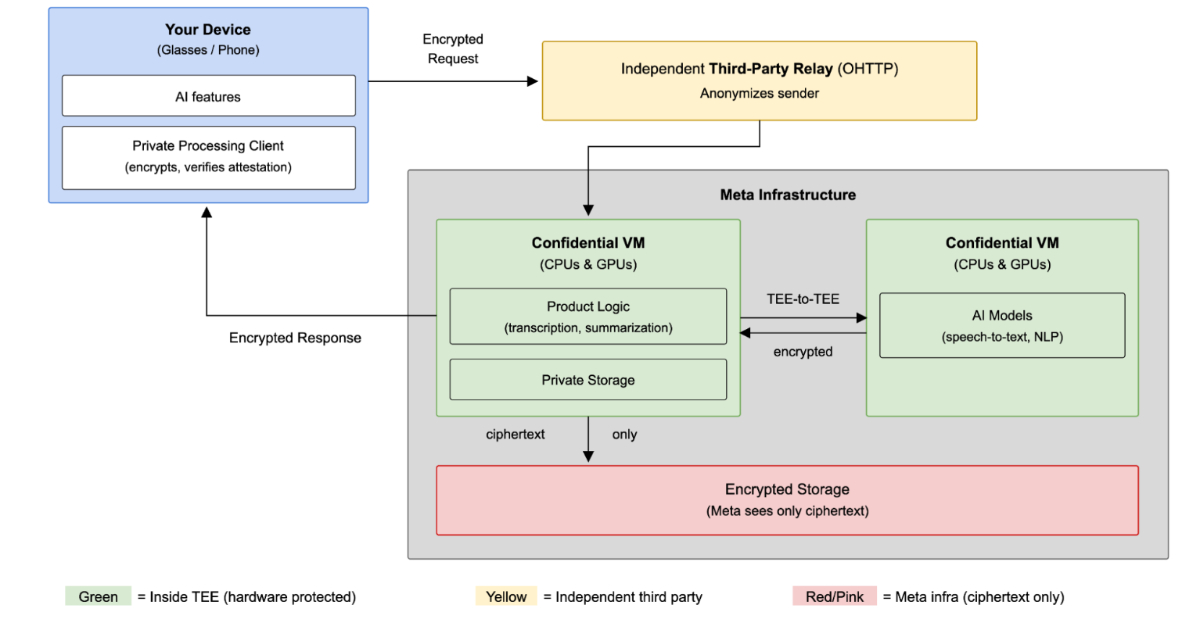
Meta has extended Private Processing, its confidential computing architecture introduced for WhatsApp and Meta AI in 2025, to AI glasses. The company announced the design before broader deployment, describing how sensitive AI workloads and persistent user context would be handled in the cloud. Engineering director Pritam Shah said the platform is ready and working, and that Meta announced it now to engage security and privacy researchers and a third-party auditor. Private Processing is not yet available on Meta's glasses, and Meta has not specified which features will initially rely on it or given a timeline.
The motivation is a split between what the glasses can do locally and what needs the cloud. Basic interactions such as calls and messages can run on the device. Streaming transcription, contextual search, and long-term recall require larger models plus access to personal context accumulated over time, which means more computing and persistent state than the glasses can host. Oskar Linde, VP of XR Technologies at Meta, described the approach on LinkedIn as a way to make AI more useful throughout the day while supporting the stateful, personal context AI glasses need without allowing Meta to access that data.
Architecturally, the confidential computing boundary moves from the device into Meta's cloud infrastructure. AI models run inside confidential virtual machines backed by hardware trusted execution environments, with processor-encrypted memory. Meta says the boundary spans CPUs and GPUs so mixed workloads stay protected under the same isolation.
Before any personal context leaves the glasses, the device performs remote attestation and establishes an attested TLS session with a TEE. The glasses verify a hardware-signed certificate and compare the workload measurement against an append-only transparency ledger. If verification fails, data transmission is blocked. Anonymous credentials and third-party OHTTP relays operated by Fastly or Cloudflare further separate user identity from request processing.
Persistent state stays inside the confidential boundary. Meta places the storage engine inside the TEE and encrypts data with user-provided keys before it leaves the protected environment. Queries execute within that same boundary, which limits exposure of database access patterns. In practice, that combination is what makes long-term recall feasible: the assistant can keep a memory of the user without that memory being readable by the operator hosting the model.
Meta describes Private Processing as built around hardware isolation, fail-closed guarantees, public verifiability, non-targetability, and encrypted storage. Production CVM images are registered in the transparency ledger so outside parties can check what code is running. Because engineers cannot inspect protected memory or capture model inputs and outputs, Meta says it relies on aggregate operational signals such as CPU utilization, memory allocation, network latency, and hardware failure rates to monitor the system. This is a meaningful operational trade-off: the same isolation that protects user data also removes the fine-grained logs and traces teams normally use for debugging model behavior and quality regressions. A developer building on this kind of stack should expect to reason about attestation reports, measurement hashes and ledger entries rather than application-level telemetry.
Meta says it is working with independent security firms, including NCC Group, and with security researchers to review the architecture and attestation mechanisms. It also plans to give researchers CVM binaries, tools, and documentation as it expands the system toward increasingly stateful, multimodal, and agentic AI experiences.
The announcement also drew community discussion about always-on wearable AI. In a Reddit discussion about Meta's glasses, one commenter argued that an assistant providing contextual information would need to continuously listen and observe its surroundings, highlighting the privacy implications of persistent sensing. That tension is not resolved by confidential computing alone: a TEE can protect data once it is inside the boundary, but the decision to capture surrounding audio and imagery happens on the device, and Meta has not said how that capture will be governed.
For context, confidential computing has become a standard pattern in cloud AI: hyperscalers and chip vendors offer hardware-isolated VMs where the host operator cannot read memory, typically accompanied by remote attestation so a client can verify which code is loaded. Extending it to a consumer wearable is less common because the trust chain must reach a battery-powered device and a user's identity, which is where the anonymous credentials and relay routing come in. Remote attestation, defined briefly, is the process by which hardware proves the identity and integrity of the software running in its TEE; OHTTP is an HTTP encapsulation designed to keep the client's identity from the server it talks to.
Why it matters: for product teams working on wearables and assistants, this signals that always-available personal context is being treated as a cloud problem with a hardware-isolation answer, not purely an on-device one. For developers, the interesting surface is the attestation and transparency machinery, which implies new tooling requirements around verifying what runs in a CVM and what measurements are registered. The open questions, and these are inference rather than reported facts, are whether third-party audit and researcher access arrive before launch and whether attestation and relay overhead are acceptable for latency-sensitive wearable interactions.
Based on reporting from the original publisher. Visit the source for full context and later updates.
Publisher excerpt
Meta has extended Private Processing to AI glasses, using confidential VMs, trusted execution environments, remote attestation, anonymous credentials, OHTTP routing, and TEE-based storage to process AI workloads and persistent user context in the cloud. By Leela Kumili