Promptim: an experimental library for prompt optimization
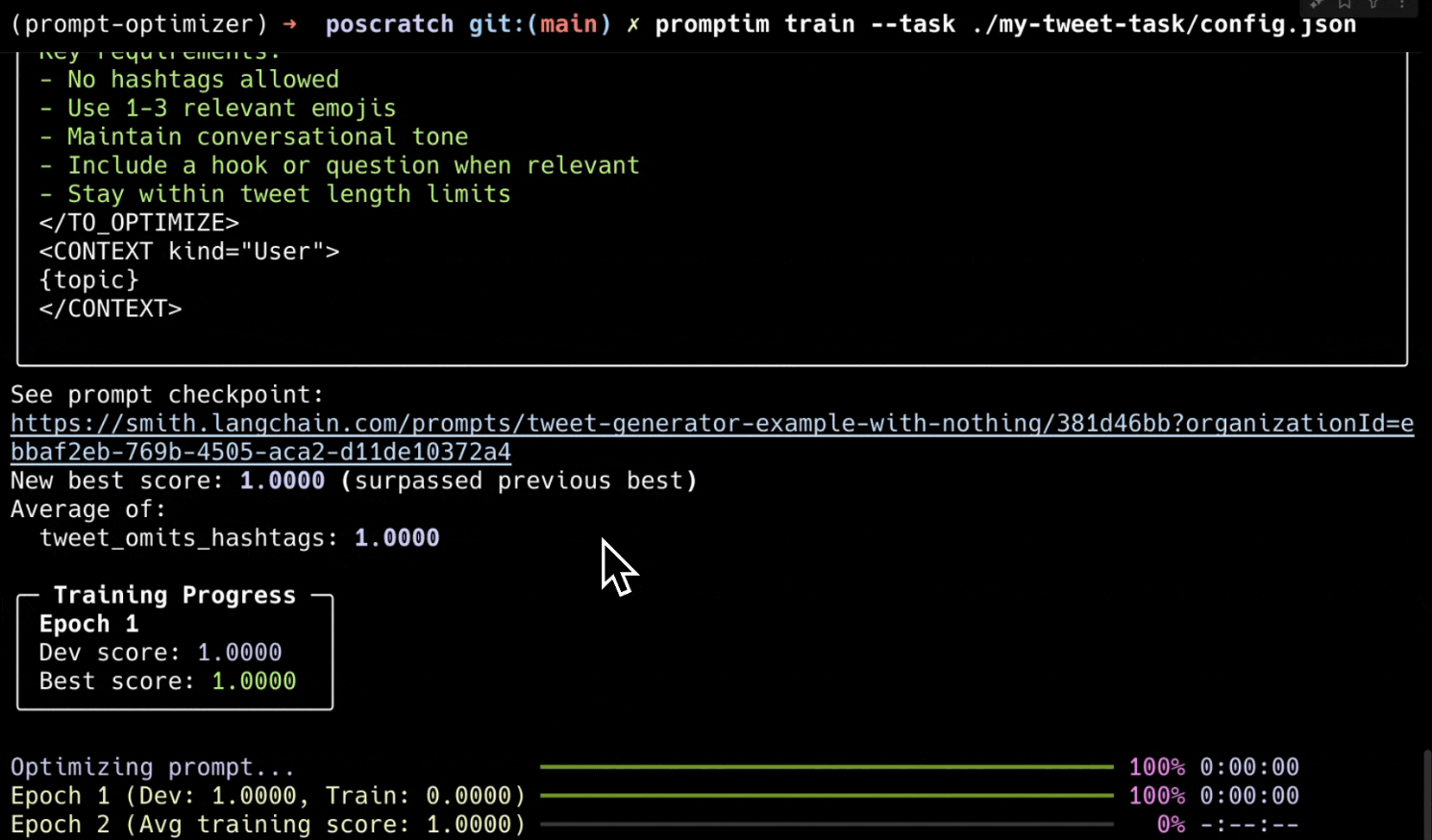
LangChain has released Promptim, an experimental open-source library for automated prompt optimization, installable with pip. The library is built around a simple contract: you supply an initial prompt, a dataset, and custom evaluators, plus optional human feedback, and Promptim runs an optimization loop that returns a refined prompt intended to score better than the one you started with.
The motivation is the way most teams already work. Prompt engineering is typically manual tweaking, and the more rigorous version of it is evaluation-driven development: assemble a dataset of inputs (expected outputs optional), define metrics, and run every prompt change across the dataset to see whether it helps or regresses. Promptim takes that setup as input and attempts the edits itself, scoring candidate prompts against the same metrics. LangChain credits DSPy as a pioneering effort in this space.
The stated benefits are three: less engineering time spent hand-tuning, more rigor in a practice that is often closer to art than science, and faster model swaps. The third is the practical one, in LangChain's framing: different models need different prompting strategies, so changing providers is not just a URL change. Because evaluations are model-agnostic while prompts are not, optimizing prompts automatically lets a team invest effort in evals and let the prompt follow the model.
The loop itself has a clear shape. You point Promptim at a LangSmith dataset, a prompt stored in LangSmith, and locally defined evaluators, and you can optionally declare train, dev and test splits. The initial prompt runs over the dev (or full) dataset to establish a baseline. Promptim then iterates over the train (or full) dataset, running the prompt on the examples and scoring them. Those results, covering inputs, outputs, expected outputs and scores, are handed to a metaprompt that is asked to propose edits to the current prompt. The revised prompt is then re-scored on the dev split; it is kept only if the metrics improve, otherwise the original stays. This repeats for N rounds.
An optional extra step inserts human review. When automated metrics are weak, or when you want signal beyond them, feedback can be collected through LangSmith's Annotation Queues and fed into the process. Prompts live in LangSmith's Prompt Hub so the final result is easy to inspect after the fact.
LangChain is explicit that this is not a silver bullet and recommends keeping a human in the loop at least as a sanity check on the output. The design choices reflect that: prompt storage in LangSmith, tracked evaluation results, and annotation queues all keep a person within reach of the loop.
The comparison with DSPy is drawn deliberately. First, Promptim targets a single prompt, while DSPy targets the whole compound AI system; LangChain argues one prompt is the more tractable problem for a first attempt. Second, Promptim leans harder on human involvement, through annotation queues, reviewable prompts and tracked results. Third, it does only one thing, rewriting the prompt, and aims to do it well, whereas DSPy spans a wider set of levers including finetuning and few-shot prompting. LangChain frames the two as tools for different problems rather than competitors.
Announced next steps include more work on dynamic few-shot prompting, surfacing Promptim inside the LangSmith UI, additional optimization methods, and eventually optimizing whole LangGraph graphs rather than single prompts, ideally via a DSPy integration.
For developers, the interesting part is the metaprompt loop as an architecture. Treating a model as the editor of a prompt, with a hard gate that keeps a candidate only when dev-split metrics improve, is a simple way to avoid drift; it also means the quality ceiling is set by the evals. If the metrics are shallow, the optimizer will happily find prompts that satisfy them without improving the actual task, which is a likely trade-off of any automated rewriting scheme. Splitting train and dev reduces overfitting to the examples being optimized against, and a held-out test split is the only honest check on the final prompt.
A second trade-off is cost and latency: each round runs the prompt over the train set, calls a metaprompt, then re-runs over dev, so N rounds multiply model calls, and the approach assumes a dataset large enough to be meaningful. Tying the workflow to LangSmith is convenient for teams already there and a friction point for those who are not. Model swapping is also only as fast as the eval suite is portable, since evaluators must still be written and trusted per task.
Why it matters: teams maintaining prompts across several models get an automated, metric-gated way to retune prompts instead of hand-editing them, and the eval suite becomes the durable asset rather than the prompt string. My reading is that the biggest near-term value is for groups already invested in LangSmith datasets and evaluations, where setup cost is low; others will weigh the platform dependency against writing their own loop. Either way, the release pushes prompt work further toward measured, reproducible iteration.
Based on reporting from the original publisher. Visit the source for full context and later updates.
Publisher excerpt
Automate prompt engineering with Promptim's optimization library. Save time, improve AI performance, and switch models faster.