Enable AI agents to pay for AWS Marketplace x402 products with Amazon Bedrock AgentCore payments
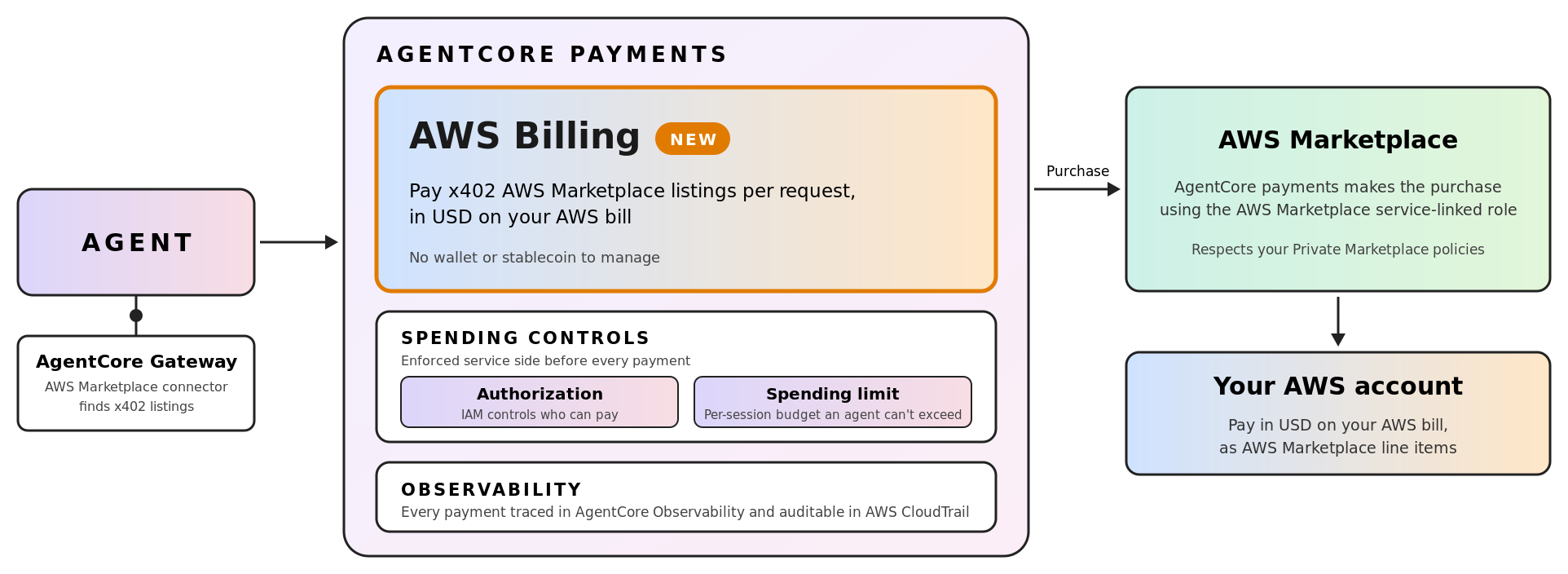
AWS has added AWS Billing as a payment option in Amazon Bedrock AgentCore payments, extending to AWS Marketplace the agent payment capability that reached general availability in August 2026. The change lets an agent discover and buy x402-enabled software, APIs, data and content listed on AWS Marketplace, paying per request in USD with the charge settling on the agent developer's AWS bill. That removes the need for stablecoin wallets or API keys to fund agent purchases, according to the company.
A companion launch is an AWS Marketplace connector inside AgentCore Gateway, described as optional, which helps agents find products and their endpoints. Developers can therefore automate discovery as well as purchasing. At launch, AWS Billing supports the x402 exact scheme, in which the seller quotes a fixed price for each request rather than a metered or variable one.
x402 here refers to an open protocol that repurposes the long-dormant HTTP 402 Payment Required status code. Instead of a human entering card details, a client receives a machine-readable quote from the server, obtains a payment token from some authority, and retries the request with proof of payment attached. AWS frames the Marketplace integration as the first place that flow runs through ordinary cloud billing rather than crypto rails.
Existing AgentCore payments guardrails carry over. Using AgentCore policy, developers set spending limits and an approved seller list. The per-session payment cap is enforced by AgentCore payments itself, so the company says an agent is unable to overspend. Transactions are auditable in AWS CloudTrail and AWS Cost Explorer. If an organization uses Private Marketplace, agents can only buy products that Private Marketplace permits. AWS argues that routing both sides of a purchase through AWS accounts gives agentic purchasing the security and auditability enterprises expect.
Setup requires a Payment Manager configured with an AWS Billing connector. The connector needs only a service-linked role, AWSServiceRoleForMarketplaceAgenticCommerce, which AWS Marketplace uses to bill purchases to the account. For each task, a developer then creates a payment session with a spending limit and hands the session ID to the agent. The first purchase an agent makes from a seller creates an agreement between the AWS account and that seller, and later purchases are tracked against it. Each product appears as an AWS Marketplace line item.
The runtime flow has five stages. First comes discovery: the agent calls three read-only gateway tools in sequence, searching listings, fetching a listing and listing its fulfillment options. Search returns only endpoints that accept x402, and the final call yields the seller's endpoint URL and accepted payment protocols. Second, a quote: the agent calls the endpoint with no payment attached, and the seller replies with HTTP 402 carrying a signed quote in the PAYMENT-REQUIRED header. AWS Marketplace verifies that signature against the seller's registered key, so a quote whose price has been altered is rejected.
Third, payment: the agent passes the quote to the ProcessPayment API with the payment type AWS_BILLING_X402. If session budget remains, AgentCore payments issues a payment token; if not, the call fails and the developer is not charged. Fourth, redemption: the agent retries with the token in the PAYMENT-SIGNATURE header and receives the content. Tokens are valid for roughly five minutes, so steps two through four must complete in a single pass. Fifth, settlement: AWS Marketplace meters each charge to the AWS bill, settling asynchronously and appearing monthly.
AWS published an open-source sample in the agentcore-samples GitHub repository to demonstrate the flow with a research agent. setup_aws_billing.py creates the payment manager, the service-linked role and three IAM roles, deliberately split so the session role can set budgets but not pay, while the agent role can pay but not create sessions, meaning the agent cannot raise its own limit. setup_gateway.py builds an AgentCore Gateway with the Marketplace connector whose role is limited to three read-only Marketplace actions. Skipping that step is possible by setting SELLER_URL to a specific endpoint, which the agent will then pay directly rather than discovering sellers through the gateway.
The demo uses a Strands agent run by strands_marketplace_agent.py. Defaults are a $0.05 session budget and a $0.02 per-request cap. In the documented test against a $0.01 seller, the agent compared two listings before buying and made exactly one payment of $0.01. At completion the sample prints the amount, the AWS Marketplace product ID and a processPaymentId. Because metering is asynchronous, the line item takes a moment to appear on the bill; purchases also surface in CloudTrail and Cost Explorer. A cleanup.py script deletes the resources.
Tavily, described as a live search provider for agentic commerce, is named as one of the verified sellers in the expanding x402 Marketplace catalog. Founder and CEO Rotem Weiss said in a provided statement that agentic commerce is as much about giving enterprises confidence to let agents transact as about the ability to pay, and that connecting agents with KYC-verified providers through secure x402 transactions supports autonomous commerce at production scale.
In practice, the interesting security design is the IAM separation rather than the payment itself. Splitting budget authority from spending authority, combined with a token that expires in minutes and a server-enforced session cap, means the blast radius of a misbehaving or manipulated agent is bounded by a number a human set earlier. The trade-off is operational: teams must provision Payment Managers, service-linked roles and role separation per account, and the exact-price-only scheme excludes sellers who want usage-tiered or variable pricing. The asynchronous monthly settlement also means spend visibility lags the actual purchases, which may matter for agents that buy frequently. A likely question for buyers is how per-request micro-charges aggregate once many agents transact continuously.
Why it matters: Developers building agents that need live web search, proprietary data or paid API calls can now let those agents purchase access without pre-provisioned API keys or crypto wallets, with costs landing on existing AWS invoices and budgets. Enterprise platform teams gain a familiar control surface, since approvals, Private Marketplace restrictions and CloudTrail auditing apply to agent purchases as they do to human ones. For sellers, listing an x402 endpoint on AWS Marketplace becomes a route to agent traffic, though it also pulls them into AWS's billing and verification regime. The main inference to draw is that agent-to-agent commerce is being folded into existing cloud procurement rather than a separate payments stack.
Based on reporting from the original publisher. Visit the source for full context and later updates.
Publisher excerpt
Amazon Bedrock AgentCore payments now supports AWS Marketplace, so agents can discover and buy x402-enabled products, APIs, data, and content and pay in USD on the developer's AWS bill, with no stablecoin wallets or API keys. This post walks through a research agent that finds a tool, pays per request through AWS Billing, and answers with sources.