Private certificate authority support in Amazon Bedrock AgentCore Identity
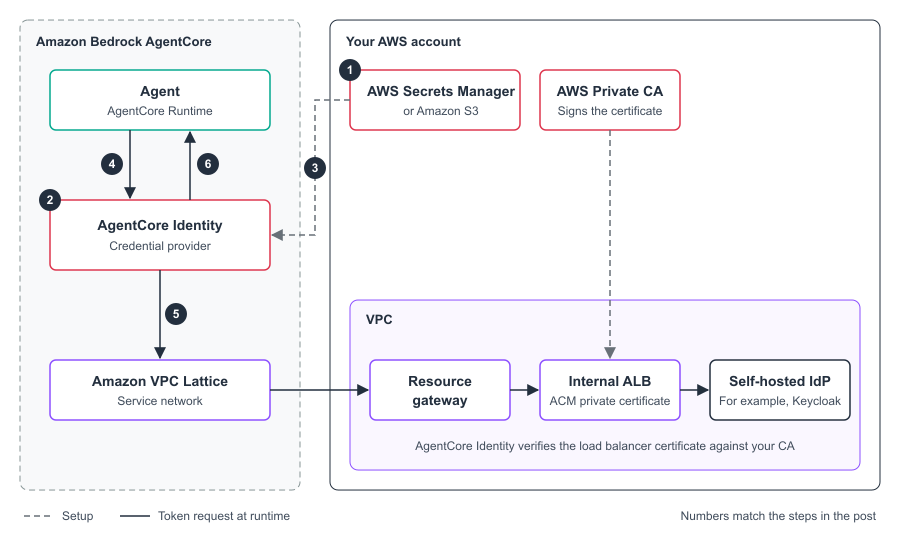
Amazon Bedrock AgentCore Identity added support for private certificate authority (CA) certificates when connecting to private identity providers. The capability, announced on the AWS Machine Learning Blog, applies to teams that self-host an OpenID Connect compliant IdP such as Keycloak or PingFederate inside a private network and secure it with a TLS certificate from a private CA. Agents can now validate that certificate against the organization's own CA instead of failing on an untrusted chain.
Setup has three moving parts. The CA certificate, PEM-encoded and containing only the public certificate and no private key, is stored in AWS Secrets Manager or Amazon S3. A credential provider holds the IdP connection details plus a reference to that stored certificate. AgentCore Identity then uses the CA to validate the server certificate presented by the IdP's OIDC discovery, JSON Web Key Set (JWKS) and token endpoints. Because trust is pinned to the CA rather than the leaf certificate, renewing the IdP's server certificate does not require touching the credential provider.
Private connectivity runs through Amazon VPC Lattice, which is required for private CA support and reaches the customer VPC through a resource gateway. Customers can let AgentCore Identity manage the VPC Lattice resources or point at self-managed resource configurations. The reference architecture in the post puts Keycloak behind an internal Application Load Balancer presenting an AWS Certificate Manager private certificate signed by AWS Private CA, with the CA certificate held in Secrets Manager or S3.
Several hard constraints shape deployment. The feature is limited to private IdPs: a credential provider or authorizer must have a privateEndpoint configured, and requests without one fail with the message that the private CA feature can only be used with private IdP. The PEM file must hold only root or intermediate CA certificates that are within their validity period and must not exceed 16 KB. Each credential provider references exactly one secret or one S3 object; trusting several CAs means bundling them into a single PEM file. The secret or object must sit in the same AWS Region as the provider. Secrets Manager secrets must also be in the same account, while S3 objects may live in another account when bucketOwnerAccountId is supplied and the bucket policy grants access. Regional availability follows VPC Lattice and the Regions where AgentCore Identity supports private IdPs.
Permissions follow the caller. AgentCore Identity reads the certificate using the credentials of the principal that calls CreateOauth2CredentialProvider, so that principal needs secretsmanager:GetSecretValue on the secret or s3:GetObject on the object, plus kms:Decrypt if a customer managed AWS KMS key encrypts it. Machine-to-machine, on-behalf-of and user-delegated flows can all use the private CA without code changes, per the post.
Configuration works from the console or the AWS CLI. In the console, private CA settings appear only after the OAuth client is tied to a VPC, reflecting the private-only restriction. With the CLI, certificateConfigurations is added to the custom OAuth 2.0 provider configuration, accepting either a secretsManager object with a secretArn or an s3 object with a uri and optional bucketOwnerAccountId. A new provider starts in CREATING status while AgentCore Identity validates the certificate and establishes private connectivity, moving to READY when agents can request tokens. Documented failure modes include rejecting a leaf certificate instead of a CA, an unreachable S3 object or secret, or a READY provider whose token requests fail because the IdP certificate was not issued by the configured CA or lacks a matching subject alternative name. For hostname checks to pass, each hostname in the discovery document should appear as a SAN on the IdP certificate.
Two operational points stand out. AgentCore Identity rereads the certificate only on create or update, so changing the underlying secret or object requires calling UpdateOauth2CredentialProvider with certificateConfigurations included; omitting it causes the provider to stop trusting the private CA. The service also publishes an EarliestCertificateDaysToExpiry metric to CloudWatch in the AWS/Bedrock-AgentCore namespace, with ProviderName, ProviderArn and TokenVault dimensions, and AWS recommends an alarm well before the value hits zero since token requests break at expiry. This suggests certificate expiry is the most likely silent outage pathway in production.
Rotation can be done without downtime. Put the current and new CA certificates in one PEM file, update the provider and wait for READY, swap the IdP server certificate to one issued by the new CA, confirm token requests succeed, then upload a file with only the new CA and update again. A likely trade-off is that AgentCore Identity does not check certificate revocation lists or use OCSP, so a stolen IdP server certificate private key stays trusted until that certificate expires or the issuing CA is removed from the PEM file and the provider updated. The CA certificate itself is public by design; what needs protecting is write integrity of the trust store, since anyone who can swap or add a CA could impersonate the IdP after the next update. AWS recommends granting writes only to the IdP operating team or pipeline and reads to the principals that create or update credential providers.
Why it matters: Teams that keep identity infrastructure off the public internet can now wire it to agents without a public CA or an internet-facing IdP, which removes a common blocker for regulated and internal-only deployments. Developers should plan Region and account placement of the trust store up front, wire the expiry alarm, and treat update calls as the switch that actually picks up certificate changes, since editing the stored file alone has no effect. In practice, I would expect the biggest ongoing effort to be key and certificate lifecycle hygiene rather than the initial integration.
Based on reporting from the original publisher. Visit the source for full context and later updates.
Publisher excerpt
Amazon Bedrock AgentCore Identity now supports private certificate authorities (CAs), so your agents can connect to self-hosted identity providers that use a private CA. This post shows how to issue an IdP certificate with AWS Private CA, configure a credential provider to trust it, rotate the CA, and protect the certificate.