[AINews] OpenAI’s Patch the Planet program is 1 of 2 parties to discover PHP2Shell vulnerabilities in core PHP affecting 70% of the web, using GPT-5.6 Sol; coordinated response over 2 months
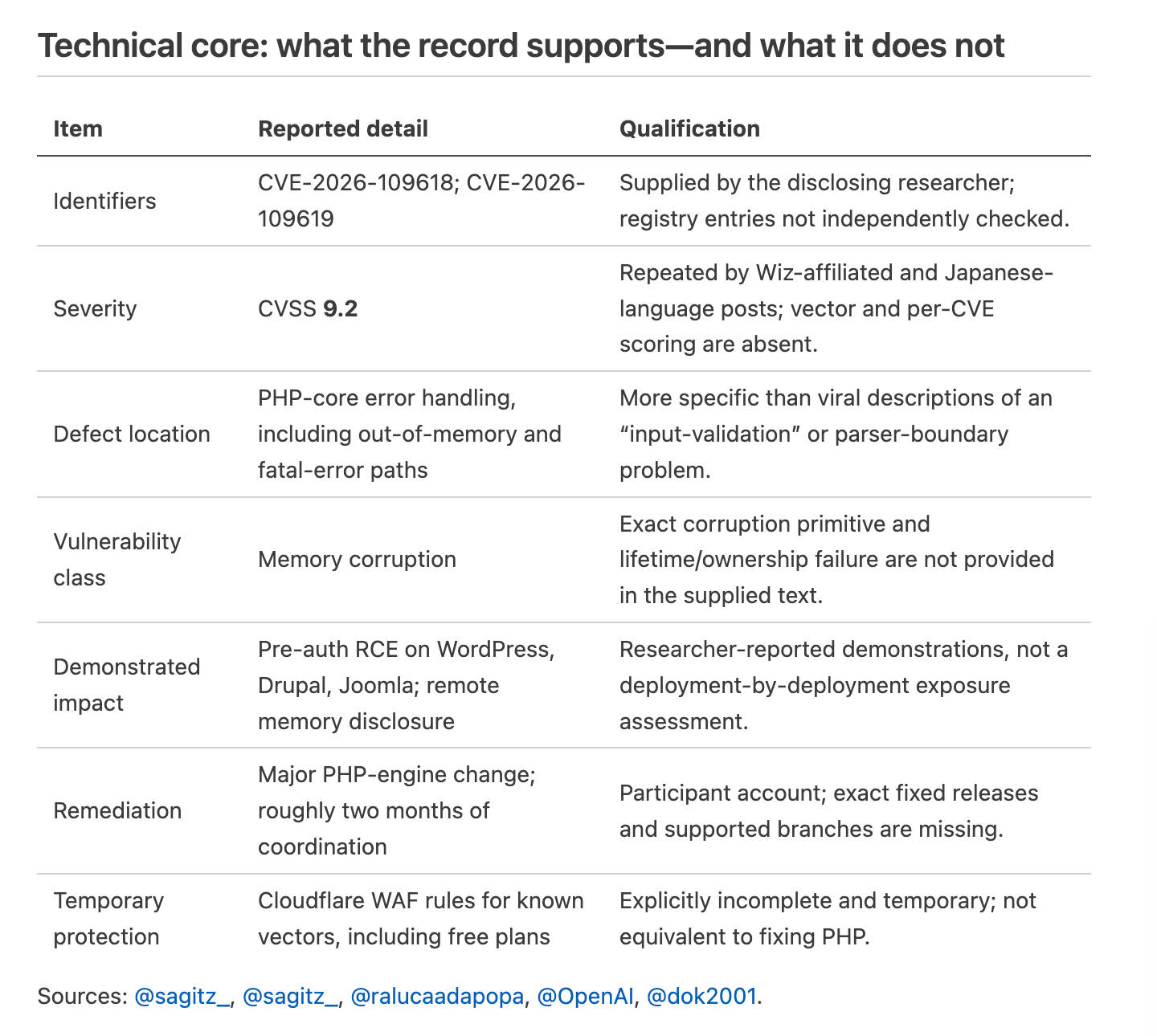
Two memory-corruption vulnerabilities in the PHP engine were disclosed and named PHP2Shell, tracked as CVE-2026-109618 and CVE-2026-109619. Researchers say the defects sit in PHP's internal handling of out-of-memory conditions and fatal errors rather than in a WordPress plugin or an application's login logic. The two independent discovery parties were Ryan Austin, a researcher at the security firm Calif, working under OpenAI's Patch the Planet program in August 2026 with the GPT-5.6 Sol model, and Wiz, recently acquired into Google Cloud, which used Gemini 4 Argon and GPT-5.6 Sol alongside its own Wiz Atlas tool. OpenAI describes roughly two months of private coordination before disclosure, led by a coalition preparing fixes and protections.
The disclosed demonstrations included pre-authentication remote code execution against WordPress, Drupal and Joomla, plus what the researchers describe as Heartbleed-style memory disclosure. The remote memory disclosure claim is stated broadly, against any PHP application; the CMS-specific RCE results are separate researcher-reported findings. Treating every PHP deployment as carrying an immediately exploitable RCE path goes beyond what was demonstrated. A participating researcher said the work with the PHP Foundation was aimed at supporting and hardening the patch, which OpenAI says required a major change to the PHP engine itself.
The response layered several defenses. Cloudflare deployed WAF mitigations before the scheduled patch release; its CTO said the rules covered known exploit vectors, were available to every customer including the free tier, and were being revised as early attacks appeared. He called the rules a stopgap and pointed operators to patch at 14:00 UTC. Japanese-language warnings told operators to prepare for a 23:00 JST release on October 21, the same moment. The NSA account in the record urged preparation for an immediate update and suggested taking systems offline where timely mitigation was not possible. OpenAI later said upgrades were available.
Reporting from The Rundown says details surfaced before the patch. A widely shared compilation attributed to Censys counted roughly 1.5 million servers running unfixed versions, and reported shutdowns touching Dutch institutions, European government sites, Wikipedia, Archive.org, Asana, GOG and others, plus a 05:55 warning from Japan's prime minister. Those individual figures and outage reports were not corroborated by underlying advisories or status pages, and the record does not establish whether each outage was precaution, patching interruption, unrelated failure or compromise. SemiAnalysis reports the Japanese prime minister urged PHP operators to patch immediately or disconnect if they could not, set against an existing Japanese breach wave; that account does not establish PHP2Shell as the cause of those earlier incidents.
After disclosure, OpenAI published a repository containing a Codex skill to walk operators through checking whether their sites were affected. That is an assistance workflow; in practice a vendor advisory, package verification and confirmation of the running build remain the authoritative checks. This is my reading of the operational shape of the event: the hard part is distribution and ownership, not discovery. A team has to find PHP across managed hosting, containers, appliances, background workers and old applications, get the right packages, deploy them, restart or replace processes, and verify what is actually running.
The AI angle drew competing credit and some overstated framing. The affirmative case rests on working exploit chains, coordinated patch engineering, detectors and patch validation rather than a benchmark score. A participating researcher called PHP2Shell the most consequential vulnerability they have helped discover. OpenAI frames it as an example of the "Defender's Window" — advanced models finding a flaw before attackers — while qualifying the claim as being to its knowledge, which is not proof that no attacker already knew. Google separately advertises Wiz testing in which Gemini 4 Argon found more than twice as many vulnerabilities as baseline models, but that promotional post exposes no dataset, baselines, budgets or false-positive accounting, so it is not an independent comparison on this bug.
Researcher access policy drew both praise and criticism: one researcher credited OpenAI's Daybreak access with findings across PHP, GitLab, Chrome and WordPress, while others contrasted it with stricter Anthropic restrictions. Reporting that Anthropic delayed broad access to Mythos-class models for four months to strengthen cyber safeguards gives context for restricted access but does not settle whether that helped or hindered here. A burst of disclosures is not itself evidence of a burst of AI-caused compromises; the feed mixes defensive discovery, supply-chain attacks, credential theft, precautionary shutdowns and unrelated bugs.
On mitigation, WAF rules cut immediate exposure but invite false confidence. Cloudflare's statement is narrower than later advice to put everything internet-facing behind a proxy: known vectors were covered, protections were evolving, patching stayed mandatory. Proxied coverage, alternate ingress paths and origin exposure all need checking. A proposal to use the RCE itself to auto-patch every server, floated by Marc Köhlbrugge with a speculative presidential pardon from J. D. Pressman, is not an authorized remediation plan; unsolicited exploitation risks unauthorized access, outages, broken fixes, destroyed evidence and cross-jurisdictional liability. The update-velocity dilemma is real too: constant updating exposes users to compromised packages, while delay leaves known holes open.
Longer-term questions remain open. Sarah Guo reports CVEs climbing from roughly 4,000 a month to 15,000 since April and asks about formal verification, safer distributions and organizations without red teams; those counts are unverified here and disclosure volume is not a measure of successful exploitation. For an incident team the defensible sequence is to pull the authoritative PHP and distribution advisories, inventory exposed runtimes, apply temporary protections where justified, deploy authenticated fixed packages, verify running processes, and investigate exploitation evidence separately — updating closes a vulnerability but does not prove credentials or data were never exposed. A June note for context: the source material does not provide an exact affected-versus-fixed version matrix, CVSS vectors or deployment prerequisites.
Why it matters: Any team running PHP — which the headline puts at 70% of the web — faces a core-engine vulnerability that no plugin update can close, so action means upgrading PHP itself and confirming the running build. The episode also previews a pattern: model-assisted discovery producing a high volume of critical findings, with defenders racing to patch and attackers watching for leaks. My inference is that patch pipeline speed and runtime inventory will matter more than the specific bug for most organizations over the coming year.
Based on reporting from the original publisher. Visit the source for full context and later updates.
Publisher excerpt
The Big Hardening begins