How DXC Technology built a multi-model AI substrate on Amazon Bedrock
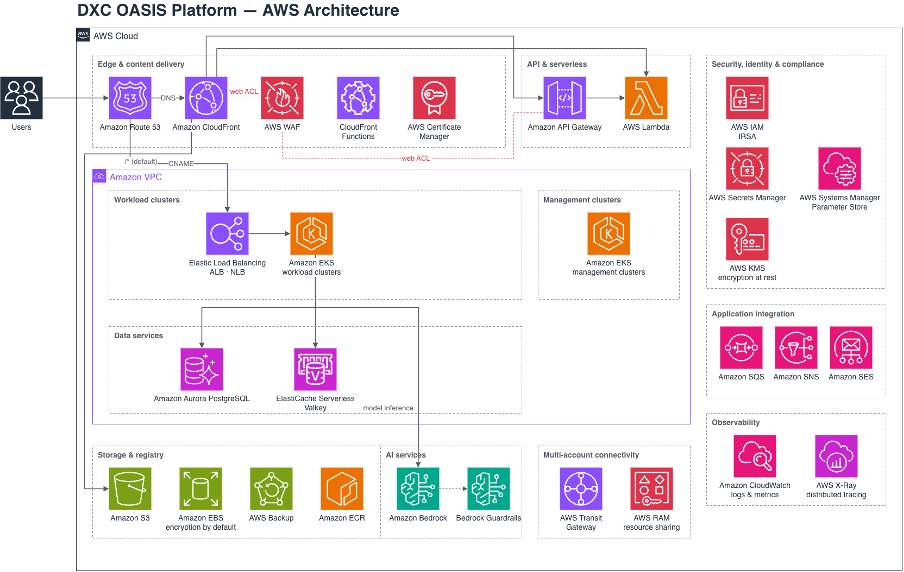
DXC Technology has detailed how it built the model layer of DXC OASIS, the agent platform it uses for mission-critical IT operations, on Amazon Bedrock. The company, which employs more than 115,000 people across 70 countries serving banks, hospitals and government agencies, started the system as a prototype in early 2025 and reached general availability in March 2026. It is now scaling toward 130 customer environments running on Amazon Elastic Kubernetes Service (EKS), with per-tenant namespaces and GitOps rollout. Since GA, DXC reports an average 95% reduction in resolution time across 56 measured use cases, with diagnostic accuracy of 92% or better validated against senior engineer judgment.
The architecture is deliberately split into two layers. The first is a governed model substrate built on Bedrock, which provides one managed interface to Anthropic Claude, Amazon Nova, Meta Llama and various open-weight model families. The second is the harness DXC built itself: orchestration across tools and systems, operational context drawn from 60 years of runbooks and escalation logic, policy enforcement, human-oversight gates and audit trails for every agent action. The stated design goals were resilience with no single point of failure at the model layer, flexibility to route each task by cost, latency and capability, data-handling compliance for regulated tenants, and bounding what any agent can do.
Requests reach the system through Amazon Route 53 and an Application Load Balancer inside the customer's VPC. The agent runtime sits on EKS in a private subnet, where a supervisor agent delegates to capability agents that use a knowledge base, AWS Secrets Manager, Amazon EventBridge and Amazon S3. Every model call exits through a VPC interface endpoint and AWS PrivateLink, so inference traffic never crosses the public internet. Identity and access management come from AWS IAM, encryption at rest from AWS KMS, transport security from TLS 1.2, and observability from CloudWatch, VPC Flow Logs, CloudTrail and OpenTelemetry. DXC says prompts and completions are not shared with third-party model providers and are not used to train foundation models, and that model availability varies by AWS Region.
The practical payoff of a single API in front of many models is that a provider outage or deprecation becomes a routing decision rather than a rebuild. DXC is explicit that uniform access is not uniform behavior: models differ in capability, response style and failure modes, so substituting one for another counts as an assurance activity. Before a model enters production routing, the harness, not the API, evaluates it against DXC OASIS task suites. This is worth noting for teams planning similar setups: a common interface removes integration work but does not remove the need for per-model regression testing.
On routing, DXC uses Bedrock's intelligent prompt routing, a single serverless endpoint that predicts response quality and sends simpler prompts to cheaper models in the same family while steering complex reasoning to stronger ones. Prompt caching is used to cut latency and cost, and Custom Model Import extends the same governance and tooling to models DXC or its clients supply. Open-weight models can sit alongside proprietary ones under one set of guardrails.
The article draws a sharp line between what the substrate provides and what the harness must add. Bedrock contributes knowledge-base infrastructure, prompt caching, IAM, regional inference controls, tenant-isolated model access, and Guardrails covering content filters, denied topics and PII filters. DXC's harness adds supervisor and capability-agent delegation built on the open-source LangGraph runtime, per-request policy enforcement, persona-based authorization, field-level constraints, tiered knowledge hierarchy and customer-specific rules about what an agent may act on. Human oversight sits entirely in the harness: four authority tiers (observe, propose, act with approval, act within scope), with every persona starting read-only, plus approval gates and escalation paths. End-to-end traceability comes from OpenTelemetry traces carrying a unique execution ID per action, so audit records come from the harness rather than from the agent's own account of its work.
The authors frame the design against a specific failure mode: an agent holding more authority than its task requires, with nothing in the architecture to stop it. Guardrails on inputs and outputs help but cannot by themselves limit what an agent is permitted to do. In practice that means the interesting safety work happens above the model layer, in scoped roles and recorded approvals.
A worked demo, set in a fictional airline called AnyCompany Airlines, shows the flow on an incident where a runbook fails to clear disk space on a FlightOps server. The CIO sees the alert as a business risk to flight scheduling within four hours, while a Linux engineer sees the technical detail. The engineer opens AI Assist from a dashboard widget, a supervisor agent plans and delegates to Metrics, Linux System and ITSM agents, and all model calls go through Bedrock. The Metrics agent confirms the server is 99% full with cited knowledge-base articles; the Linux System agent traces the cause to a single 5 GB temporary file. Nothing executes until the engineer approves the plan, and the fix is recorded with what ran, on which server, who approved it and when. The conversation can then be turned into a draft knowledge article.
Representative measurements illustrate where the gains come from. Filesystem incidents fall from 53 to 90 minutes to 3 to 6 minutes, roughly 89% to 97% savings. Database performance incidents drop from 2 to 3 hours to 5 to 12 minutes. Cloud policy validation goes from 4 to 8 hours to 15 to 30 minutes, and patching validation from 45 to 90 minutes to 5 to 10 minutes. The agents now serve 12 operational personas spanning Linux, Windows, SAP, virtualization, backup and patching, AWS, Azure and network operations. These figures come from DXC's own measured use cases, so treat them as vendor-reported rather than independently benchmarked.
DXC credits four architectural decisions. Model choice, orchestration framework and deployment target are kept as independent decisions so the system avoids re-platforming when a layer changes. Resilience is compounded across serverless infrastructure, guardrails, private networking and approval gates rather than resting on one control. The substrate-harness boundary is drawn explicitly to avoid both under-engineering and over-engineering. And autonomy is bounded before it is scaled, with read-only defaults and authority granted one tier at a time. DXC says it is evaluating Amazon Bedrock AgentCore alongside its current orchestration layer and plans to extend the system to additional regulated workloads as new frontier models arrive in Bedrock.
Why it matters: Teams putting agents in front of production systems are being pushed toward layered control, and this account is a concrete reference architecture for that. Treating model access, orchestration and authority as separate decisions means model swaps become routing changes, but it also means the testing and approval machinery around each model is work you own. Developers building similar harnesses should note where DXC placed responsibility: filtering at the model layer, and the enforcement of what an agent may actually do in their own code.
Based on reporting from the original publisher. Visit the source for full context and later updates.
Publisher excerpt
DXC Technology runs mission-critical managed IT services for regulated organizations across 70 countries. Learn how DXC built DCX OASIS, its Human+AI operating model, on a governed multi-model substrate in Amazon Bedrock, separating a resilient model substrate from a trusted harness that orchestrates, governs, and audits AI agents at scale.