Ian Buck Kicks Off NVIDIA’s Week at SC26 as Science Enters the Age of Agents
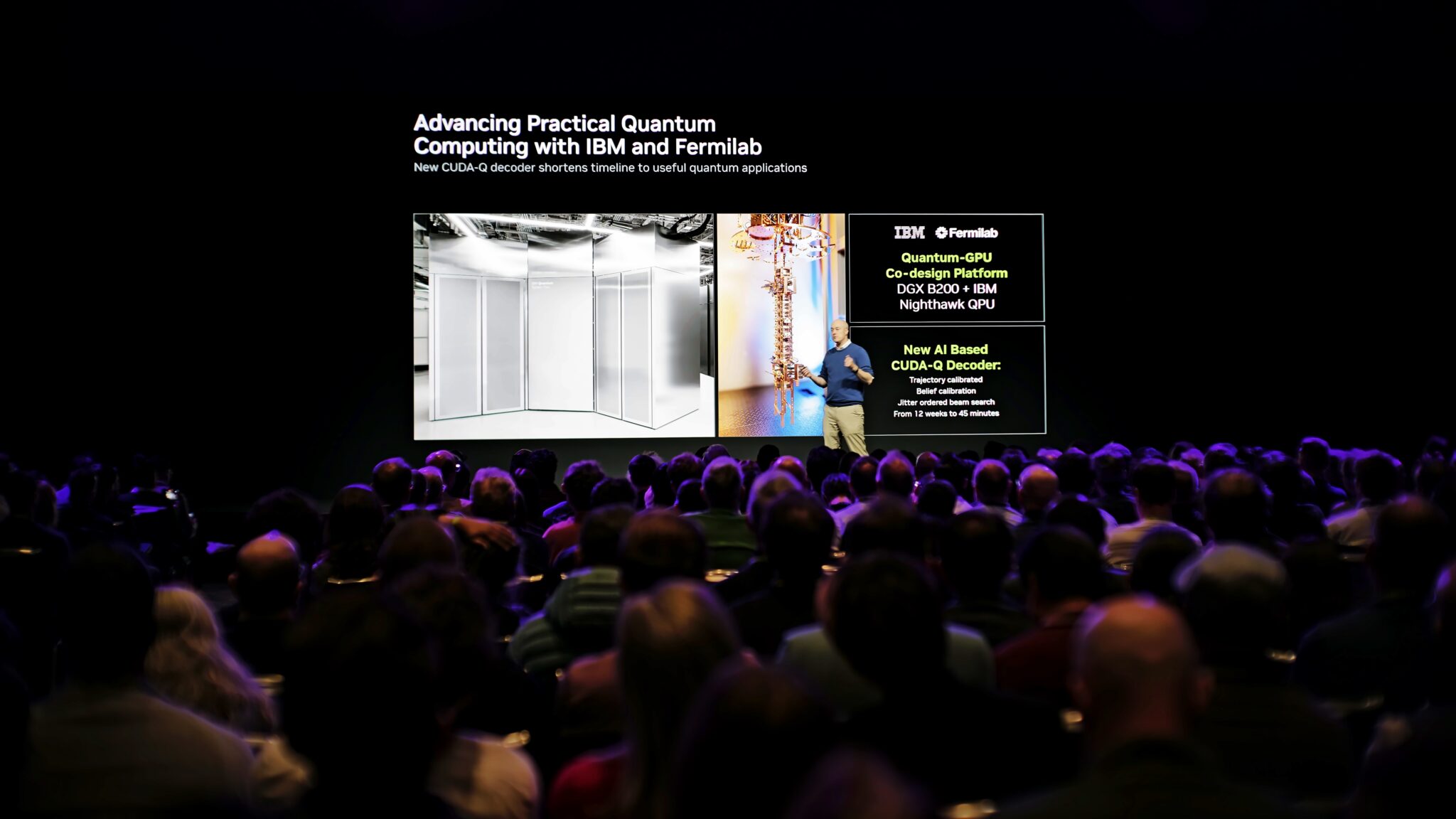
NVIDIA opened its week at SC26 in Chicago on Monday with a special address from Ian Buck, vice president of hyperscale and high-performance computing, who used the slot to announce a package of tools and hardware aimed at scientific computing. The announcements covered Nemotron for Science, a new Rubin HPC GPU in the Vera Rubin platform, an expanded Vera CPU line for high-performance computing, and a quantum computing collaboration with IBM and Fermi National Accelerator Laboratory.
Buck framed the direction of the field around three converging pillars. Simulation, he said, remains the foundation and will always sit on top, with AI, quantum computing and now agents working alongside it. He opened by recalling his first public CUDA talk two decades earlier, at an SC06 tutorial in Tampa, Florida, and noted that NVIDIA now ships more than 1,000 CUDA-X libraries.
The headline software item, Nemotron for Science, bundles the Nemotron 3.5 Super VL open model with a new open chemistry dataset and post-training recipes for life sciences and chemistry. The key design choice is that everything runs locally: on a DGX Spark workstation, an ordinary workstation, or the researcher's own supercomputer. That matters because it keeps data and model weights under the institution's control, a point Buck made directly when he said researchers own their data and own the model.
Buck illustrated what these agents do in practice. At Argonne National Laboratory, an agent built with the toolkit received a single prompt, planned and tested hypotheses, selected which simulations to run, and identified two new binding sites. An agent from KTH Royal Institute of Technology autonomously repairs broken GROMACS molecular dynamics setups; in one overnight run on a single DGX Spark, Buck said it fixed 81% of test cases. At the SETI Institute's Allen Telescope Array, an agent took a one-line prompt to plot a methanol line and then retuned for Doppler shift on its own.
NVIDIA also introduced an Nsight AI Porting Agent, which moved a routine from the Weather Research and Forecasting model to GPUs, speeding it up more than 5x. The token cost Buck cited is notable: roughly 150 million tokens for that single porting job. That figure is a useful signal for teams planning agent-driven code migration, because inference cost at that scale is a real budget line rather than a rounding error.
On the CPU side, Buck argued that agents depend heavily on CPUs to execute tool calls between model steps, evaluating results and feeding them back into the loop. DKRZ, the German Climate Computing Center, has selected Vera CPUs for its HLRE-5 supercomputer, expected in early 2028. That system joins previously announced Vera deployments at the Texas Advanced Computing Center.
Rubin HPC is a new GPU in the Vera Rubin platform built for science, engineering, analytics and AI. It supports precisions from FP64 down to FP4, adds acceleration for sparse data, and connects over seventh-generation NVLink. Buck said it carries more than 50,000 CUDA cores, roughly three times Hopper's count. It is expected in 2028. The FP64-to-FP4 range is significant for scientific users, since double precision has long been the baseline for simulation codes while FP4 is aimed at the low-precision inference agents rely on; a single part covering both ends simplifies procurement for mixed HPC and AI workloads, though the sparse acceleration and core count say nothing on their own about memory bandwidth, which usually determines real simulation throughput.
On quantum, Buck described a simulation on Jülich's JUPITER supercomputer showing that a technique called magic state cultivation can cut the operations required for one logical step tenfold. That work is being added to CUDA-Q. He also introduced a decoding algorithm, TCBP-JOBS, that reduces error-correction research computation from 12 weeks to 45 minutes, part of an effort to bring decoding latency down from about 300 microseconds to 10.
Separately, NVIDIA, IBM and Fermilab announced plans for a quantum computing co-design platform supporting error-correction and applications research. NVIDIA and IBM are pairing DGX B200 systems with IBM quantum computers, including machines powered by IBM Quantum Nighthawk. Error correction remains the central obstacle to useful quantum machines, so a co-design effort pairing classical GPUs with quantum hardware is a sensible place to concentrate engineering effort; it is also a multi-party arrangement whose practical output will only be visible over time.
Finally, Buck showed one of the first deployments of NVIDIA Photonics co-packaged optics switches, at Lambda, claiming 15x better reliability on bit errors and link flaps. Co-packaged optics moves the optical engine next to the switch ASIC rather than at the faceplate, which is widely seen as a route to lower power and higher port density for large AI clusters; reliability figures like this one are early field data rather than broad multi-site results.
Why it matters: Research teams and the developers who support them get an open, locally runnable stack for building agents that plan experiments, run code and check results, plus a CPU and GPU roadmap stretching to 2028 for capacity planning. The Argonne and KTH results, the 5x WRF port, and the TCBP-JOBS speedup suggest agent-driven scientific work is moving from demo to measurable workflow, though several headline numbers come from single runs and should be treated as indicative rather than general benchmarks (my inference). Organizations weighing Vera or Rubin systems should note the 2028 timelines when scheduling procurement.
Based on reporting from the original publisher. Visit the source for full context and later updates.
Publisher excerpt
NVIDIA’s Ian Buck kicked off the company’s week at SC26 in Chicago on Monday with new tools for AI agents, software that can plan experiments, run code and check results on researchers’ own systems. In NVIDIA’s special address, Buck announced Nemotron for Science, the Rubin HPC GPU and an expanded Vera CPU platform for high-performance […]