Introducing Amazon SageMaker HyperPod Global Inference Gateway: One endpoint across Regions and clusters
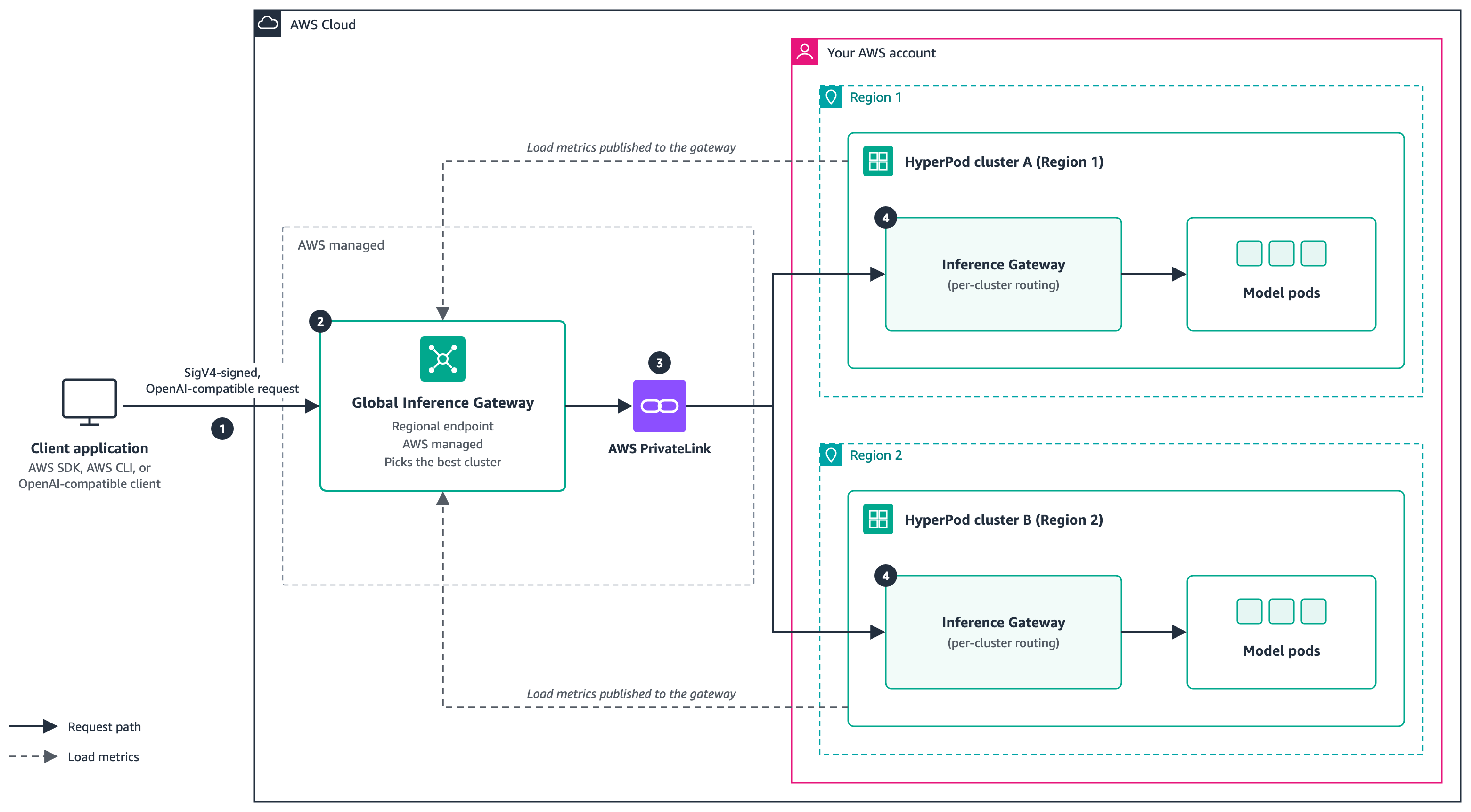
AWS has introduced the Amazon SageMaker HyperPod Global Inference Gateway, a SageMaker-managed endpoint that routes inference requests across every HyperPod cluster a customer registers, whether those clusters sit in one AWS Region or several. The gateway is the second tier of the architecture AWS described in an earlier post about the per-cluster Inference Gateway. The existing Inference Gateway gives each cluster a single GPU-aware endpoint that reads signals such as key-value cache utilization and queue depth to place each request on the best pod; the Global Inference Gateway adds cluster selection above that, while pod selection inside each cluster continues unchanged.
The problem being addressed is capacity fragmented across clusters and Regions. AWS illustrates it with a team serving four models on five HyperPod clusters spread across two Regions. Without any gateway, clients would track 20 endpoints, one per model per cluster. The per-cluster Inference Gateway cuts that to five, but each client still has to choose a cluster, which produces uneven load during peaks, manual failover when a cluster goes down, and custom load balancers, DNS and cross-Region networking maintained by the customer.
The Global Inference Gateway collapses that to a single SageMaker-managed endpoint. During a peak, requests overflow to clusters with available capacity instead of queuing on a saturated one. If a cluster fails, the gateway moves its traffic to the next-best cluster without client changes. Private connectivity is handled by AWS PrivateLink, and every request is authenticated with AWS Signature Version 4 and authorized through IAM. AWS states that the gateway does not log or store prompts or completions.
Setup involves two decisions. First, publish a cluster: turn on the spec.globalRouting block in the cluster's existing InferenceGatewayConfig, once per cluster. The HyperPod Inference controller then creates a Network Load Balancer in front of the cluster's Inference Gateway, publishes a VPC endpoint service on it, and uploads the listener's certificate to the customer's TLS bucket, all in the customer's account. A cluster is reachable only after it is published, and listing an unpublished cluster in a gateway call fails with a message describing the fix. Second, create the gateway with CreateGlobalInferenceGateway, passing the clusters to route across; SageMaker returns one endpoint.
Request flow runs in four steps. The client signs with SigV4 and calls the gateway's regional endpoint. The gateway authenticates the caller and picks the best cluster. PrivateLink carries the request to that cluster, in-Region or cross-Region. The cluster's Inference Gateway then routes to a model pod as before. Each cluster's metrics publisher reports load back to the gateway, giving it the live signals needed to score candidates.
Routing decisions use four weighted signals. KVHeadroom scores available KV cache and GPU memory (default weight 0.20); QueueDepth measures backlog (0.25); RegionProximity measures distance from the gateway's Region (0.40); ErrorRate tracks recent failures (0.15). Weights range from 0.0 to 1.0, and setting them requires all four to sum to 1.0; omitting them applies the defaults. The default mix prioritizes nearby clusters while still shifting traffic toward capacity and away from failing clusters. Teams that value resilience over latency can raise ErrorRate, for example to 0.7 with the other three at 0.1. Weights are passed in the Routing parameter of CreateGlobalInferenceGateway and can be changed later with UpdateGlobalInferenceGateway; new requests pick up new weights while in-flight requests finish under the old ones.
On the IAM side, callers need sagemaker:InvokeGlobalInferenceGateway, with a separate sagemaker:InvokeGlobalInferenceGatewayWithResponseStream action for streaming responses. The execution role is scoped to describe only listed clusters, reach only their Amazon EKS API, and read only routing certificates under the gig/ prefix of the TLS bucket. If clusters validate JSON Web Tokens, the token is passed with --customer-identity-token (the X-Amzn-SageMaker-Customer-Identity-Token header) without a Bearer prefix; it travels inside the SigV4 signature, so an unsigned token gets a 403 and a repeated token a 400. AWS advises enabling JWT checks on every cluster that serves a model, or none, to avoid a request succeeding on one cluster and failing on another. This consistent-policy requirement is a reasonable design constraint: mixed authentication postures across a gateway would make behavior hard to predict.
Operationally, AddInferenceGateway and RemoveInferenceGateway are called in the gateway's Region even for clusters elsewhere. Removing a cluster stops new requests, lets in-flight ones finish and deletes the private endpoint, and a gateway always keeps at least one cluster; withdrawing it fully also means setting globalRouting.enabled: false. DeleteGlobalInferenceGateway stops the gateway endpoint while per-cluster endpoints keep serving. On failure, traffic shifts to the next-best cluster and returns gradually after recovery; a failed request is retried once on another cluster unless streaming has started, and a 503 is returned if no healthy cluster remains. Creation failures land in FAILED with a FailureReason.
AWS offers several practical cautions. Decide group membership before publishing and give the same modelName to every cluster that should share a model's traffic. Publish only clusters that belong to a gateway, since a published cluster outside any gateway receives no traffic but its Network Load Balancer is still billed. Every model must appear in a scheduler or requests return 404. Using --resolve-conflicts OVERWRITE with incomplete configuration can reset load balancer or TLS settings. A workload can be pinned to one Region by creating a gateway containing only clusters in that Region.
Bagelcode's Jinhyung Park, VP of AI Platform, said beta tests routed requests across two AWS Regions through a single endpoint and kept serving when one cluster could no longer serve the model, giving a small platform team cross-Region failover without maintaining its own routing layer.
The service is available in 13 AWS Regions: US East (N. Virginia), US East (Ohio), US West (N. California), US West (Oregon), South America (São Paulo), Europe (Frankfurt), Europe (Ireland), Europe (London), Europe (Stockholm), Asia Pacific (Tokyo), Asia Pacific (Mumbai), Asia Pacific (Singapore) and Asia Pacific (Sydney). AWS recommends staying on the per-cluster endpoint for single-cluster deployments and moving to the global gateway when a second cluster is added.
Why it matters: Teams aggregating GPU capacity across clusters and Regions can now expose one OpenAI-compatible, SigV4-signed endpoint instead of building cross-Region load balancing and failover themselves, which lowers operational toil for small platform teams. The main trade-offs to weigh are cross-Region latency for overflow traffic, the billed Network Load Balancer on any published cluster left out of a gateway, and the need for uniform JWT policy across clusters. Inference: the tunable weights make this a scheduling-policy product as much as a networking one, so expect teams to iterate on weight configurations rather than treat defaults as fixed.
Based on reporting from the original publisher. Visit the source for full context and later updates.
Publisher excerpt
Amazon SageMaker HyperPod introduces the Global Inference Gateway, one managed endpoint that routes inference requests across your HyperPod clusters in one Region or across Regions. It picks the best cluster, fails over automatically, and authenticates every request with SigV4 and IAM over AWS PrivateLink.