Access OpenAI GPT models on Amazon Bedrock from Canada with cross-Region inference
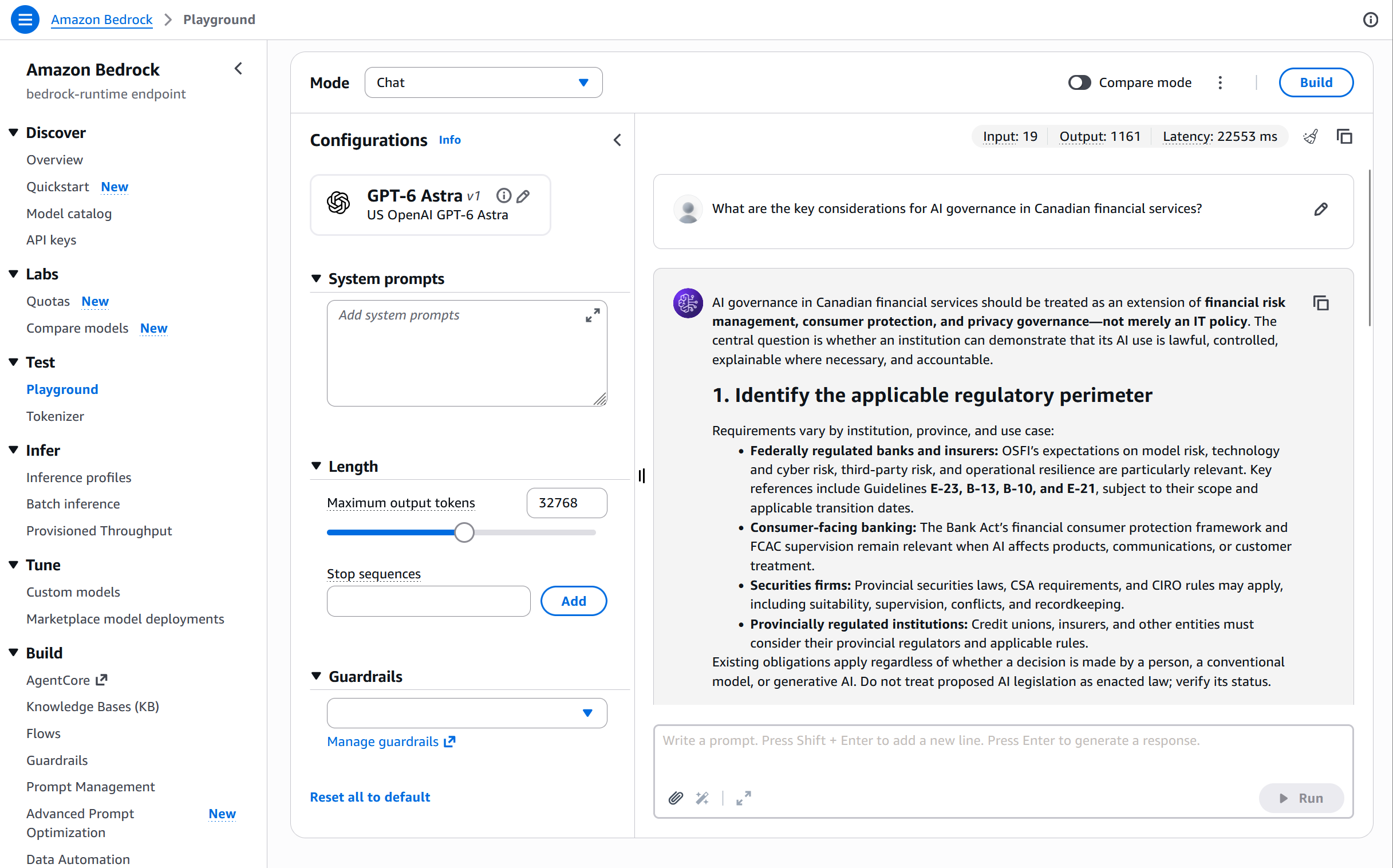
AWS has made OpenAI's GPT-5.6, GPT-6 and GPT-6.1 model families callable from the Canadian AWS Regions on Amazon Bedrock through cross-Region inference, the service's capacity-sharing mechanism. Applications with a source region of Canada (Central) ca-central-1 or Canada West (Calgary) ca-west-1 can now invoke the models; inference itself runs outside Canada, in North America for the geographic profile or in any supported commercial region for the global one.
The lineup covers three families and seven model variants, positioned differently. GPT-6.1 Sol is pitched at demanding reasoning and coding where both quality and cost matter. GPT-6 spans Astra for complex end-to-end reasoning and agentic work, Sol for recurring reasoning and coding tasks, and Luna for fast, low-cost, high-volume work with adjustable reasoning effort per request. GPT-5.6 comes in Sol for heavy reasoning, coding and agentic workloads, Terra as a balanced everyday production option, and Luna for latency-sensitive, high-volume jobs.
The GPT-5.6 and GPT-6 models take text and image input and return text, with a 1-million-token context window, a reasoning mode and tool calling. GPT-6.1 Sol matches that context window and tool-calling support and adds further input and output modalities documented in its model card. All three families support prompt caching on Bedrock, and all are reachable through the OpenAI Responses API, the OpenAI Chat Completions API and Bedrock's own Converse API on the bedrock-runtime endpoint.
Two inference profiles are offered from Canada. Profiles prefixed us. keep requests inside the source region and US regions, which suits workloads that must stay within North America. Profiles prefixed global. spread across every supported commercial region where the model is deployed, drawing on a larger capacity pool. Profile membership can change, and the global profile for GPT-5.6 is offered only from ca-central-1; teams in Calgary must use the us. profile for those models. AWS advises checking which profiles are live in a source region before deploying, either through the list-inference-profiles CLI call filtered on SYSTEM_DEFINED and the string openai, or in the console under Inference then Cross-Region inference.
Permissions follow a two-part pattern. The caller needs bedrock:InvokeModel* on the inference profile ARN, plus invoke rights on the underlying foundation-model ARN, gated by a StringLike condition on the bedrock:InferenceProfileArn key. For the quickest start AWS points to the managed AmazonBedrockLimitedAccess policy; for production it recommends a scoped custom policy. Applications using the API-key path with the OpenAI SDK also need bedrock:CallWithBearerToken, and the Responses API needs invoke permissions on the default project ARN.
Organizations that fence regions with service control policies get a matching template. A Deny statement on bedrock:InvokeModel* prevents calls outside ca-central-1 and ca-west-1 unless the request carries an inference profile ARN matching the us.openai.* or global.openai.* patterns. This lets CRIS traffic through while blocking direct calls to unapproved regions; AWS notes every destination region in the chosen profile must be allowed for a request to succeed.
Client code changes are small. With the OpenAI SDK, point base_url at https://bedrock-runtime.{region}.amazonaws.com/openai/v1 and pass a profile ID such as global.openai.gpt-6-astra as the model. The sample uses the aws-bedrock-token-generator Python package to mint a short-lived Bedrock API key from existing credentials, avoiding a stored static key, and the endpoint accepts either that key or standard SigV4 signing. Streaming uses stream=true with a loop over response.output_text.delta events; tool use declares functions in the tools parameter and reads back function_call items from the response. Teams standardized on AWS SDKs use boto3's converse call, keeping in mind that GPT-5.6 and GPT-6 can return a reasoningContent block beside the text, so code should select the text block explicitly.
Prompt caching is available without code changes: Bedrock automatically caches eligible prefixes of 1,024 tokens or more. Cached tokens read on later requests are billed at a discount and excluded from the tokens-per-minute quota, and they surface in the response usage object and CloudWatch metrics; explicit cache breakpoints and cache-write pricing are covered in the documentation and model cards.
Quotas are measured in tokens per minute per model, with input and output sharing one limit, and the us. and global profiles draw on separate allocations, so switching profile changes the budget. Consumption counts input, cache-write input and output tokens, with output multiplied by a per-model burndown rate, meaning output-heavy workloads eat quota faster than raw counts suggest. Increases are requested in the Service Quotas console under "Cross-Region InvokeModel tokens per minute" at account level, and AWS recommends requesting early and load-testing with representative prompts, output lengths, concurrency and streaming before launch.
Observability stays anchored to the source region. Invocation logs and CloudWatch metrics are recorded there whatever region processed the request, and CloudTrail's additionalEventData.inferenceRegion field records the destination region, for example us-west-2. Full request and response payloads can be delivered to S3 or CloudWatch Logs through model invocation logging, off by default and switchable via the console or PutModelInvocationLoggingConfiguration. Data Exports itemizes spend by model and profile, and a CloudWatch Coding Agent Insights dashboard covers coding-assistant telemetry such as token usage, request counts, active users and cost per team. Cleanup means disabling invocation logging and removing test IAM policies and API keys; the system-defined profiles cost nothing when idle.
On security, AWS says requests travel the private backbone under TLS 1.2+ rather than the public internet, and data at rest, including invocation logs, knowledge bases and configurations, stays in the source region by default, with only transient inference in the destination and providers lacking access to prompts or completions by default. One OpenAI-specific caveat: content flagged by automated abuse classifiers may be retained for up to 30 days in the destination region for review. Teams that need processing confined to Canada and the US should pick the us. profile, and AWS suggests compliance teams review its abuse-detection documentation.
Why it matters: Canadian developers and product teams that previously had to reach outside their home regions, or build custom routing, for frontier OpenAI models can now call them with a profile ID swap and modest IAM work, while keeping logs and stored data local. The trade-off is that compute and, for flagged content, possible retention happen abroad, so regulated sectors such as finance and healthcare will need to weigh the two profile types against residency commitments. The 1M-token context, tool calling and caching support make these viable for agentic and high-volume production workloads, though quota planning and reasoning-block parsing are the practical gotchas to budget for.
Based on reporting from the original publisher. Visit the source for full context and later updates.
Publisher excerpt
Canadian organizations can now access OpenAI GPT-5.6, GPT-6, and GPT-6.1 models on Amazon Bedrock from the Canada (Central) and Canada West (Calgary) Regions using cross-Region inference. This post covers the models and inference profiles, how to set up permissions, and how to invoke them with the Responses, Chat Completions, and Converse APIs.