How NVIDIA Open Source Tools Are Helping Researchers Build Next-Generation 6G Networks
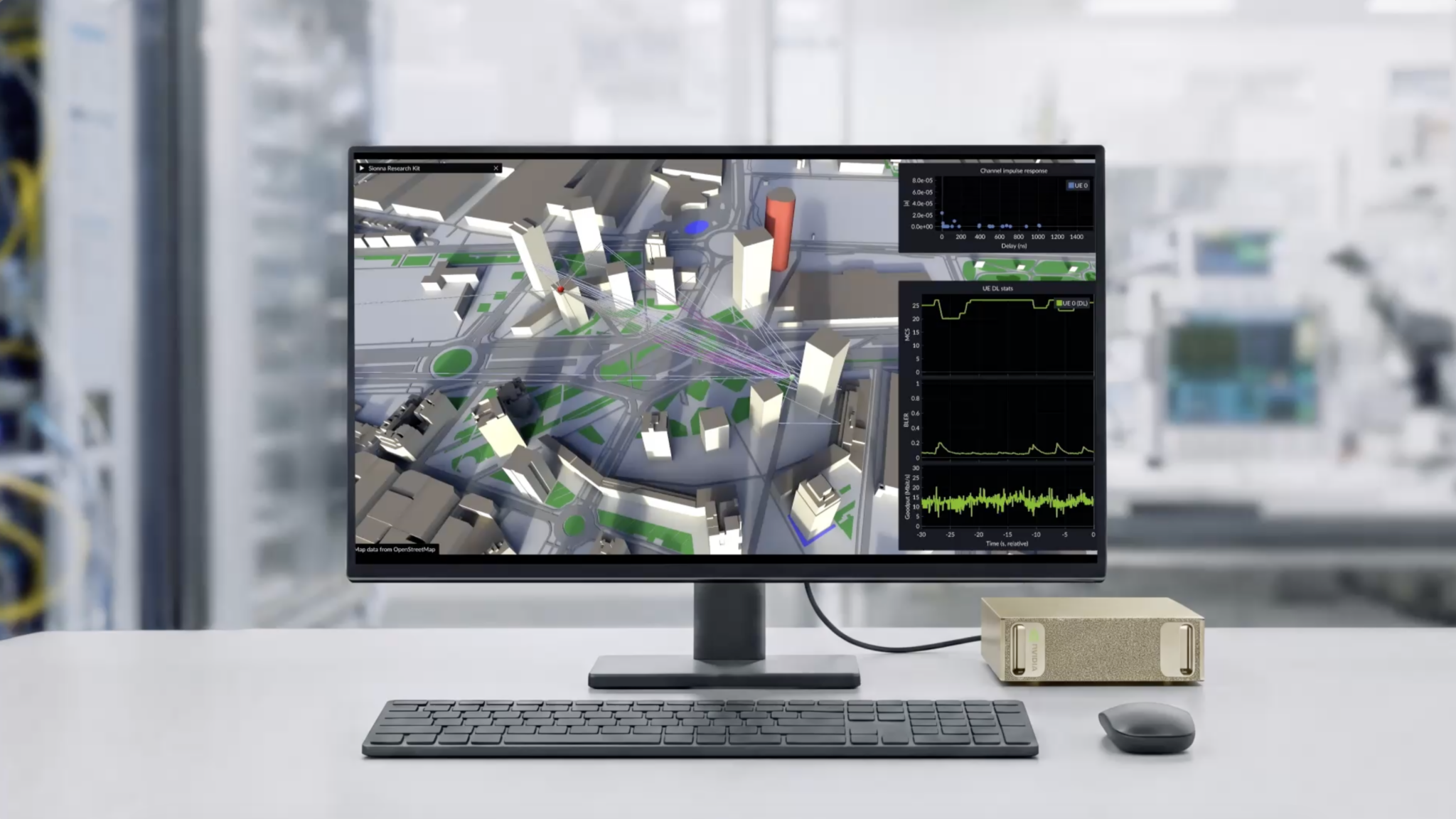
NVIDIA marked the first anniversary of open sourcing its Aerial wireless software by outlining how researchers are using Aerial, Sionna and related open source tools to prototype 6G network concepts. The company said global developer adoption of NVIDIA AI Aerial and NVIDIA Sionna grew tenfold over the past year, that its open source 5G/6G tooling has passed 1 million downloads, and that more than 8,000 research and academic institutions worldwide are using the platforms. Both AI Aerial and Sionna are available on GitHub.
The tools span two halves of the same workflow: simulation and AI model training on one side, and experiments on real over-the-air wireless systems on the other. Aerial provides software-defined radio access network (RAN) capability, including the CUDA-accelerated ACAR stack and a Testbed product; Sionna is a simulation library for wireless links, including channel modeling and machine learning components. In practice, that combination lets a lab iterate in software before moving to hardware, which is a meaningful shortcut given how expensive and slow over-the-air trials are.
The projects NVIDIA described address four distinct problems, and each produced concrete measured numbers.
Robots with lower latency. At King's College London, researchers explored goal-oriented semantic communications: rather than streaming full camera images, a robot sends compact descriptions of objects, their positions and their relationships, so only the information the task needs crosses the link. They connected a camera-equipped robot arm to an NVIDIA Jetson AGX Orin running Sionna, handling both a software-defined 5G network and edge AI processing. In fruit-packing and cube-stacking experiments with deliberately introduced faults, task completion time fell by up to 52.6% and task success improved relative to sending periodic images. The setup also detected dropped objects and recovered from failed actions, and a digital-twin configuration checked planned movements for potential collisions before execution. This suggests that for embodied AI, how data is represented on the radio link can matter as much as raw bandwidth.
Receivers that learn. Interference and shifting radio conditions cause decoding errors and retransmissions, which delay time-sensitive traffic such as drone imagery for responders. Neural receivers replace parts of the conventional signal-processing chain with learned models. SoftBank integrated a neural receiver into NVIDIA Aerial CUDA-Accelerated RAN (ACAR) and tested it against a commercial 5G smartphone; under interference, the neural receiver delivered higher uplink throughput than a conventional receiver across all 15 tested settings, with a maximum gain of roughly 60%. Separately, ETH Zurich researchers used the Aerial Testbed to fine-tune neural receivers on local measurements, cutting block error rates by more than one-third compared with selected pretrained versions. A likely trade-off is that gains of this kind are environment-specific, which is why the ETH result emphasizes local tuning; generalization across sites and vendors remains an open engineering question.
Base stations that sleep. The University of Leeds built a system that forecasts network demand 10 minutes ahead and uses the forecast to decide when base stations can power down, first checking that neighboring active stations can still serve affected devices and monitoring for changes that require capacity to return. The team tested it with a portable, DGX Spark-powered 5G network-in-a-box plus a digital twin that validated decisions against real wireless equipment, and reported a 45.6% reduction in RAN power consumption against a full-power baseline while maintaining device connectivity. Energy has long been a major operating cost for carriers, and AI-driven sleep scheduling is one of the more plausible near-term uses of machine learning in the RAN because the decision cycle is slow enough to be safe.
Faster simulation. The Centre Tecnològic de Telecomunicacions de Catalunya (CTTC) is bringing GPU-accelerated radio channel models running on ACAR into its open source 5G-LENA network simulator. Channel models compute how signals propagate between antennas and devices, a cost that grows with simulated network size. In an early evaluation, runtime dropped from roughly three hours to 10 to 20 minutes depending on the integration, while preserving expected statistical behavior and network performance. Faster simulation mostly buys breadth: more design candidates evaluated per unit of researcher time.
NVIDIA frames all of this as progress toward AI-native 6G networks that combine connectivity, computing and sensing on one software-defined platform. That is a vendor's framing, and readers should treat the individual results as lab findings rather than field-proven gains; each came from a specific setup, and some depend on digital twins or controlled interference conditions. Still, the shared reliance on open tooling points to a real shift in wireless research, where the barrier to trying an idea is increasingly software and GPU time rather than access to a licensed testbed. NVIDIA said 6G developer sessions at GTC Washington, D.C. will showcase further work.
Why it matters: Teams building robotics, industrial connectivity or network infrastructure now have a lower-cost path to test 6G-era ideas, since the same open stack covers simulation, AI training and over-the-air experiments. The reported numbers, including the 52.6% faster robot tasks, 60% peak uplink gain for the neural receiver, 45.6% RAN power reduction and simulation speedups from three hours to minutes, are useful benchmarks for setting expectations. Because these tools run on NVIDIA hardware and CUDA, a lab's choice of platform carries a degree of vendor lock-in, which is an inference rather than a stated claim.
Based on reporting from the original publisher. Visit the source for full context and later updates.
Publisher excerpt
A year ago, NVIDIA open sourced its Aerial wireless software, joining Sionna and a broader suite of open source tools for accelerating next-generation 6G network development. Together, they give researchers a foundation for testing ideas, comparing results and building on each other’s work — connecting simulation and AI training with experiments on real over-the-air wireless […]