The Jev Revolution: What Engineers Are Already Building with System One Models
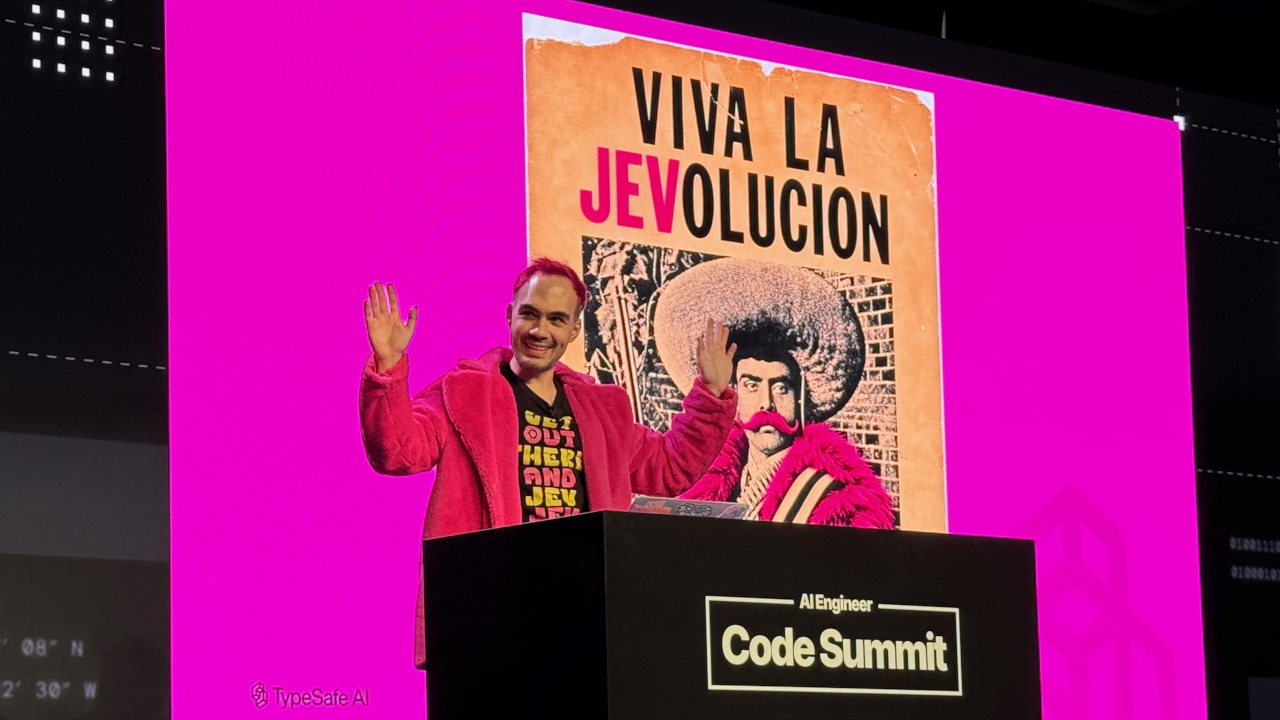
At the AI Engineer Code Summit, the day's organizing theme was system one models: non-generative models that return structured choices, scores or probabilities rather than free-form text. Diogo Almeida, co-founder and CEO of TypeSafe AI and lead creator of Jev, used his keynote to argue that such models belong inside application code and should be pointed at automation broadly. Jev launched in September, less than two months before the talk, and became a fast favorite among AI engineers; Almeida's launch appearance on Latent Space became the outlet's most popular episode of the year.
Almeida's framing centered on reliability as the core problem with putting large language models at the heart of software. He described Jev as reliable intelligence suited to automating everything, and argued that because code is the language of automation, system one models should be integrated with code rather than bolted on as a separate layer. Latent Space founder swyx read the talk as a call to sprinkle system one model calls liberally inside application code, producing smarter software instead of what he characterized as convoluted string-concatenation-and-hope AI engineering. The phrase smart software recurred throughout the presentation.
The reliability argument was illustrated with a memorable image: an LLM gives you Einstein 95% of the time and Mr. Bean 5% of the time, and if you cannot tell which you are getting, automation is difficult to justify. Almeida closed by appealing to dreamers who do not want to be limited by what has happened so far, and said TypeSafe AI aims to make the product as dependable as a fourth logic gate. In practice, this suggests the pitch is less about raw capability than about predictable, machine-consumable outputs that ordinary control flow can branch on.
Chinmay Goyal of Glean followed with a more grounded account of how the search and enterprise knowledge company uses the model. Glean runs system one models alongside LLMs and other classifiers, and Goyal highlighted Jev's zero-shot flexibility: when the taxonomy of a decision space changes, the team does not have to fine-tune repeatedly. He told Latent Space that Jev powers a significant number of flows, but customers are shielded from which model type serves a request, since the goal is simply a product that works. Internally, that means routing decisions and model selection stay hidden behind the product surface. Goyal also offered rules during his talk on when Jev is the right choice, though the published account does not enumerate them.
UiPath's Chibi Vikram and Kevin Bernstein presented experiments treating Jev as a reusable building block. One example ranked document chunks with a tournament structure: Jev picked the most relevant chunks from small groups, winners advanced to later rounds, and the process finished in under a second even with thousands of Jev calls. Vikram's takeaway was that the model can look less intelligent in isolation, but composing it with strategies and patterns yields more capable behavior even with the current Jev model. This is a familiar pattern in retrieval pipelines: cheap, fast scorers can be layered into reranking schemes where latency budgets would rule out a reasoning model at every step. A likely trade-off is that tournament-style ranking multiplies call volume, so the economics depend on per-call cost staying low.
Scott Roberts, a principal engineer at Workday, closed the session with prototypes. In one, an interface begins filling in a time-off card while the user is still typing, an example of a fast model call changing what the software itself does rather than only generating text. Roberts described the shift as moving from predicting what you want to say to predicting what you want to do. That reframing is useful for product teams: speculative or anticipatory UI depends on sub-second inference, which is exactly where system one models differentiate themselves from reasoning LLMs.
The broader takeaway from the session, as the write-up framed it, is that a model like Jev can open unexpected ways to build software. One attendee who leads AI at his company had built a fantasy football news sorting and ranking site with it on the side. Almeida closed by comparing the moment to early internet experimentation, predicting an explosion in what software can do as people explore the boundaries not necessarily because it is valuable but because they can.
For developers, the practical distinction is worth restating. System two reasoning models deliberate token by token and are slower and costlier per call; system one models return a bounded answer, such as a label, a rank or a probability, cheaply enough to call many times inside a request. That makes them suited to classification, routing, filtering and ranking, and to UI that responds within typing latency. The trade-off is that each call is narrow, so the intelligence lives in the surrounding pattern, as the UiPath tournament shows. Teams evaluating Jev should expect to design orchestration around it rather than prompt it.
Why it matters: Developers building agents and enterprise search are being pushed toward hybrid stacks where a fast, narrowly scoped model handles most decisions and a reasoning LLM is reserved for the hard remainder. If TypeSafe AI delivers on its reliability claim, teams can encode model calls in ordinary control flow and test them like other logic, which is an inference about direction rather than a reported result. The prototypes from Glean, UiPath and Workday indicate the patterns are already being pioneered in production-adjacent settings.
Based on reporting from the original publisher. Visit the source for full context and later updates.
Publisher excerpt
At AI Engineer Code Summit, lead Jev creator Diogo Almeida called on developers to automate everything. Also, Glean and others showed how they’re using Jev.