Architecture patterns for fast session startup on Amazon Bedrock AgentCore runtime
Amazon Web Services has published guidance on session startup for its Bedrock AgentCore runtime, centered on a platform version called V2. Setting platformVersion to "V2" changes how sessions begin: rather than initializing the container for every session, the runtime prepares the environment once, snapshots it, and restores that snapshot for each new session. AWS says start times become faster and more consistent, and that V2 also reclaims memory a session does not use so billing tracks actual consumption. The same post introduces build hooks, which the runtime now supports.
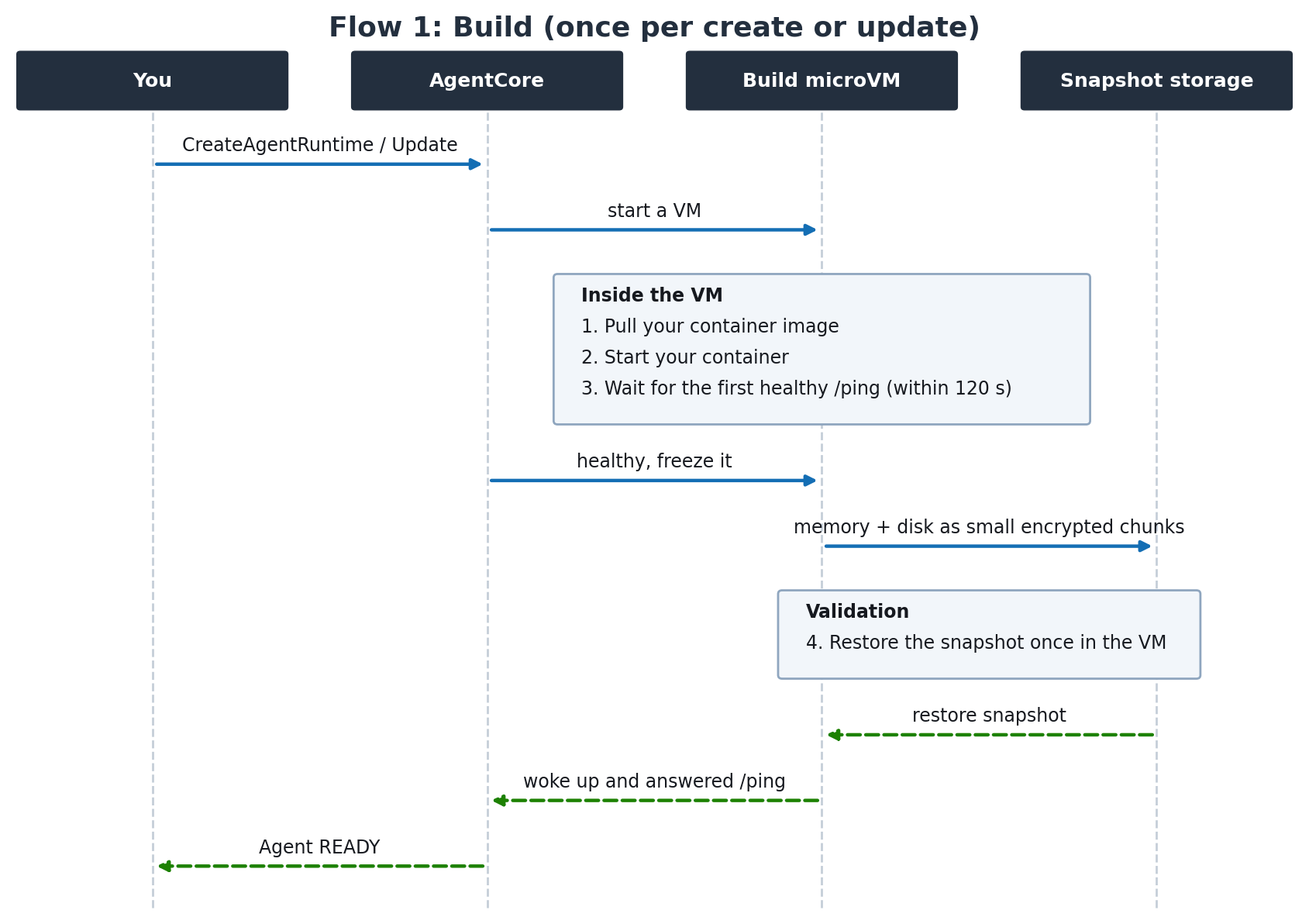
On V1, a new session meant pulling the container image from Amazon Elastic Container Registry, starting the container and running initialization code before the first request could be served. The image pull dominated, so cold start grew with image size. V2 does that work once per create or update: the container starts in a fresh microVM, the runtime waits for the first healthy GET /ping (which must arrive within 120 seconds), clears the operating system file cache to keep the snapshot small, freezes the microVM and stores its memory and disk as a snapshot. Every create or update now takes a few minutes while that snapshot builds. In this model, "init" means everything before /ping reports healthy, which in the AgentCore Python SDK is everything before app.run() calls. Teams running their own HTTP server in Node.js or another language must only report healthy once initialization has finished.
When a session arrives, the snapshot is restored into a new microVM and the process resumes where it was frozen, with imports, objects and clients intact. Files from the image load lazily, block by block, on first read and are then cached closer to the host. Three consequences follow. Everything held in process memory at snapshot time, including anything in a RAM-backed filesystem such as /dev/shm, is available at memory speed from the first access. File reads do not carry over, because the cache was cleared before the freeze. And image files are fetched on first read, so the first touch of each block pays a storage round trip. AWS points out the resemblance to Lambda SnapStart, a well-known comparison for developers weighing snapshot-based cold start on AWS.
Work placed before the freeze therefore behaves differently from work done per request. Libraries imported during init are already in memory when a session starts; imported in the handler, they are read from the image in every new session. Clients such as boto3 are restored with endpoint and credential resolution done, though sockets reconnect on first use; network connections opened before the snapshot are stale after restore and should be closed. Static data held in an object stays in memory, but merely reading a file during init has no lasting effect. Situations init cannot cover include a CLI that runs as a separate process and exits, or a browser binary, since a restored session must fetch those from the image again.
Before optimizing, the post argues for measuring the split between platform and code. AgentCore runtime publishes CloudWatch metrics in the AWS/Bedrock-AgentCore namespace: Latency, the time to first byte, and OverheadLatency, the platform share such as starting the microVM and restoring the snapshot. Code time is the difference. Init time does not appear in either metric on V2 because it runs once at build; logging it before app.run() surfaces it in the runtime's build logs instead. High OverheadLatency on new sessions points at session start, while first-request code time far above the second request in the same session suggests initialization that belongs in init. AWS recommends percentiles such as P90 and P99 or trimmed means such as TM90 over plain averages, and testing at the new-session rate expected in production, not a handful of sessions after a deploy.
The headline advice inverts the usual serverless cold-start playbook. Rather than lazy imports and minimal startup, V2 favors doing static work eagerly during init: construct objects, not just import modules; initialize clients and local tools; keep prompts, configuration and small indexes in memory; keep long-running helpers such as a language server or pre-imported worker alive and talk to them over a pipe or socket; copy files that cannot be held in memory to /dev/shm or a ramfs mount; and ship compiled bytecode, since uv pip install does not compile by default (set UV_COMPILE_BYTECODE=1 or use pip install --compile). The trade-off is explicit: a fuller init shortens the handler but enlarges the snapshot, memory held is paid for in every session, and teams should re-measure end-to-end start to confirm latency moved rather than merely relocated. The post also recommends S3 Files or Amazon EFS, mounted during init through an access point in VPC mode, for large reference data read selectively.
Build hooks go beyond init for artifacts a process cannot hold. The container exposes an HTTP endpoint that receives two POST requests during a runtime build. The first arrives on the build microVM after the agent reports healthy and before the freeze, so anything loaded and retained then becomes part of the snapshot. The second arrives on a separate microVM that restores the snapshot, and nothing from it is snapshotted; its purpose is to touch the files sessions will need so restored sessions fetch them first. The X-Amzn-Bedrock-AgentCore-Runtime-Warmup-Type header distinguishes the calls as memory and disk, and the two share a 120 second budget. Only a 2xx response after the work completes counts; any other response, a failed connection or running out of time fails the create or update with no retry, and build-log streams show which call failed. Hooks are configured through hooksConfiguration on create or update, with an optional port from 8000 to 12000 and a path that must not collide with reserved routes such as POST /invocations or GET /ping. UpdateAgentRuntime replaces the entire hook configuration, so it must be resupplied on each update.
The post flags snapshot pitfalls that are bugs, and in the case of random values a security issue. Dynamic data such as tool catalogs from AgentCore Gateway, feature flags and price lists should be loaded in the handler and cached at module level with an expiry, since sessions can last up to 8 hours. Per-session values must likewise be created in the handler. Session limits are stated as idleRuntimeSessionTimeout, 15 minutes by default and configurable from 60 seconds to 8 hours, and maxLifetime, 8 hours by default and at most.
For sub-second targets, the recommended pattern is pre-warming on user engagement. If a fresh session takes roughly 2 seconds and a running one answers in about 200 ms, a chat or voice experience can hide startup by generating a session ID when the user opens the app or chat window, firing a background warm-up invoke against that ID, and reusing the ID for later turns; the handler answers the prime request without a model call. Session IDs need at least 33 characters. The cost is a session for each user who engages without sending a prompt, which a short idle timeout keeps small.
Why it matters: Teams running agents behind interactive interfaces on AgentCore should treat V2 as a configuration switch plus a code review, since initialization that used to be spread across sessions now runs once at deploy and shapes every restore. Developers porting agents with heavy local assets, such as browser automation, coding toolchains or small local models, are the most likely to need build hooks and the in-memory restructuring described. The likely trade-offs, in this reading, are slower deploys, larger and more expensive snapshots, and a hard dependency on careful handling of dynamic and per-session state.
Based on reporting from the original publisher. Visit the source for full context and later updates.
Publisher excerpt
Amazon Bedrock AgentCore runtime V2 snapshots your initialized environment and restores it for each new session, so session start no longer grows with image size. This post explains how V2 starts a session, how to measure session start time, and four patterns to keep work off the first request.