Gemini's Personal Intelligence is coming to cars
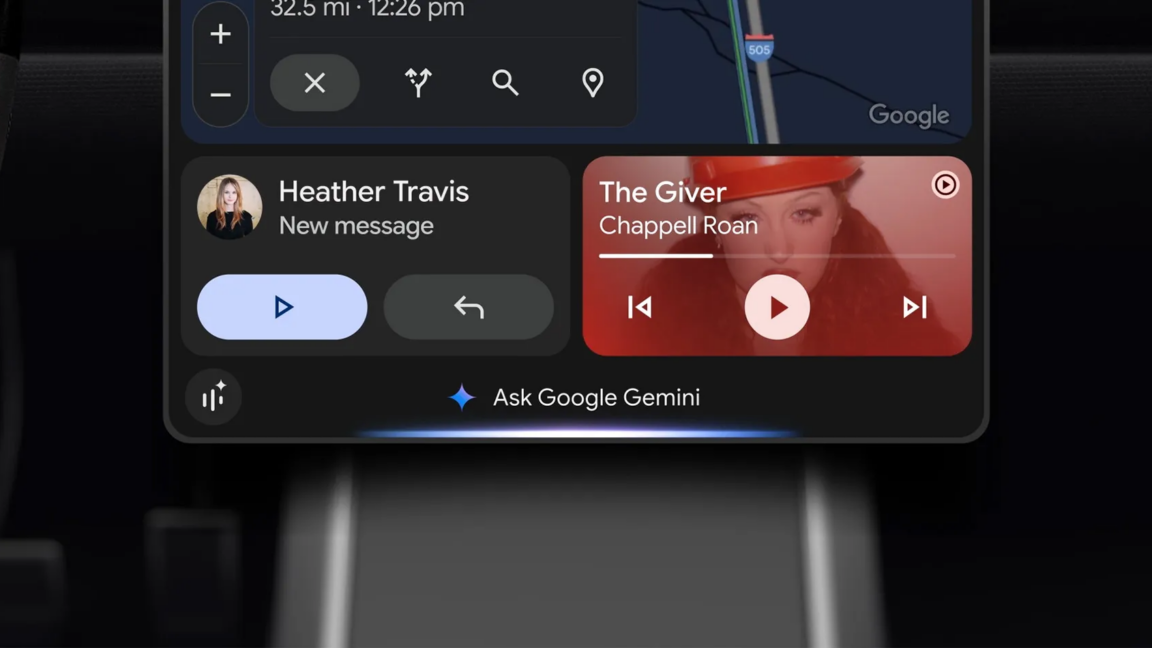
Google has begun bringing Personal Intelligence, the Gemini capability that lets the assistant draw on a user's own account data when answering questions, to its in-car platforms. The rollout starts in Android Auto now, and vehicles that run Google built-in, meaning cars whose infotainment systems host Google's software directly rather than projecting a phone interface, will receive it over the next few months. Personal Intelligence arrived in Gemini at the start of 2026, first as a paid feature and later for all Gemini users, but until now it was absent from the car. Google describes the car as a natural fit, since drivers can speak a short request and keep their attention on the road instead of spelling out details to the assistant.
The example Google offers is asking Gemini to take you to your doctor's appointment, with the assistant pulling the appointment from a connected calendar rather than requiring a date, time or address. Gemini can also use visual analysis on photos to identify a location and start navigation from there. Behind these examples is the same mechanism that operates elsewhere in Gemini: when Personal Intelligence is enabled, the model can reach into connected Google services, including Workspace apps such as Gmail and Calendar, plus Search and Photos, as context for its answers.
That context is the whole point of the feature and the reason Google treats it as a differentiator. A generative model produces better answers when it has more relevant background, and Google already holds much of that background for many users, so the assistant does not need to be briefed from scratch. For a driver, the practical benefit is shorter commands and fewer follow-up questions, which is a plausible safety argument when the alternative is tapping through menus or dictating specifics. It is also an argument that depends entirely on the user having opted in and having those services connected in the first place.
Personal Intelligence is off by default, though Google frequently prompts Gemini users to enable data sharing, so some people may already have turned it on without fully registering what it covers. Because Gemini has replaced Assistant across devices, existing settings carry over into Android Auto; a user who enabled personal context on a phone will find the car behaving the same way. The controls sit one level deep in the Gemini app's settings, under a Connected Apps section, where Workspace, Search, Photos and other services can be toggled individually. That is the place to look before a road trip, particularly in a shared or family vehicle where passengers may also interact with the screen and where a driver might not want account-derived answers surfacing in front of them.
Google says it does not train Gemini on personal data, but it does process user inputs and outputs while the model is in use, and those outputs can contain personal information when connected services are active. The company attempts to filter such material out but, according to the reporting, stops short of guaranteeing it. This is a familiar trade-off in assistant products: the same context that makes replies useful is the context that can leak into logs, summaries or spoken answers. In practice, a connected-calendar request spoken aloud in a car with other people present is a small but real disclosure, and the transcript may persist in activity history depending on account settings.
The rollout order is notable. Google built-in vehicles, which are relatively rare, often get new automotive features first; this time Android Auto, the far more widely used phone-projection route, leads. One detail remains unresolved publicly: whether Google built-in cars will expose their own settings interface for Personal Intelligence or simply inherit the phone-side configuration.
Why it matters: developers and product teams building for Android Auto or Google built-in now have a Gemini that can resolve underspecified, context-dependent requests, which changes what voice flows are worth designing. Teams should also expect user confusion over inherited settings, and should treat opt-in state, transcript retention and shared-cabin privacy as design constraints rather than afterthoughts.
Based on reporting from the original publisher. Visit the source for full context and later updates.
Publisher excerpt
It's probably time to audit your Gemini settings.