Empowering frontline maternal care with AI-assisted ultrasound
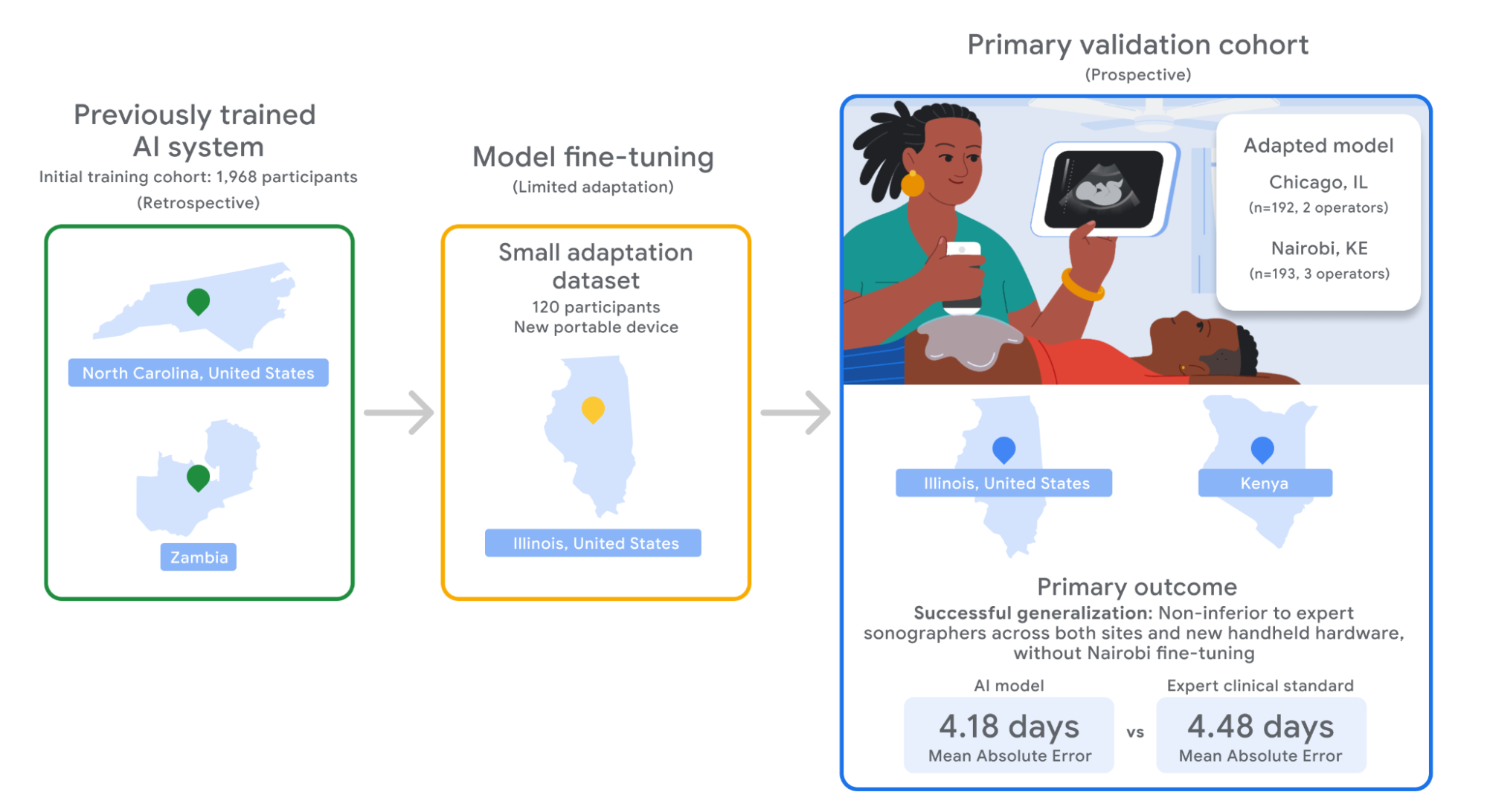
Google Research has published a prospective, multi-center study in JAMA Network Open evaluating an AI model that estimates gestational age from "blind sweep" ultrasound scans, performed by operators without specialized sonography training. The work, described in a Google Research blog post authored by research engineer Angelica Willis and clinical lead Nichole Young-Lin, was tested live on mobile devices at two clinical sites: Northwestern Medicine in Chicago and the Jacaranda Health clinic network in Nairobi, Kenya.
The premise rests on a shortage of trained sonographers. Standard prenatal dating requires an expert to locate specific fetal cross-sections and take precise biometry measurements, a skill that takes years to acquire and varies by operator. The blind sweep alternative has a frontline health worker glide a low-cost handheld probe across the abdomen in a standardized pattern, with the AI handling interpretation. Google cites World Health Organization estimates of more than 250,000 preventable pregnancy-related deaths annually and notes that two-thirds of people globally lack access to diagnostic imaging such as ultrasound.
The study design is the practically interesting part. The model was originally trained on data from 1,968 participants in North Carolina and Zambia, collected with Sonosite, GE and Butterfly Networks commercial probes. For this study it was fine-tuned on just 120 participants from Chicago, roughly 6% of the original training set, to adapt it to new probe hardware, the Clarius C3 handheld transabdominal probe, and to extend predictions beyond 36 weeks. No Nairobi data was used in tuning, keeping the Kenyan site a strictly independent external test. The model was then tested prospectively on 192 participants in Chicago and 193 in Nairobi.
Across a primary cohort of 385 participants between 16 and 36 weeks, the AI achieved a mean absolute error of 4.18 days against 4.48 days for the expert sonographer standard, meeting the non-inferiority bar. By site, the adapted model reached 4.10 days in Chicago and 4.27 days in Nairobi, the latter with zero local optimization. Exploratory results suggested the system held up in multiple gestation pregnancies and outperformed traditional biometry formulas in cases of fetal weight extremes above the 90th percentile. Mean absolute error here is the average absolute difference between predicted and actual gestational age in days, so single-digit-day accuracy is in line with what the clinical standard itself delivers.
Two deployment lessons stand out. The team observed that swappable batteries worked better than plug-in docking stations for keeping devices charged between back-to-back patients, a reminder that field constraints often decide adoption more than model quality. They also argued that earning clinician and patient trust will require safeguards built into the app, such as confidence estimates that reject poor-quality sweeps and communicate uncertainty.
The study has clear limits worth noting. It covers a specific window of 16 to 36 weeks and roughly 385 prospective participants, so the evidence base is promising but not large. The fine-tuning set was small and drawn from one city. It is also research, not a cleared or launched clinical product, and the post describes the results as groundwork informing later multimodal medical research rather than an availability announcement.
Why it matters: If AI can read blind sweeps from minimally trained community health workers using cheap handheld probes, prenatal dating could reach regions where expert sonographers essentially do not exist, and gestational age anchors most screening and delivery decisions. For developers and product teams, the study is a useful template for medical AI that generalizes across hardware and populations with minimal fine-tuning, plus a reminder to design for device logistics and uncertainty signaling from day one. The open question, and this is inference, is regulatory clearance and validation at larger scale before anything like this reaches routine care.
Based on reporting from the original publisher. Visit the source for full context and later updates.
Publisher excerpt
Health & Bioscience