Uber Eats Rebuilds Search Pipeline to Cut End-to-End Latency by 50%
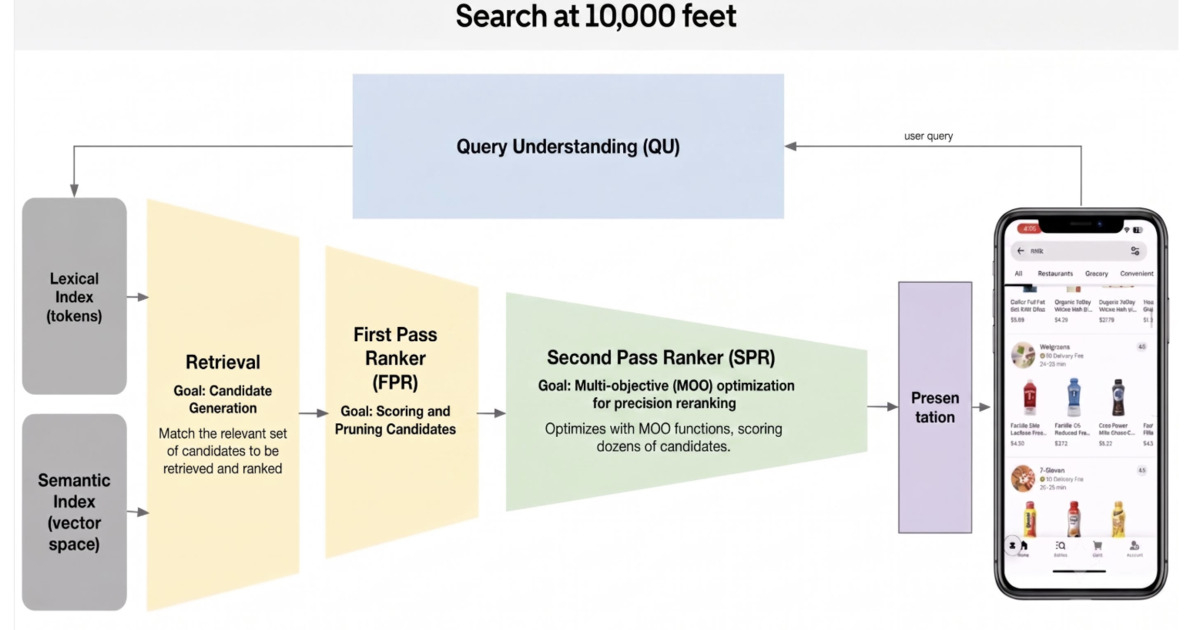
Uber has rebuilt major parts of the Uber Eats search pipeline and reports a 50% reduction in end-to-end search latency, according to InfoQ. The changes span retrieval, feature hydration, ranking, advertising, presentation and infrastructure, and an agentic coding workflow was used to identify, benchmark and validate additional optimizations.
The work began with a shift in the primary latency metric. Instead of backend API response time, Uber measured Above-the-Fold completion, defined as the time until the first screen of results is rendered with images. Pagination with server-side caching reduced the initial response, and asynchronous rendering let result items be processed concurrently. Uber reports these changes improved Above-the-Fold latency by more than 200 milliseconds.
After finding that tens of thousands of candidates were hydrated before ranking and many were discarded, Uber reduced retrieval work. Removing low-value retrieval strategies cut about 120 milliseconds, while product-level embeddings reduced data lookups by more than 100 times and saved another 50 milliseconds. Separating ranking hydration from presentation data reduced latency by more than 100 milliseconds, with dependency removal and request hedging contributing another 35 and 40 milliseconds respectively. The advertising path was redesigned with column-oriented bid data, in-memory access and less serialization, reducing latency by about 130 milliseconds. Infrastructure changes included parallel encoding, smaller embeddings, connection management improvements and Go data structure changes to reduce garbage collection overhead.
Uber is now exploring end-to-end microbatching, product-based retrieval, Zero Pass Ranking and HTTP multipart streaming. It reports that early product-based search testing has produced more than a 50% reduction in p99 latency. The planned changes allow processing stages to overlap rather than waiting for entire preceding stages to complete.
Based on reporting from the original publisher. Visit the source for full context and later updates.
Publisher excerpt
Uber has rebuilt major parts of the Uber Eats search pipeline, reporting a 50% reduction in end-to-end latency. Changes include Above-the-Fold measurement, reduced retrieval work, parallel hydration, advertising data redesign, infrastructure optimizations, and an agentic coding workflow. Uber is also exploring microbatching, product-based retrieval, and HTTP multipart streaming. By Leela Kumili