AI model decodes the language cells use to communicate
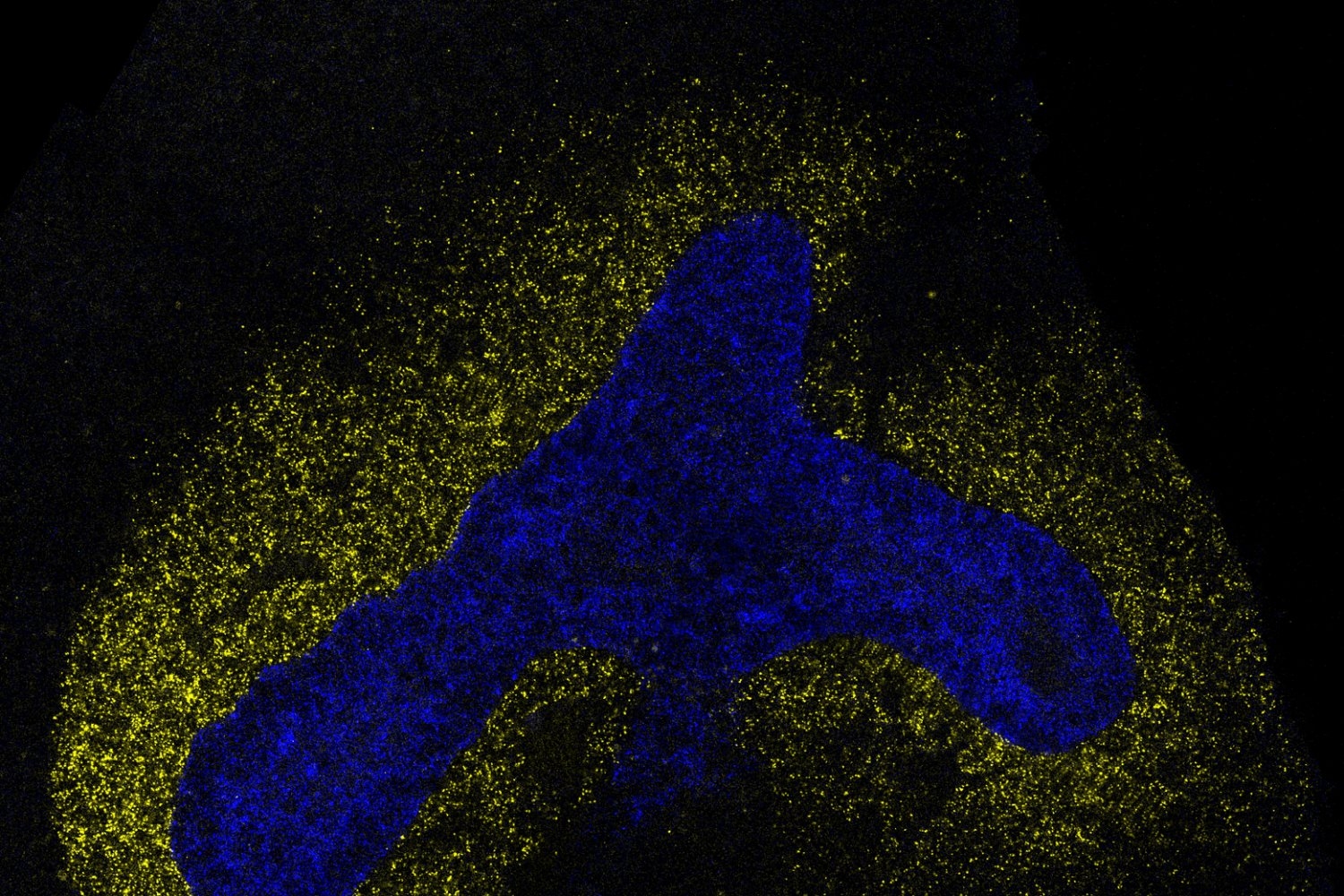
MIT researchers have developed a machine learning model that reads a cell's gene activity and reconstructs which chemical signals it received during development. The work, led by MIT assistant professor of biology and Whitehead Institute for Biomedical Research member Pulin Li and graduate student Nicholas Hutchins, was published open access in the journal Nature Methods on Sept. 8.
The problem the model addresses is a long-standing bottleneck in developmental biology. Cells in an embryo decide what to become based on signals exchanged with their neighbors, and those messages travel through multi-step sequences called signaling pathways that convert external cues into changes in which genes are switched on or off. Recovering the sequence of instructions a cell has received would let researchers understand how tissues form and how those processes fail in disease. The obstacle was the assumption that a pathway's downstream effects differ so much between cell types that each pathway would have to be mapped separately in every cell type.
The MIT team reports the opposite. Each signaling pathway leaves a distinctive pattern of gene activity, which they call a fingerprint, and that fingerprint is consistent across cell types for the same pathway. If that holds generally, signaling histories can be reconstructed across many cell types at once rather than mapped one cell type at a time.
IRIS is a neural network-based model, meaning a system trained to recognize patterns in complex data. It takes a cell's overall gene activity as input and estimates which signaling pathways were likely active at specific times during development. The team trained it on a large experimental dataset measuring how thousands of human embryonic stem cells responded to dozens of combinations of six major signaling pathways at multiple stages of development, producing what amounts to an atlas of how signaling combinations shape cell behavior.
Generalization to unfamiliar cell types is the model's central claim. Li compares it to voice recognition systems such as Siri that are trained mainly in English but use that training to help recognize other languages, a technique called transfer learning. That is the stated reason IRIS can be applied across many cell types, including ones it has not seen.
For validation, the researchers turned to single cells from mouse embryos during gastrulation, the stage when cells rapidly branch into different fates. IRIS predicted with accuracy when and where specific signaling pathways would activate in cells destined for heart, gut, muscle, and spinal cord tissue, according to the study.
The team also used IRIS predictively rather than descriptively. Asked to identify the signals needed to produce a cell type important for lung development, the model predicted that activating a specific signaling pathway would push development in a lung-specific direction. Experiments in mouse embryos confirmed that prediction, which the researchers present as evidence the approach can yield a practical recipe for steering stem cells toward chosen fates.
The stated applications are stem cell engineering for regenerative medicine and organoids, the miniature three-dimensional models that mimic real organs and are used to study disease and test drugs. The logic is direct: once the signal pattern that drives a stem cell toward a given cell type is known, those signals can be recreated to control cell fate in the lab or in a medical setting. Better lung models, for instance, would give researchers a way to study asthma, lung cancer, and pulmonary fibrosis, in which lung tissue becomes scarred often without a known cause, and to test candidate therapies against them.
Hutchins frames the broader value in terms of speed, describing IRIS as helping decode the language cells use to talk to each other much faster than experiments alone could realistically achieve.
For developers and product teams, the significance is less the biology than the pattern. IRIS is another case of transfer learning turning a narrow experimental dataset into a model that generalizes to new contexts, the same principle behind foundation models in vision and language. A likely trade-off is that predictions are only as good as the training atlas: the model was trained on human embryonic stem cells dosed with combinations of six pathways, so its accuracy on cell types, organisms, or pathways outside that space is an open question rather than a demonstrated capability. A practical concern for anyone building on this kind of tool is that its most convincing result, the lung prediction, was verified in mouse embryos, meaning the path from a computational prediction to a validated wet-lab outcome still runs through animal experiments.
Why it matters: Computational biologists and stem cell engineers gain a method that, if it generalizes as reported, replaces per-cell-type pathway mapping with a single model that infers signaling history from gene activity alone. Teams working on organoids or regenerative medicine could use predicted signal combinations as starting recipes for directing cell fate, though each prediction still needs experimental confirmation. For AI practitioners, it is a compact example of transfer learning applied to a scientific bottleneck rather than a consumer task.
Based on reporting from the original publisher. Visit the source for full context and later updates.
Publisher excerpt
A new computational approach reveals how cells communicate to assemble into tissues. This could accelerate stem cell engineering, improve disease models, and inform therapies.