Novo Nordisk modernizes manufacturing process documents with Amazon Bedrock AgentCore
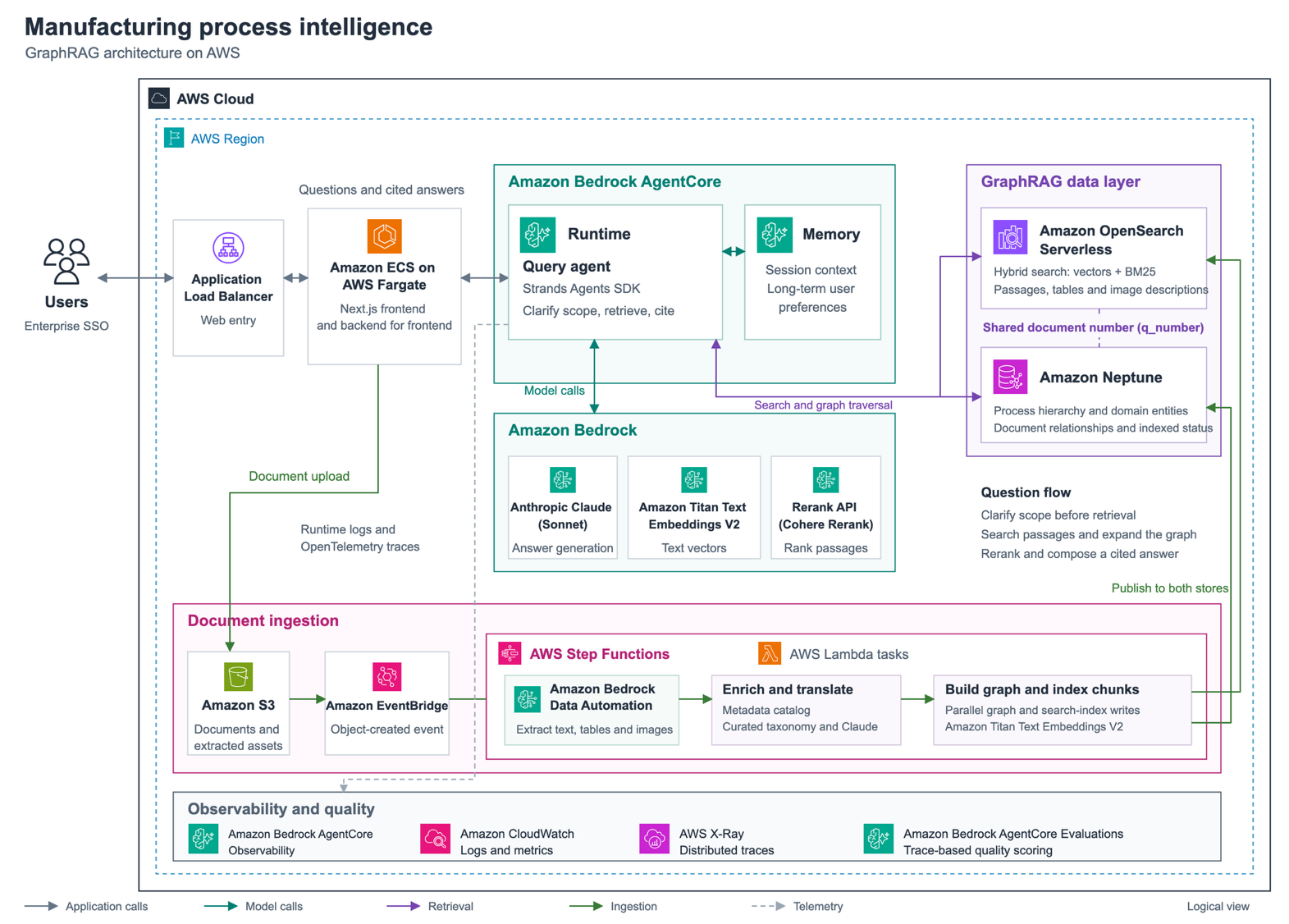
Novo Nordisk's Manufacturing Technology team within the Tablet area has built an intelligent support system for manufacturing process documentation, deployed on AWS and described in an AWS Machine Learning Blog post. The system pairs an AI process-intelligence assistant that answers process questions with citations against an agentic layer that handles document work. According to the post, subject-matter experts (SMEs) now complete tasks that previously took hours or days in minutes. The team built it in collaboration with AWS, with domain experts and data and AI engineers working together throughout.
The problem it targets is familiar to anyone who has maintained controlled documentation. Novo's manufacturing operations require every quality-relevant process step to be described, controlled and validated through formal documents: standard operating procedures, work instructions, forms and training materials. Updates arrive constantly, driven by regulatory changes, process improvements, equipment modifications and audit findings, and each one needs review, structured approval and communication to affected stakeholders. With thousands of active documents across divisions, departments and product programs, tracking what is due for revision or pending approval has largely relied on spreadsheets and disconnected systems. The post points to the resulting risks: outdated documents staying in circulation, delayed updates and gaps in compliance visibility. A second problem is knowledge distribution, where finding the right answer depends on experienced people knowing where to look.
The architecture is a GraphRAG design, meaning retrieval augmented generation in which a knowledge graph contributes structure alongside search. Two stores are kept deliberately separate: a knowledge graph in Amazon Neptune holds structure and relationships, while a hybrid search index in Amazon OpenSearch Serverless covers document contents. They are bridged at query time by shared document numbers rather than merged into one engine. The reasoning layer runs on Amazon Bedrock AgentCore, chosen for its managed agent runtime with built-in session isolation, native tool orchestration, and integrated AWS Identity and Access Management and observability. Agent runtimes are built with the Strands Agents SDK and powered by Anthropic Claude models on Amazon Bedrock. Ingestion uses Amazon Bedrock Data Automation for multimodal parsing, orchestrated with AWS Step Functions and AWS Lambda, and the whole stack is defined as infrastructure as code with the AWS Cloud Development Kit.
The graph is organized in two layers. A high-level taxonomy models the organization's official process framework as a hierarchy of process nodes, roughly three levels deep, and each controlled document is attached to the lowest applicable process level so it has a known place. A low-level taxonomy consists of domain entities that SMEs define, such as sites, product generations, equipment and process steps, modeled as first-class graph nodes linked to documents through a small set of unified relationship types. Because the document number in an OpenSearch passage is also a graph node, a search hit becomes an immediate entry point into the graph without fuzzy re-matching.
This is worth noting as a design choice. Early GraphRAG approaches let a language model extract entities freely, which suits open-ended exploration but produces noisy, hard-to-audit graphs. In practice, a fixed, expert-curated schema tends to suit regulated domains better, because the domain already has a real ontology and auditors can be shown exactly how entities enter the graph. The post describes a human-in-the-loop promotion process for new entities, and frames the shift toward ontology-guided extraction as where the field has moved more broadly. A likely trade-off is slower onboarding of new document types, since the taxonomy must be extended deliberately rather than discovered automatically.
Retrieval combines the strengths of both stores. OpenSearch handles recall by fusing dense vector similarity, using Amazon Titan Text Embeddings, with lexical BM25 matching via reciprocal rank fusion; the lexical side catches exact tokens such as document numbers, equipment codes and multilingual terminology that embeddings often blur. Neptune then answers what is connected and how far, covering neighboring documents, references, hierarchy position and change impact. A typical flow is vector search finding seeds, then graph expansion from them, with the reverse order for relationship-first questions. A cross-encoder reranking stage through Amazon Bedrock Rerank reads each candidate passage alongside the question and reorders results before anything reaches the model.
Guided mode is the distinctive piece. Questions like which samples are taken on a granulator have several correct answers depending on product generation, site, equipment and batch size. Rather than retrieve first, the agent clarifies scope first, then searches. Some attributes, such as site and product generation, are asked directly for process-specific questions; deeper ones are derived from the graph at query time. A scope-resolution step matches the user's term against real graph nodes and offers only values that exist there, which is designed to reduce hallucinated options. When experts add a distinguishing attribute to the taxonomy, the assistant surfaces it without prompt or code changes.
Grounding rules are explicit. A document can exist in the graph with metadata and relationships before its contents are searchable, and a deterministic flag records whether content is indexed, so the assistant does not infer availability from empty search results. Answers default to approved and effective documents at the latest applicable version unless a user asks for drafts or history. Where material is missing or ambiguous, the system says so and flags when SME, quality or regulatory review is needed. An automated evaluation harness checks relevant-source selection, valid document status, latest applicable version, scope compliance, citation accuracy, and faithful preservation of requirement strength (must, should or may).
The wider document vault holds on the order of four million documents. Every onboarded document across registered domains enters the graph with metadata and hierarchy position, so the assistant can reason about placement and connections even for the millions whose full text is not yet indexed; full-text indexing is added domain by domain. Because scope resolves before retrieval, the search runs over a small in-scope slice rather than millions of documents. The post also lists capabilities that follow from the same foundation, including tracing a document's full reference chain and flagging where it points at superseded material, plus future document generation and revision with impact analysis. A prototype shown to SMEs early was used to sharpen the taxonomy, retrieval path and guided-mode behavior before rollout.
Why it matters: Any team building RAG over large regulated or contractual document sets faces the same failure modes here: exact identifiers, version and lifecycle state, multi-hop references, and the need to admit when nothing relevant exists. This deployment is a concrete reference of clarify-before-retrieve paired with a curated graph, so architects weighing vector-only RAG against GraphRAG can see one production-shaped answer and its costs. My inference is that the biggest ongoing investment is taxonomy curation by domain experts rather than infrastructure, since the managed services and infrastructure-as-code stack remove much of the undifferentiated work.
Based on reporting from the original publisher. Visit the source for full context and later updates.
Publisher excerpt
Novo Nordisk's Manufacturing Technology team within the Tablet area team built a process-intelligence assistant on Amazon Bedrock AgentCore, using a GraphRAG architecture that pairs a knowledge graph in Amazon Neptune with hybrid search in Amazon OpenSearch Serverless to turn millions of controlled manufacturing documents into grounded, cited answers.