Agentic engineering intelligence with Amazon Nova Multimodal Embeddings and Amazon Bedrock AgentCore
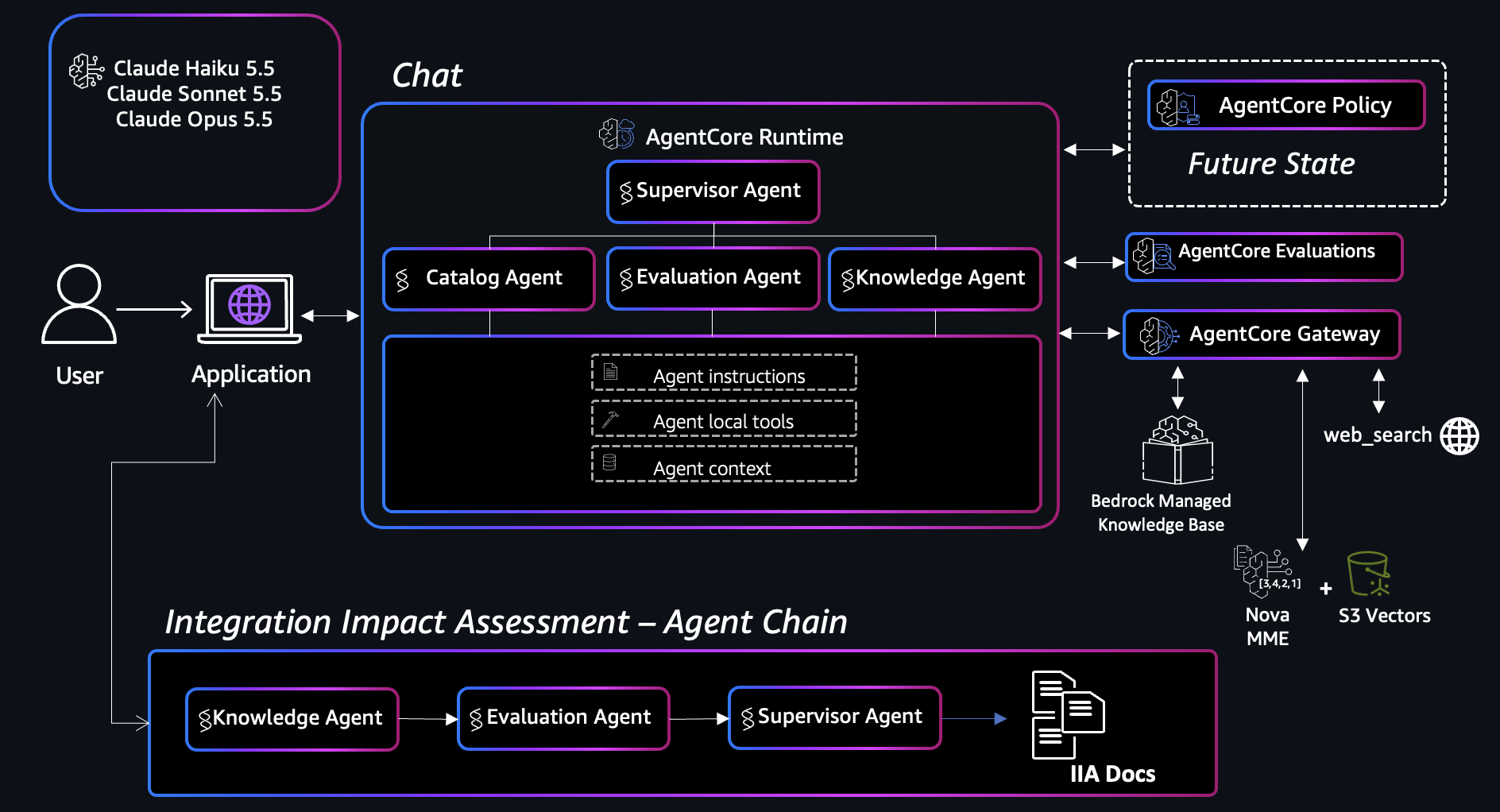
AWS published a technical walkthrough on its Machine Learning Blog showing how to build a multi-agent assistant that reduces the manual cross-referencing behind aerospace part substitution evaluation. The system combines Amazon Bedrock AgentCore, Amazon Nova Multimodal Embeddings and the open source Strands Agents SDK. It targets a familiar bottleneck: when a qualified component goes obsolete or gains a long lead time, an engineer spends days checking specifications across vendor datasheets, interface control documents and qualification records before writing a justification memo. An incorrect swap on a flight-critical part can cause mission failure, and the reasoning behind past decisions often sits in email rather than a checkable package.
The governing design rule is that the engineer makes every decision while the system assembles the evidence. That rule decides where large language models are used and where ordinary code takes over. Three pillars carry the architecture: deterministic spec-fit evaluation in Python, multi-agent orchestration through a planner and three specialists, and a human-in-the-loop step where the system drafts documents but never recommends or approves a substitution. Each evaluation also writes an audit-trail entry aligned with AS9100 sections 8.4 and 8.5.6, the aerospace quality standard clauses covering externally provided processes and production changes.
Routing and model tiers are deliberately split. A planner built on Claude Haiku 5.5 produces a numbered routing plan in a couple of seconds, since routing is a classification task with no tool calls. Three specialists on Claude Sonnet 5.5 then execute tools in sequence, passing context forward. A supervisor on Claude Opus 5.5 synthesizes results only when two or more specialists contributed; AWS notes that synthesizing an already-complete single-specialist answer adds about 8 seconds of latency with no quality gain. The reasoning is a cost-and-latency match: a small model classifies, a mid-tier model runs tools, and the largest model writes the combined answer.
The Catalog specialist discovers parts via knowledge base search and spec filtering (kb_search, filter_parts_by_spec, get_part_specs, get_substitution_requirements). The Evaluation specialist scores candidates and compares photos (score_substitution_fit, compare_parts, visual_similarity_score, check_qualification_status, generate_substitution_memo). The Knowledge specialist answers datasheet and ICD questions, checks live end-of-life status through web search, and retrieves visual content. Tool scoping is strict: the Knowledge agent has no catalog discovery tools, and the Catalog agent has no evaluation tools, which keeps behavior predictable.
Scoring runs as plain Python against a hand-written requirements schema rather than through a model. The schema lists critical specs per component category with rules such as exact match on bus voltage or a candidate mass no more than 20 percent above the reference. The tool returns per-spec pass, flag or review status, counts, out-of-tolerance items, lifecycle flags and an explicit disclaimer that the output is evidence only. Because identical inputs always yield identical verdicts, the table can enter a formal review package. In practice this is the most important architectural choice in the design: a probabilistic model's judgment would be hard to defend in an audit, so the model is confined to presenting and explaining code-produced results it cannot alter. Audit logging follows the same split, with the orchestration layer reading the specialist's tool-call history and writing the entry itself so logging does not depend on the model remembering.
Nova Multimodal Embeddings plays two roles. First, datasheets, ICDs and performance charts are embedded so text and visual content share one semantic space; an engineer can ask for a torque curve for the 0.06 Nms wheel or upload a chart image and get the matching diagram with source attribution. Second, when two candidates are compared, the model embeds both product photos into 1024-dimensional vectors and cosine similarity quantifies visual likeness, while Claude describes observable differences such as a housing roughly twice the diameter with a six-hole rather than four-hole mounting pattern. AWS reports similarity around 0.84 for wheels in the same product family and 0.40 for different classes.
Retrieval uses two paths. Text and document queries go through a managed knowledge base built with Amazon Bedrock Managed Knowledge Bases and routed through an AgentCore Gateway alongside a Web Search connector for live lifecycle data. Image-as-query goes directly to a native Amazon S3 Vectors index, because the managed knowledge base retrieval API does not accept image input. A single retrieve_visual_content tool wraps both paths for the Knowledge specialist. A separate fixed chain, Knowledge then Evaluation then Supervisor, produces the formal Integration Impact Assessment rather than letting the planner improvise a document flow.
The sample corpus is seven reaction wheels from a fictional manufacturer, AnyCompany, spanning 0.003 to 5.0 Nms of momentum storage. Each part is a folder pairing a specs.json with structured engineering fields and a lifecycle profile (status, years to end of life, typical lead time in weeks, lead-time risk), plus description text, an ICD PDF, a rendered datasheet page, a cropped chart region and a product photo. Every part states its vendor explicitly, and specialist prompts treat the structured vendor value as authoritative, forbidding guesses from folder IDs, file names, photos or search results. That guardrail addresses a real failure mode of vision-capable models: confident misattribution of hardware they appear to recognize.
The walkthrough requires an AWS account with Bedrock access in US East (N. Virginia), model access to Nova Multimodal Embeddings and the three Claude models, a managed knowledge base, an S3 Vectors index, an AgentCore Gateway with web search and a knowledge base target, Python 3.10 or later, Jupyter, and Docker if adapting the deployment recipe. The code ships as five standalone Jupyter notebooks importing from a self-contained mei_core module, with their own parts data, chart crops and evaluation query set.
For teams weighing similar systems, the pattern generalizes beyond aerospace: use deterministic code for anything that must be reproducible or auditable, reserve models for routing, retrieval and narrative, and keep a human as the approver. A likely trade-off is that a hand-maintained tolerance schema needs ongoing curation as component categories grow. Why it matters: product and platform teams building regulated or safety-critical workflows get a concrete reference for mixing multimodal retrieval, agent orchestration and hard-coded business rules on AWS. Developers can reuse the notebook structure and the split between managed knowledge base retrieval and direct vector index access for image queries. The human-approval and audit-logging pattern is likely to be the part most worth copying, since it is what makes such a system defensible in a formal review.
Based on reporting from the original publisher. Visit the source for full context and later updates.
Publisher excerpt
Learn how to build a multi-agent engineering assistant that compresses aerospace component substitution evaluation from days to minutes, using Amazon Nova Multimodal Embeddings, Amazon Bedrock AgentCore, and the Strands Agents SDK to assemble substitution evidence while keeping the engineer as the decision-maker.