How Anthropic’s Dynamic Workflows Coordinate Claude Agents (Updated with video!)
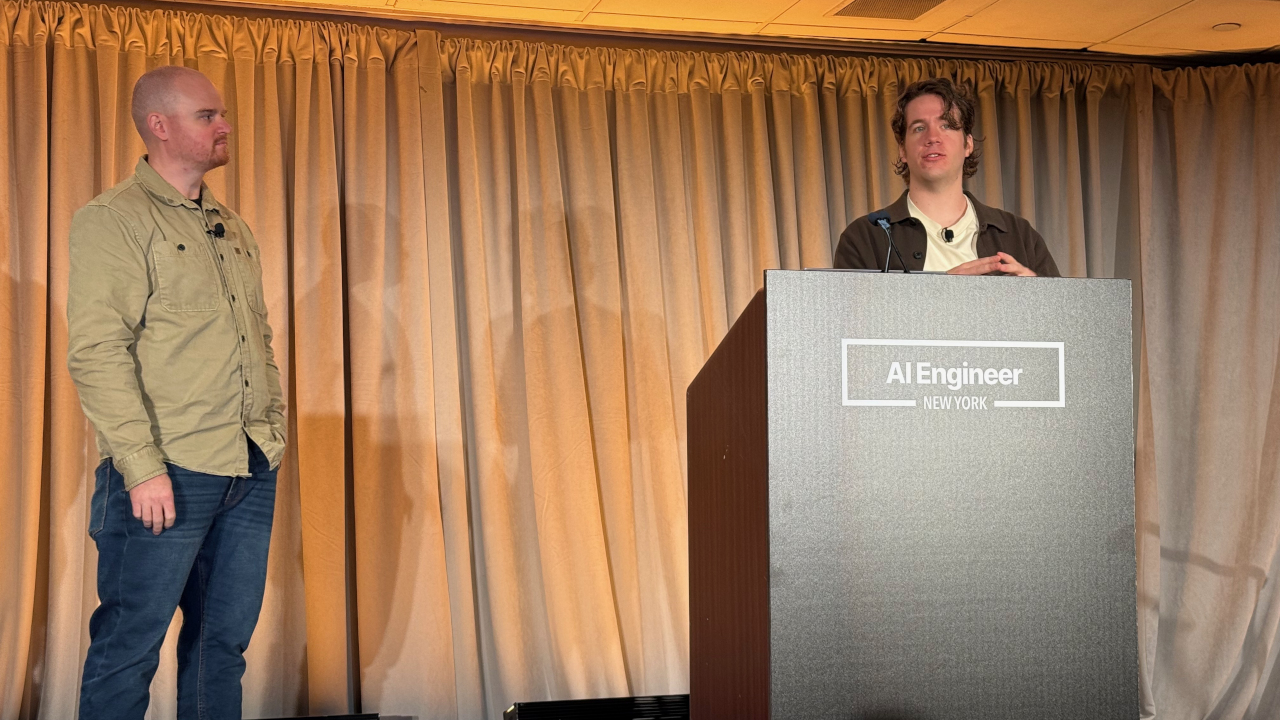
Anthropic announced a feature called dynamic workflows on the Friday before AI Engineer New York 2026, and two of its technical staff presented it at the conference, which opened with a morning of workshops. CJ Avilla and Harrison Stall, both Members of Technical Staff, described dynamic workflows—referred to throughout as "flows"—as a new type of multiagent orchestration built for ambitious workloads, available inside Claude Console, the interface developers use to reach Claude through the API and where Claude Managed Agents live.
The feature changes who does the organizing. Claude Managed Agents previously required developers to set up a coordinator plus a roster of subagents. With flows, the lead agent drafts a plan, then writes an orchestration program of its own that starts agents, gathers their results and routes information between stages. Stall framed it as letting Claude orchestrate the entirety of its own multiagent topology, carrying discrete, verifiable units of work through several phases without the developer wiring the connections. Developers retain an override: Avilla noted that pre-configured specialist subagents can still be passed in through the agent configuration.
The presenters traced the idea back to Claude Code and a "harness for every task" notion, arguing that flows can run longer than a single agent or a fixed roster. Their framing leaned on computing history—Ken Thompson's original Unix, and Linux growing from one maintainer, Linus Torvalds, into layers of trusted lieutenants—to make the case that large agent projects need the same kind of hierarchy. Avilla described the practical pain point: people running many agents start to feel like the bottleneck, sitting in GitHub approving a flood of pull requests and checking that each one works.
The demo was deliberately modest: a stock watchlist scanner. A scan phase handed individual tickers to agents with isolated contexts, and a later review phase looked over what they found before producing a report. It is a small illustration of the pattern flows are meant to scale—fan-out, then consolidation—rather than a showcase of the ambitious workloads Anthropic is pitching.
Audience questions exposed the operational edges. Asked how Claude decides how many agents a task needs, and whether a simple ticker scan could fan out into hundreds of subagents, Stall pointed to evals and lower defaults, adding that ambitious tasks generally need explicit encouragement toward more parallelism. On cost control, Stall said the model does not know its budget while running, though developers can set a session budget; telling agents their budget, he suggested, might make them a little anxious, which drew laughs.
For repeated runs, Avilla pointed to another recent capability called dreaming, a research preview. Per its documentation, a dream reads an existing memory store together with past session transcripts and produces a reorganized store, merging duplicates, replacing entries that are stale or contradicted and surfacing new insights. In a flow, Avilla described this as crystallizing and improving the memory tied to those sessions. Asked whether the watchlist flow could notice its own scanning model was inadequate and change the next scheduled run, Stall said that is not built in, but both suggested hill-climbing and dreaming as routes to improving the loop.
Visibility has an answer: graphing inside Claude Console lets developers inspect what the lead agent passed to a subagent, payload by payload, across every transition in the graph. Coordination between subagents is partial. Stall said agents share a filesystem they can use to exchange information, but there is no API for instructing one workflow subagent to message another directly.
On cost, Avilla was blunt in the watchlist comparison: flows cost much more than a single-agent approach, while being much more effective at finding all the details—hence the emphasis on setting a budget. Asked whether flows could support large scientific work, with a reference to OpenAI's recently announced proof concerning the Navier–Stokes Millennium Prize problem, Stall declined to detail how Anthropic handles large scientific problems but said broadening that capability is the goal. Flows, he said, are a way to throw test-time compute at hard problems and get more capability out of models faster, and as an API service he cast unlocking that as a first step toward making such discoveries broadly doable by the general public.
My reading is that flows trade predictability for leverage. A fixed roster is easier to reason about and to budget; a self-designed topology can scale to work a human would otherwise coordinate by hand, but it puts weight on evals and defaults, on session budgets as a backstop, and on post-hoc inspection through the graph to catch a plan that sprawls. The absence of agent-to-agent messaging beyond a shared filesystem is a notable design constraint—it keeps a flow's data flow inspectable, at the cost of richer negotiation between branches.
Why it matters: Teams already running fleets of coding agents through Claude Console are the immediate audience, since flows remove the hand-built coordinator layer and let the model decide how much parallel work to spin up. Product teams should plan for cost variance and lean on session budgets and the Console graph, and treat self-improving loops as something to assemble from dreaming and hill-climbing rather than a built-in. Whether flows deliver on scientific-scale ambitions is, by inference, unproven outside vendor demos and evals, so early adoption should start with bounded tasks where output is easy to verify.
Based on reporting from the original publisher. Visit the source for full context and later updates.
Publisher excerpt
At AI Engineer New York, Anthropic drew on lessons from Unix and Linux to explain how agents can tackle bigger projects without overwhelming developers.