How to Build Proactive, Always-On Agents with the Schedules SDK in Managed Deep Agents
LangChain published guidance for building proactive, always-on agents on Managed Deep Agents, the hosted agent runtime that runs on LangSmith Deployments. The post sets out what scheduled runs enable, the two components it treats as necessary, and code patterns for defining schedules either in an agent's source or at runtime. The company reports that over 70% of Managed Deep Agents runs on LangSmith originate from scheduled runs rather than a person sending a message.
The core mechanism is the cron task, an operating-system scheduling idea LangChain describes as more than fifty years old, now applied to agent runs. A scheduled run in Managed Deep Agents is deliberately minimal: it is the prompt passed in at the configured cadence, executed against a thread and memory tied to the principal who created the schedule. That means a daily digest and a user-created reminder traverse the same path, differing only in prompt, timing and ownership.
LangChain attributes a set of agent behaviours to scheduling. Memory condensation is the first: a background job periodically reflects on prior conversations and folds the results into long-term memory, which the post calls "dreaming." Proactiveness is the second, where a recurring run nudges the agent to explore next actions against its goal and surface messages without being asked, whether that goal is general assistance such as flagging a deadline or a specialised objective. Smart triage is a third, with a frequent run scanning a stream such as Slack or email and notifying the user of anything notable. Follow-ups use the same machinery for user-requested reminders, and orchestration covers an agent that sleeps while an asynchronous subtask completes then wakes to check progress.
The post argues two pieces are needed. The first is a cron server that makes adding schedules easy, accepts a prompt alongside the schedule and any required skills or permissions, and applies jitter so simultaneous runs are spread out rather than hitting at once. The second is an agent-friendly interface that lets the agent create and modify reminders in a governed way.
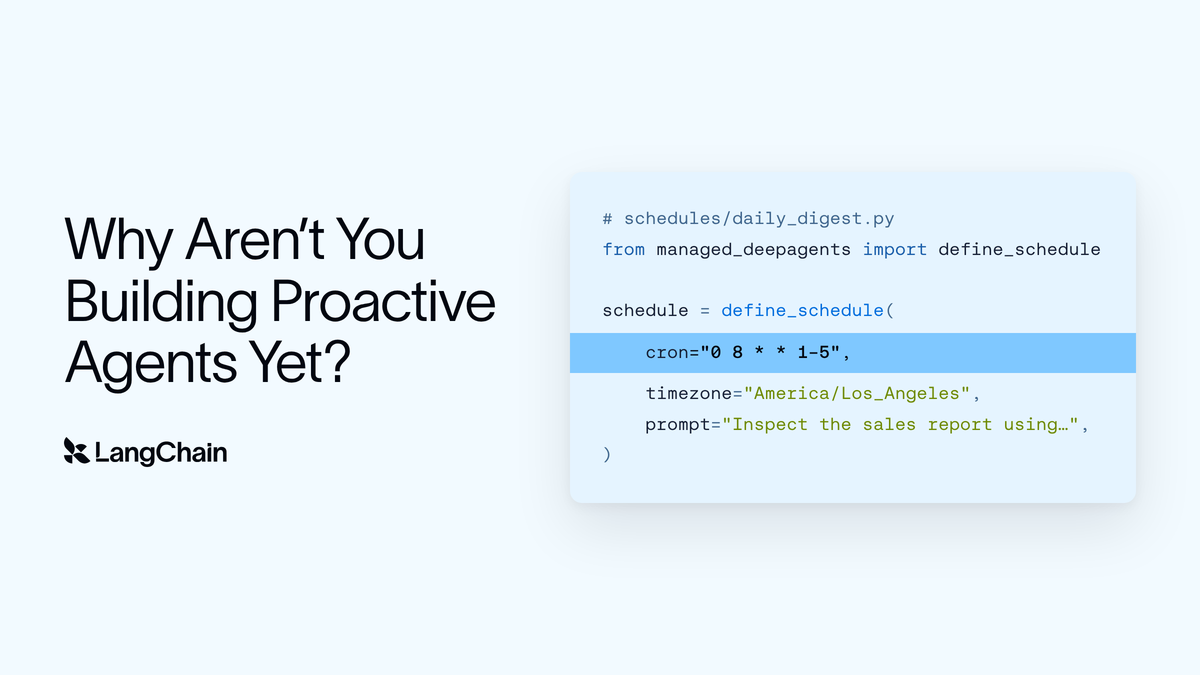
Managed Deep Agents supplies the cron server as a built-in component that can trigger runs dynamically. Schedules can be static, declared in the agent definition, or dynamic, created at runtime through the Schedules SDK. A fixed schedule is a file in a schedules directory: the post's example sets a weekday 08:00 cron in the America/Los_Angeles timezone with a prompt telling the agent to inspect the sales report and send a KPI readout. This suits behaviour baked into an agent's design, such as a daily digest.
Dynamic schedules cover requests developers did not anticipate, with end users asking the agent to set up recurring tasks. LangChain's pattern wraps the SDK in tools, which modern agent frameworks expose to the model as callable functions. The example defines three tools: set_schedule, which calls runtime.schedules.create with an owner of type user plus a cron and prompt; list_schedules, which pages through the current user's schedules; and delete_schedule, which removes one by identifier with the same owner filter. The owner parameter is the interesting piece, since it scopes each schedule to a principal and ties its runs to the corresponding thread and memory.
LangChain notes that different agent types need different toolkits. A single-shot check-in can be simpler than full cron control: the post's check_in_later tool takes a prompt and a number of minutes, computes a UTC timestamp, and creates a one-off schedule with an at value instead of a cron expression. For product teams this offers a graduated exposure model, where agents get narrow reminders or full scheduling capability depending on risk appetite. Anyone who has built reminders on top of job queues will recognise the trade-off: a narrow tool is easier to govern but pushes more scheduling logic into application code, while a general set and delete pair gives users flexibility at the cost of more schedules to audit.
Getting started is a documentation link plus two CLI commands, mda init and mda deploy, positioned as the route to distributing a proactive agent inside an organisation. In practice, the operational questions this design raises are the familiar ones for background jobs: how often an agent should wake, how much load a fleet of schedules places on the runtime, and how users inspect or revoke what their agents have scheduled. The list and delete tools address the last point at the agent level, and jitter addresses the second.
Why it matters: teams building agents on LangSmith's hosted runtime can now treat scheduled runs as a first-class primitive alongside chat turns, with a reported majority of production activity already arriving that way. That shifts design work toward prompts that are safe to run unattended, per-user ownership of schedules, and tool surfaces narrow enough to trust an agent with. Expect more agents to act on a cadence rather than only on request, and expect schedule management and auditability to become part of the product conversation, which is inference rather than a stated LangChain roadmap item.
Based on reporting from the original publisher. Visit the source for full context and later updates.
Publisher excerpt
Most proactive agents run on a simple cron. Learn what scheduled runs unlock, from memory to smart triage, and how to add them to Managed Deep Agents.