50 years of tech devices
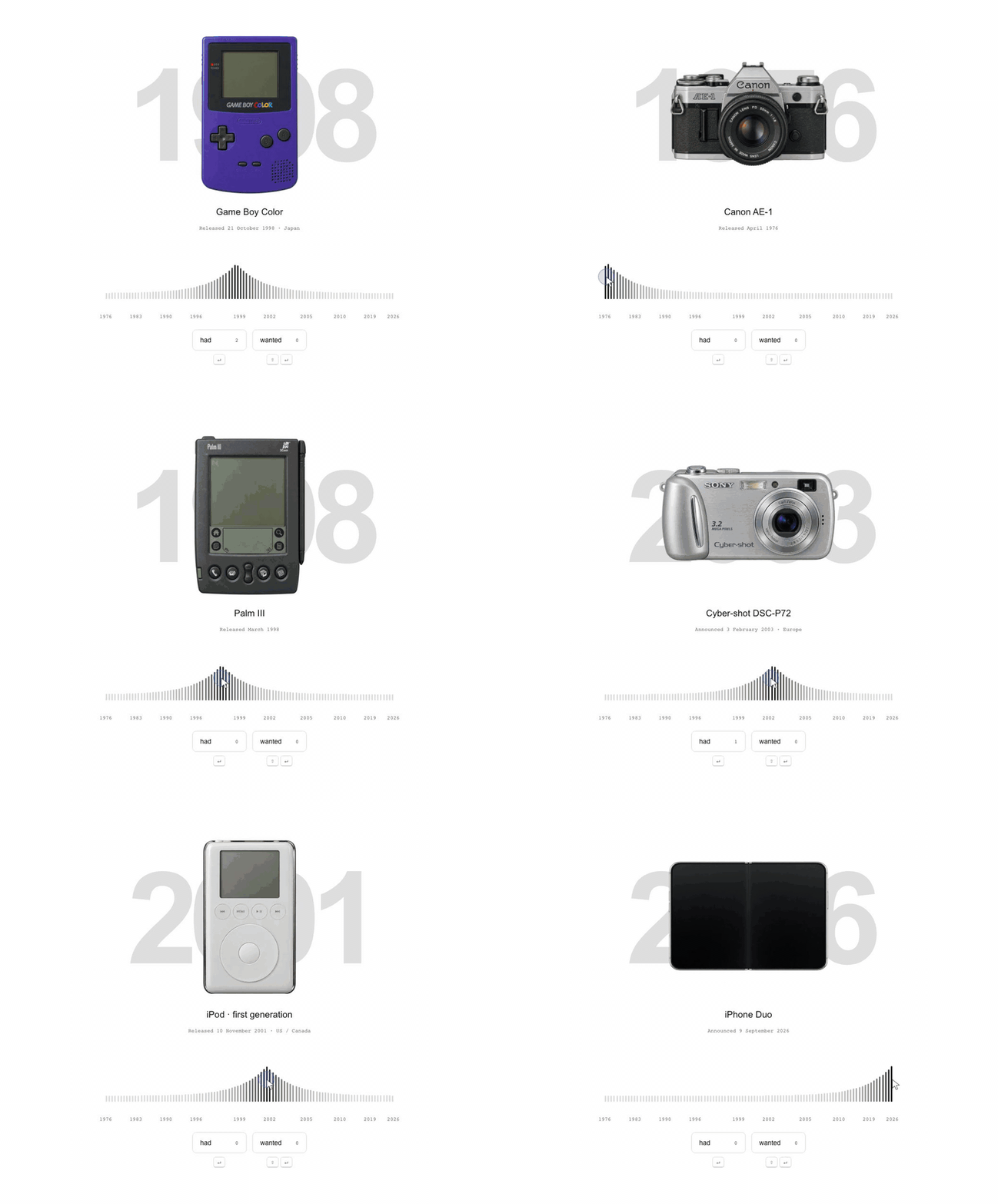
Ben Tossell published a site at bentossell.com/devices that lets visitors drag a timeline to move through popular devices from 1976 to 2026. The build covers 87 devices, every image on the site is generated by Astra, and it took about a morning's work, beginning in Codex and finishing in Factory. He reports 40 messages from himself, 7 subagents, and 1,455 votes at the time of writing.
The project started two weeks earlier as a separate idea about forgotten devices from his childhood. He asked Astra for realistic devices usable for their intended purpose, 50 in a grid, and it produced a grid page called "still works" hosted on here.now. After seeing a timeline-scrubbing demo by Cole, where dragging through years changes a Mac button under the cursor, Tossell decided to combine the two ideas.
He then asked Codex to locate where the original device images had been rendered and to build a simple timeline scrubber that surfaces a different device as the years move from left to right. Within about a minute the agent had found the images and the prompts behind them and produced three versions. Tossell chose the third and added requirements: the timeline had to be draggable left and right with a finger, and every device needed an exact release date rather than a vague decade such as "1990s."
The initial fifty devices stopped around the 2000s, so he generated more up to the present. For each device the agent determined the real model, found a reference photograph, and generated a new image of that exact unit. The example prompt shown in the newsletter is highly specific, describing a silver Casio Data Bank CD-401 from 1984 with a square silver case, black calculator face, four silver memory buttons above the LCD, twelve below it, and an instruction to match the reference layout rather than a later DBC model. This suggests the visual consistency across the set depends on tight, reference-grounded prompts rather than a single style instruction, which is a useful pattern for anyone generating product imagery at scale.
Naming subagents as a technique, Tossell describes one as another agent that reports back from its own session, used when work can run in parallel instead of clogging the main thread. That framing matches how several agent tools now handle fan-out tasks: the orchestrating conversation stays short while child sessions do research or generation and return results.
A voting feature came next. Visitors can mark a device as one they had or one they wanted, and the site shows a real count for each. Anyone who votes gets a shareable page of their own picks. For that work he moved to Factory's Droid, saying he trusts it to get the most out of the models. As before, the agent produced three mockups, then several rounds refined the details such as buttons and keyboard shortcut placement.
On hosting, the site lives on his own domain. His homepage and the device site are separate sites on here.now, which can mount a site at a path on a domain. The agent read the here.now documentation, set up the mount, added a link line to the homepage and published both, and Tossell notes the join is invisible to visitors.
The architecture is deliberately thin. The device list is one file, the images are in another, and votes are the only stored data, handled by here.now. The personal "my devices" page persists nothing, which avoids authentication and a database; the picks travel in the URL itself. Tossell calls the resulting links ugly but working well. That is a reasonable trade for a small shared page, though it means anyone can edit a link to show a different set of devices, and long lists make unwieldy addresses.
Before publishing, load times felt slow: a visitor would drag and wait for the picture. A Droid session diagnosed the causes and proposed fixes, and after approval and a preview showing the dimming behavior, it redeployed. A separate session produced a leaderboard of the most-had and most-wanted devices, again as three options with one shipped. Game Boy Color led, which Tossell speculates may be because the page loads on that device, and he is considering randomizing the starting device.
The agent also made the promotional media: a GIF and a video for his social post, produced via a subagent asked to scrub the timeline quickly while pausing on some devices, capped at ten seconds.
After the leaderboard went live, counts stopped updating and the site displayed a message that counts were unavailable and retrying. Tossell asked how the setup would cope if 100,000 people voted. The agent's long technical answer was turned into an HTML explainer with large pictures and few words, a technique he describes as rough but adequate for internal use. The cause, according to his account, was his own testing exhausting a per-person hourly limit on reading votes, and there is a hard wall at 25,000 votes. The proposed improvements were applied and counts now update properly.
Why it matters: this is a concrete example of a non-specialist shipping a multi-feature site with agents in a single morning, using parallel subagents, generated imagery, agent-written hosting configuration and agent-made promo video. For product teams, the vote ceiling and rate-limit incident are the practical lesson: small serverless-style backends have fixed read and write limits that only surface under real traffic, so it is worth asking early what breaks at volume. The URL-encoded share page is a pattern worth copying for low-stakes features that should avoid auth and storage, with the caveat that shared links are editable by anyone who receives them.
Based on reporting from the original publisher. Visit the source for full context and later updates.
Publisher excerpt
Ben's session #7