Govern and discover records with common metadata in AWS Agent Registry
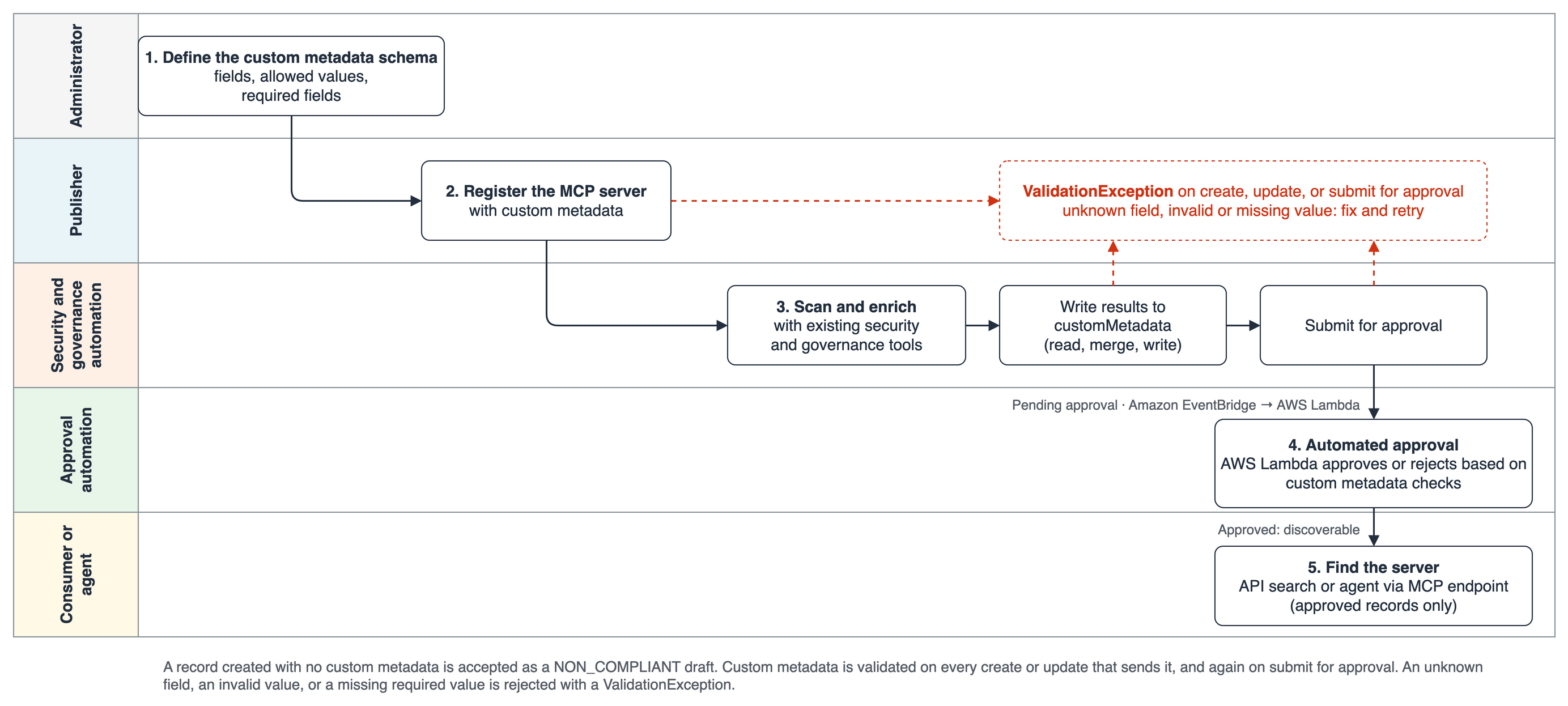
AWS has added custom metadata schemas to AWS Agent Registry, its catalog for registering, approving and discovering agents, Model Context Protocol (MCP) servers and skills. The feature addresses a gap the service had until now: organizations could record a name, description, protocol descriptor and approval status for each entry, but had no way to define their own attributes inside the registry, such as business unit, owner team, risk classification or environment, and attach them consistently to every record.
Under the new model, a registry administrator writes a schema once and applies it to the registry. All records in that registry must then conform. Publishers supply values for the schema's fields when they create or submit a record, and the registry validates those values before accepting them. Approvers can lean on the validated values during review, and consumers and agents can filter on them when searching.
A schema consists of field names, a type, allowed values and a required-or-optional flag per field. Each field is a Text, Enum, URL or Boolean. Some attributes can be defined as common fields that apply to every record type, and the administrator can also add record-type-specific fields through overrides, for instance a network egress field that only applies to MCP servers. The post's example defines a default schema with environment (an enum of prod, staging and dev), businessUnit, ownerTeam, cmdbId, dataClassification (public, internal, confidential or restricted), securityScanStatus (PENDING, PASSED or FAILED) and securityScanReportUrl, with environment, businessUnit and securityScanStatus marked required.
Validation behaviour has three distinct outcomes. A record created with no custom metadata at all is stored as NON_COMPLIANT, which lets a team save work in progress but blocks it from being submitted for approval until the required fields are present. A record carrying an unknown field, a missing required field or a value outside an allowed set is rejected outright with a ValidationException naming the offending path. A record with valid values is COMPLIANT. Crucially, compliant does not mean approved: the source is explicit that approval remains a separate decision made by approvers.
In the worked example, a payments team registers an MCP server for read-only ledger lookups and its first pipeline attempt sends environment as "production" rather than one of the three permitted values. The registry rejects it with a message pointing at the environment enumeration, and the same submission succeeds once the pipeline sends "prod". This illustrates the practical value of the enum type: inconsistent spelling across teams is caught at write time rather than surfacing later in audits or searches.
Enrichment and approval are designed to be automated. Because downstream scanners, configuration management database sync jobs and classification tools can write values through the API before submission, an approval step can become a check of structured evidence rather than a manual judgment call. In the sample, an update first reads the existing custom metadata, merges in the scan status, scan report URL, CMDB identifier and data classification, and writes the whole map back, since an update replaces the entire metadata map rather than patching individual keys. This read-modify-write pattern is a detail developers should plan for, because two concurrent writers could overwrite each other's fields; the source does not discuss concurrency.
Submission triggers a pending-approval event to Amazon EventBridge, which a rule routes to a custom AWS Lambda function. The example function approves a record only when it is COMPLIANT, the scan passed, a CMDB ID is present and the data classification is public or internal; failures are rejected with a reason naming the failed check. The source suggests routing records with confidential or restricted data to human review instead of rejection, which is a sensible distinction between a policy breach and a record that simply needs a higher level of scrutiny.
Discovery is where the shared vocabulary pays off. Custom metadata values are indexed, and the search API accepts a natural-language query combined with structured filters, for example environment equal to prod AND businessUnit equal to payments AND securityScanStatus equal to PASSED. Only approved records are returned, so a matching draft or pending record stays hidden. Agents can use the same capability through the registry's MCP endpoint, which exposes search, list and get as MCP tools; the sample Strands agent on Amazon Bedrock translates a plain-language request into those filters.
The service documentation also spells out schema evolution rules that matter for planning. Changes are additive only: an administrator can add fields, extend an enum or promote an optional field to required, but cannot rename, remove or change the type of an existing field. Existing records are not rewritten when the schema changes. A record that no longer matches is reported as NON_COMPLIANT but keeps its approval status, and its next update must satisfy the new schema. Editing an approved record creates a draft that must be resubmitted, and submission fails until every required field is populated; meanwhile consumers continue to see the approved revision.
This suggests teams should treat the schema as a long-lived shared vocabulary rather than a per-team convenience. Deciding names and allowed values with the publishing and approving teams before the first schema is created avoids the dead end of an unrenameable field. A likely trade-off is that making fields required up front slows onboarding, which is why the guidance favours an interim value such as PENDING for facts that arrive after registration. Keeping secrets, internal endpoints and detailed findings out of metadata is also prudent, since the values are broadly readable and indexed.
The walkthrough requires Python 3.11 or later and boto3 1.43.113 or later, an AWS account in a supported Region and IAM permissions for the service; a sample implementation is published on GitHub. Availability is region-dependent.
Why it matters: Teams running growing fleets of agents and MCP servers now get a registry-enforced schema, which means governance checks and discovery filters operate on the same facts instead of drifting per team. Developers should expect pipeline failures on invalid enum values and design their automation around whole-map updates and additive-only schema changes. Product and platform teams can, in inference, replace ad hoc approval spreadsheets with evidence-based automation wired through EventBridge and Lambda, provided the schema is agreed early and kept free of sensitive detail.
Based on reporting from the original publisher. Visit the source for full context and later updates.
Publisher excerpt
Custom metadata schemas in AWS Agent Registry let an administrator define typed, validated fields that every agent, MCP server, and skill must carry. This post follows an MCP record from schema definition through registration, enrichment, approval, and discovery, so teams govern and find resources with one shared set of facts.