State of Supply Chain Sustainability Report finds corporate commitment at record high, but governance lags behind
The MIT Sustainable Supply Chain Lab has released its 2026 State of Supply Chain Sustainability Report, based on a survey of 1,810 supply chain professionals across 91 countries. The headline finding is that stated commitment to sustainability has reached its highest level in the report's seven-year history: 83 percent of respondents rate sustainability as important or very important to long-term business success. Sreedevi Rajagopalan, director of the lab and lead author, framed the moment as one where commitment is strong, measurement is expanding and AI is accelerating, while the harder work lies in converting those gains into accountability and genuine transition.
The gap between stated commitment and operating capacity runs through the whole report. Fifty-nine percent of respondents say they became more committed to sustainability after recent U.S. policy shifts that deprioritize environmental concerns, but 68 percent say tariff uncertainty has forced them to delay, scale back or abandon sustainability strategies outright. Nearly one-third report that tariff-related disruptions actually increased their operational emissions. Beyond trade policy, more than eight in ten respondents across North America, Europe and Asia agree that ongoing geopolitical conflict is reducing the effectiveness of their organization's climate action. The report's framing is that decarbonization plans were built on assumptions of stable trade and relative peace, and neither assumption is holding.
The internal picture is where the numbers get most actionable for anyone responsible for governance. Among companies with publicly stated sustainability goals, only 51 percent have set up a formal cross-functional sustainability team, which the report identifies as the governance structure most strongly associated with embedding sustainability into daily decisions. Only 33 percent place sustainability oversight at the board level. The payoff is measurable in the survey data: companies with formal cross-functional teams say sustainability is frequently or always built into decisions 57 percent of the time, while companies where responsibility sits in a single function report that just 13 percent of the time — a 44-point spread.
Where sustainability has taken hold is telling. Embedding is deepest in day-to-day operational choices: transportation and logistics at 39 percent, procurement at 35 percent, warehousing at 34 percent and product design at 33 percent. It thins out sharply in the decisions that lock in long-term emissions, including capital investment, network design and supply chain risk planning. The report's reading is that companies are getting better at operating more sustainably without getting better at designing sustainable supply chains. For product and engineering teams, that distinction matters: an efficient process can still sit inside a network layout or capital plan that commits the organization to high emissions for a decade.
AI is the second thread. Seventy-eight percent of North American organizations report current use of AI in sustainability initiatives, and 87 percent of adopters report a positive impact on sustainability goals. Eighty-six percent say they have reduced material waste, 81 percent reduced energy use, and 63 percent use AI to estimate missing supplier emissions data. But among mature agentic AI users, only 53 percent report a reduction in total greenhouse gas emissions and 29 percent report an increase. That suggests efficiency gains and net emissions can move in opposite directions, likely because AI workloads add compute and because efficiency frees capacity that gets spent elsewhere. Warehousing shows the pattern most clearly: among advanced and fully automated warehouses using AI, 78 percent report higher energy use since implementation and 76 percent report higher waste, while only 24 percent use AI-driven real-time monitoring to track environmental consequences. The practical lesson is that instrumenting the AI system's own footprint early is cheaper than discovering the increase afterward.
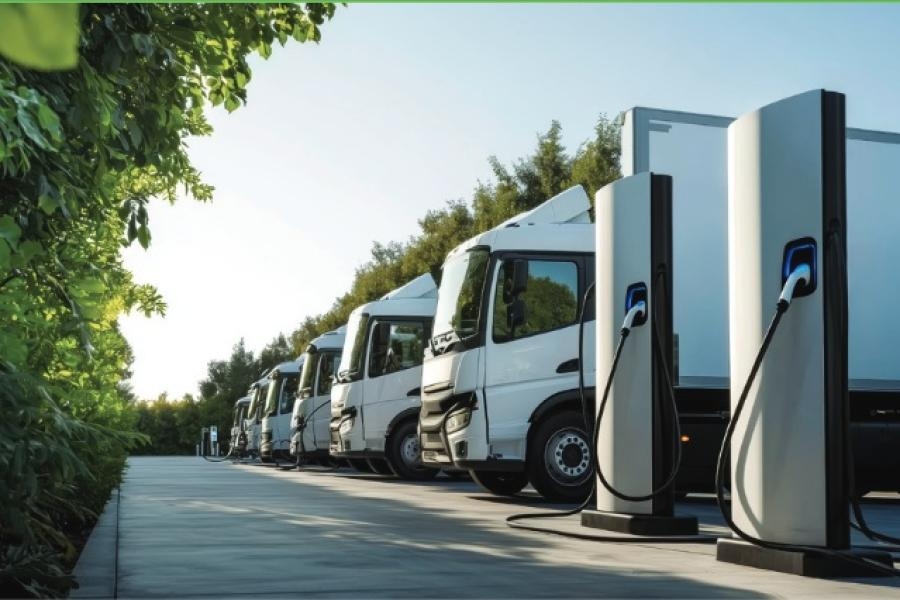
Freight transportation shows a similar split between effort and outcome. Nearly every freight company is cutting emissions through route optimization, load consolidation and driver-behavior programs, but 43 percent of fleets still run mostly or entirely on conventional diesel and only 8 percent have completed a full transition to low-emission energy. Regional policy signals explain a lot of the divergence: 84 percent of European freight companies say recent policy changes positively affected their decarbonization strategy, compared with 44 percent in North America. Battery-electric vehicles are at scale in 60 percent of European companies versus 36 percent in North America. When the policy direction is unclear, capital-intensive transitions tend to stall — an inference consistent with the report's own framing about unclear signals.
Scope 3 collaboration is the clear bright spot. Participation in joint supplier engagement and decarbonization programs jumped from 31 to 58 percent in a single year, and partnerships to manage shared suppliers' emissions more than doubled from 23 to 55 percent. The share of companies working entirely alone collapsed from 18 to 6 percent. The report, supported by the C.H. Robinson Foundation, Breakthrough, CO2 AI and Dassault Systèmes, treats this as evidence that indirect emissions cannot be tackled in isolation.
Why it matters: the report's pattern suggests the binding constraint on supply chain sustainability is no longer executive intent but governance, measurement and infrastructure, which is precisely the layer product and platform teams can influence. Buyers of supply chain software should expect demand for supplier data exchange, emissions estimation and monitoring that catches operational side effects rather than assuming efficiency equals reduction. Teams building AI-heavy logistics or warehouse systems may want to treat energy and waste telemetry as a first-class feature, since the survey links heavy automation to rising energy and waste and to a shortage of real-time monitoring. The Scope 3 numbers also point to a durable market for multi-party supplier programs, as most companies appear to have concluded that shared suppliers require shared measurement.
Based on reporting from the original publisher. Visit the source for full context and later updates.
Publisher excerpt
MIT's Center for Transportation and Logistics finds sustainability commitments are strong, but governance gaps and external disruptions prevent execution.